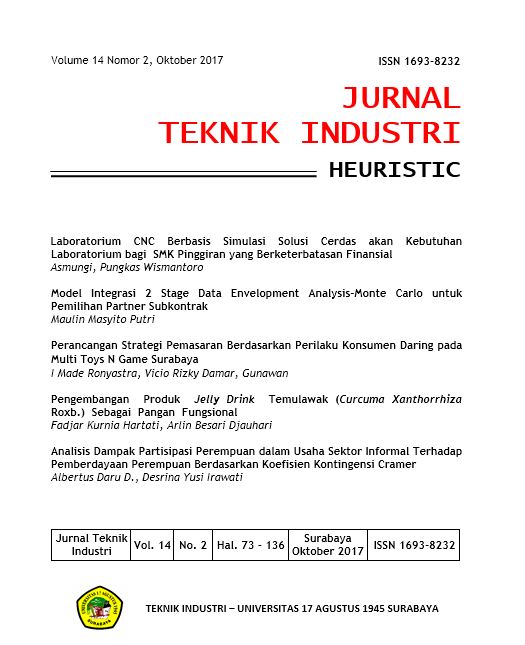
PENGEMBANGAN PRODUK JELLY DRINK TEMULAWAK (Curcuma xanthorrhiza Roxb.) SEBAGAI PANGAN FUNGSIONAL
DOI:
https://doi.org/10.30996/he.v14i02.1175Abstract
People still consider the curcumin as a herb that has a taste and smell that is less preferred so as to increase consumption of ginger need to be diversified more modern products, one of which is jelly drink. Success in the manufacture of jelly drinks is determined by the concentration of gelling agents. The objective of the research was to determine the effect of carrageenan and sugar concentration on the physical and organoleptic properties of jelly drink curcumin, looking for the best treatment, which was then best tested for curcumin, total phenol and antioxidant activity to ensure that the product was potential as one of functional food products. With Randomized Block Design (RAK) method 2 factors, namely the concentration of carrageenan (K) and sugar (G), each consisting of 3 levels and repeated 4 times so that there are 36 samples. The results showed that the average total soluble solids ranged from 10.5 to 17.2 o Brix, the mean of sineresis ranged from 5.11 to 7.16% and the mean suction rate ranged from 28.17 to 49.05 seconds / 50 ml. The best treatment was found in combination treatment of 1% carrageenan and 10% sugar (K3G1) containing curcuminoid 1,2415%, phenol jelly drink curcumin 2,2659 mg GAE / g sample and IC50 value of 73 ppm. Keywords: curcumin, carrageenan, jelly drink, antioxidantDownloads
References
Bappeda. Kab. Cirebon (2012). Kajian Terhadap Upaya Peningkatan Pendapatan Asli Daerah Melalui Sektor Pariwisata Di Kabupaten Kuningan. Cirebon: Lembaga Penelitian UNSWAGATI.
Ernawati, N. M. (2010). Tingkat Kesiapan DEsa Tihingan-Klungkung, Bali Sebagai Tempat Wisata Berbasis Masyarakat. Analisis Pariwisata Vol. 10 No. 1 Tahun 2010.
Iswari, A. N. (2014). Strategi Dinas Kebersihan dan Pertamanan Kota Surabaya dalam Pengelolaan Ruang Terbuka Hijau (RTH) untuk Mewujudkan Pembangunan Berkelanjutan dan Berwawasan Lingkungan . Jurnal Kebijakan dan Manajemen Publik Volume 1, Nomor 1, Januari 2014.
Jalaludin, A. M. (2015). Peran Dinas Kebersihan, Pertamanan dan Pemakaman (DKKP) dalam Pengelolaan Sampah di Kota Tarakan. eJournal Administrasi Negara, 3 (4) 2015: 1048-1059.
Miles, M. B., & Huberman, A. M. (2007). Analisis Data Kualitatif, Buku Sumber tentang Metode-Metode Baru. Jakarta: Universitas Indonesia Press.
Moleong, L. J. (2012). Metodologi Penelitian Kualitatif edisi revisi. Bandung: PT Remaja Rosdakarya Offset.
Nafila, O. (2013). Peran Komunitas Kreatif dalam Pengembangan Pariwisata Budaya di Situs Megalitikum Gubung Padang . Jurnal Perencanaan Wilayah dan Kota, Vol. 24 No. 1, April 2013, 65-80.
Rahardjo, I. (2012). Pengembangan Sistem Kelistrikan Microbid Baron Technopark dalam Upaya Pengembangan Kawasan Wisata. Jurnal Ekonomi dan Studi Pembangunan Vol. 4, No. 1, Maret 2012.
Rendro. (2010). Beyond Borders: Communication Modernity & History The First LSPR Communication Research Conference 2010. London: STIKOM The London School of Public Relations.
Semiawan, C. R. (2010). Metode Penelitian Kualitatif Jenis, Karakteristik dan Keunggulannya. Jakarta: Grafindo.
Soebagyo. (2012). Strategi Pengembangan Pariwisata di Indonesia. Jurnal Liquinity Vol. 1, No. 2, Juli-Desember 2012, 153-158.
Sugiyono. (2012). Metode Penelitian Kualitatif dan R&D. Bandung: Alfabeta.
Surabaya.go.id. (2015, September 10). Dipetik May 31, 2016, dari http://www.surabaya.go.id/berita/8079-dinas-kebersihan-dan-pertamanan
Utama, I. G. (2015). Pengantar Industri Wisata. Yogyakarta: Deepublish.
Yuliani, T. M. (2010). Jelajah Wisata Nusantara: Berbagai Pilihan Tujuan Wisata di 33 Provinsi. Yogyakarta: Niaga Swadaya.
Zakariya, F., & Suprihardjo, R. D. (2014). Konsep Pengembangan Kawasan Desa Wisata di Desa Bandungan Kecamatan Pakong Kabupaten Pamekasan. Jurnal Teknik POMITS Vol 3, No 2, (2014) .
Zebua, M. (2016). Inspirasi Pengembangan Pariwisata Daerah. Yogyakarta: Deepublish.
Candidates; Assesment of in vitro and in vivo Activity Against Herpes Simplex
Virus Type Z. Antiviral Res.42. 291-226.
De Garmo, E.D., W.G Sullivan dan J.R Canada. 1984. Engineering Economy.
Macmillan Publishing Company. New York.
Havsteen, B.H. 2002. The biochemistry and medical significance of the flavonoids.
Pharmacol Ther.96:67–202.
Handayani, T. 2008. Pengaruh xanthorrhizol terhadap sel hepatoma HepG2. Jurnal
Kedokteran Maranatha. 8(1):29-35.
Hendrich, A.B. 2006. Flavonoid-membrane interactions: possible consequences for
biological effects of some polyphenolic compounds. Acta Pharmacol Si. 27:27–40.
Hong, R., Spohn, W.H., Hung, M. 1999. Curcumin inhibit tyrosine kinase activity of
P185neu and depletes P185neu. Clinical Cancer Research 5: 1884-1891
Jayaprakasha, G.K.L., Rao, J. dan Sakariah, K. 2006. Antioxidant activities of curcumin,
demethoxycurcumin and bisdemethoxycurcumin, Food Chemistry 98: 720–724.
Jun, M.H.Y., Yu, J., Fong, X, Wan, C.S., Yang, C.T., Ho. 2003. Comparison of
antioxidant activities of isoflavones from kudzu root (Pueraria labata Ohwl). J.
Food Sci. 68: 2117–2122.
Jun MHY, Yu J, Fong X, Wan CS, Yang CT, Ho. 2003. Comparison of antioxidant
activities of isoflavones from kudzu root (Pueraria labata Ohwl). J. Food Sci.
: 2117–2122.
Kamalakkannan,N., Rukkumani,R., Suresh, P., Viswanathan,P., Rajasekharan, K.N.,
Munan,V. P. 2005. Comparative Effect of Curcumin and an Analogue of
Fadjar K Hartati, Arlin B. Djauhari, Pengembangan Produk Jelly Drink . . .
Curcumin in Carbon tetrachloride-Induced Hepatotoxicity in Rats. Basic Clin
Pharmacol Toxicol, 97. 15-21.
Kamaludin. 2008. Jam dan Jelly. http://www.kamaludin.blogspot.com. 18 Januari 2017
(14:20).
Kawamori,T., Lubet,R., and Steele, V.E. 1999. Chemopreventative Effect of Curcumin
a Naturally Occuring Anti Inflamatory Agent During The promotion or
Progression Stage of Colon Cancer. Cancer Res. 59. 597-601.
Kim, S.J. 2008. Curcumin stimulates proliferation of embryonic neural progenitor cells
and neurogenesis in the adult hippocampus. The Journal of Biological Chemistry
(21): 14497-14505.
Kumalaningsih, S. 1986. Kimia Gizi dan Pangan. Jurusan Teknologi Pertanian.
Universitas Brawijaya. Malang.
Morris, ER., K Nishinari and M Rinaudo. 2012. Gelation of Gellan. Journal Food
Hydrocolloids. 28:373-411
Movileanu, L, Neagoe, I, dan Flonta, M.L. 2000. Interaction of the antioxidant
flavonoid quercetin with planar lipid bilayers. Int J Pharm.205:135–46.
Nurfina,A.N., Reksohadiprojo, M.S., Timmerman,H., Jenie,U.A.,Sugiyanto, D. dan Van
der Goot,H. 1997. Synthesis of Some Symmetrical Curcumin Derivatives and
Their Antiinflamatory Activity. Eur J Med Chem. 32. 321-8.
Manian, R, Anusuya, N, Siddhuraju, P, dan Manian, S. 2008. The antioxidant activity
and free radical scavenging potential of two different solvent extracts of Camellia
sinensis (L.) O. Kuntz, Ficus bengalensis L. and Ficus racemosa L. Food Chem
:1000–1007.
Meyer, Lilian H. 1978. Food Chemistry. Reinhold Publishing Corporation. Japan
Osawa, T., dan Namiki, M. A. 1981. A Novel Type of Antioxidant Isolated From Leaf
Wax of Eucalyptus Leaves. Agric. Biol. Chem. 45 :735-739.
Pelezer M.J., 1997. Buku Penentun Ilmu Gizi Umum. Jakarta
Rachman F, Logawa ED, Hegartika H, Simanjuntak P. 2008. Aktivitas antioksidan
ekstrak tunggal dan kombinasinya Dari tanaman curcuma spp. Jurnal ilmu
kefarmasian Indonesia. 6(2) : 69-74
Rahayu, W.P. 2001. Penuntun Praktikum Penilaian Organoleptik. Jurusan Teknologi
Pangan dan Gizi. Fakultas Teknologi Pertanian. IPB. Bogor
Rao, S. 1985. Effect of Curcumin on Serum and Liver Cholesterol in rats. J Nutrition.
1307-1316.
Rice-Evans, C. 2004. Flavonoids and isoflavones: absorption, metabolism and
bioactivity. Free Radic Biol Med. 36:827–828.
Rosiyani L. 2010. Evalusi Perubahan Metabolit Pada Temulawak Dengan Waktu
Tanam Berbeda. Skripsi. Bogor (ID) : Institut Pertanian Bogor
Sastrosupadi, A. 1995. Rancangan Percobaan Praktis Bidang Pertanian. Kanisius.
Yogyakarta.
Jurnal Teknik Industri HEURISTIC vol. 14 no. 2, Oktober 2017, hal. 107 -122, ISSN: 1693-8232
Soumyanath, A., Zhong, Y.P., Gold, S.A., Yu, X., Koop, D.R., Bourdette, D., Gold,
B.G. 2005. J Pharm Pharmacol 57(9):1221-9 (ISSN: 0022-3573).
Srijanto. 2004. Pengaruh Waktu, Suhu dan Perbandingan Bahan Baku Pelarut Pada
Ekstraksi Kurkumin dari Temulawak (curcuma xanthorriza roxb.) Dengan
Pelarut Aseton. Prosiding seminar nasional rekayasa kimia dan proses. UNDIP.
Semarang
Sugiarto, A.W. 2011. Pengaruh Konsentrasi Karagenan dan Gula Pasir Terhadap Sifat
Fisikokimia dan Organoleptik Jelly Drink Alang-alang (Imperata cylindrica (L.)
P. Beauv.). Skripsi. Universitas Widya Mandala. Surabaya.
Tarahovsky, Y.S., Muzafarov, E.N., dan Kim, Y.A. 2008. Rafts making and rafts
braking: how plant flavonoids may control membrane heterogeneity. Mol Cell
Biochem 314:65–71
Therkelsen. 1993. Effect of an Indonesian Medical Plant, Curcuma xanthorrhiza Roxb.
On The Levels of Serum Glucose and Triglyceride, Fatty Acid Desaturation, and
Bile Acid Excretion in Streptozotocinduced Diabetic Rats. Agricultural
Biological Chemistry 55 (12) : 3005-3010
Sudarmadji, S., Bambang,H. dan Suhardi. 1997. Analisa Bahan Makanan dan
Pertanian. Liberti Yogyakarta bekerjasama dengan Pusat antar Universitas
Pangan dan Gizi UGM. Yogyakarta.
Sunanto, H., (1997), Budi Daya Murbei dan Usaha Persuteraan Alam, Penerbit Kaisus,
Yogyakarta
Yanto, T.(2015). Pengaruh Dan Konsentrasi Gula Terhadap Karakteristik Fisikokimia
dan Sensori Jelly Drink.Universitas Jendral Soedirman. Purwokerto
Downloads
Published
How to Cite
Issue
Section
License
Authors who publish with Heuristic agree to the following terms:
- Authors transfer the copyright and grant the journal right of first publication with the work simultaneously licensed under a Creative Commons Attribution-ShareAlike 4.0 International License.. that allows others to share the work with an acknowledgement of the work's authorship and initial publication in this journal.
- Authors are able to enter into separate, additional contractual arrangements for the non-exclusive distribution of the journal's published version of the work (e.g., post it to an institutional repository or publish it in a book), with an acknowledgement of its initial publication in this journal.
- Authors are permitted and encouraged to post their work online (e.g., in institutional repositories or on their website) prior to and during the submission process, as it can lead to productive exchanges, as well as earlier and greater citation of published work (See The Effect of Open Access)