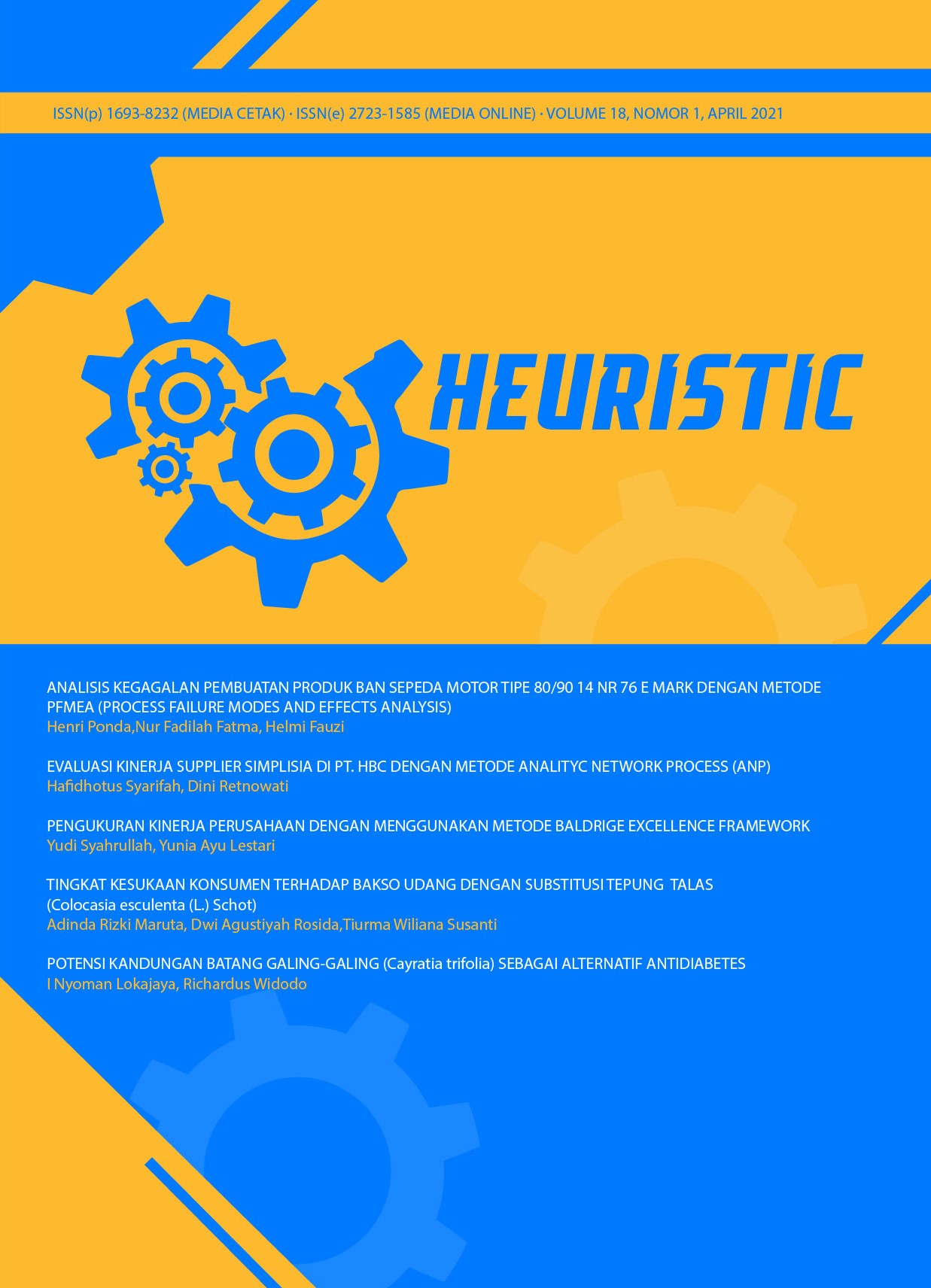
TINGKAT KESUKAAN KONSUMEN TERHADAP BAKSO UDANG DENGAN SUBSTITUSI TEPUNG TALAS (Colocasia esculenta (L.) Schot)
DOI:
https://doi.org/10.30996/heuristic.v18i1.5328Keywords:
bakso udang, tepung tapioca, tepung talas, tingkat kesukaanAbstract
Penelitian ini bertujuan untuk mengetahui tingkat kesukaan konsumen terhadap bakso udang yang disubstitusi tepung talas dengan komposisi tepung : P1T1 (tapioka 40 gram dan talas 10 gram, P2T2 (tapioka 30 gram dan talas 20 gram), P3T3 (tapioka 20 gram dan talas 30 gram), P4T4 (tapioka 10 gram dan talas 40 gram) dan K (kontrol tepung tapioka 50 gram). Bakso udang diuji cobakan pada 30 orang panelis menggunakan uji organoleptik yang meliputi: tekstur, warna, aroma dan rasa dengan mengunakan 5 skala (sangat suka, suka, agak suka, tidak suka, sangat tidak suka). Hasil penelitian menunjukkan pada kategori tekstur, perlakuan kontrol dan P1T1 disukai oleh sebagian besar panelis (46,7%), semakin banyak substitusi tepung talas semakin sedikit panelis yang menyukai tekstur bakso udang. Pada kategori warna perlakuan Kontrol, P1T1 dan P2T2 disukai oleh 30%–33,3% panelis, semakin banyak substitusi tepung talas semakin sedikit panelis yang menyukai warna bakso udang. Untuk kategori Aroma sebagian besar panelis menyukai perlakuan P2T2 (36,7%), sedangkan untuk perlakuan lain kesukaan panelis terhadap aroma tidak jauh berbeda (23,3%-26,7%) Jumlah panelis yang menyukai rasa bakso udang dengan substitusi tepung talas tidak berbeda jauh pada semua perlakuan, yaitu berkisar 30%.
Downloads
References
Anderson, Perry (2008) Kemalism. In London Review of Books. Vol.30:17
Archik, Kristin. 2012. European Union Enlargement, CRS Report for Congress .
Barysch, K. (2007), What Europeans Think about Turkey and Why, Centre for European Reform. Retrieved 15 December 2015 from www.cer.org.uk .
Börzel, Tanja A. 2002. States and Regions in the European Union. Institutional Adaptation in Germany and Spain. Cambridge: Cambridge University Press.
Casanova, J. (2003): Religion, European Secular Identities, and European Integration. Paper presented at the Mellon Sawyer seminar at Cornell University, October 7, 2003
Casanova, J. (2006): The Long, Difficult and Tortuous Journey of Turkey into Europe and the Dilemmas of European Civilization, Constellations, vol.13, no.2, pp.234-47
Delanty, Gerard (1995). The European Heritage from a Critical Cosmopolitan Perspective. LEQS Paper No. 19, February 2010.
Hooghe, Liesbet, and Gary Marks. 2001. Multi-Level Governance and European Integration. Lanham: Rowman & Littlefield.
Krok, Ania et.al. 2007. European Union Enlargement, Oxford: Oxford University Press
Milward, Alan S. 1992. The European Rescue of the Nation-State. Berkeley, Ca.: University of California Press .
Moravcsik, Andrew. 1991. Negotiating the Single European Act: National Interests and Conventional Statecraft in the European Community. International Organization 45 (1): 19–56.
Müftüler Bac, M. (2005): Turkey’s Political Reforms and the Impact of the European Union. In South European Society and Politics, vol.10(1) .
Neumann, I.B. (1998) Uses of the Other: “The East” in European identity formation. Minneapolis: University of Minesota Press.
Pagden, A. (2002). Introduction. In Pagden, A. (ed.). The Idea of Europe: from Antiquity to the European Union. Cambridge: Cambridge University Press.
Redmond, J. (2007). Turkey and the European Union: troubled European or European trouble? In International Affairs, vol. 83(2), pp.305-317.
Sandholtz, Wayne. 1996. Membership Matters: Limits of the Functional Approach to European Institutions. Journal of Common Market Studies 34: (3): 403–429.
Schimmelfennig, Frank et al. (2002). “Theorizing European Union enlargement: research focus, hypostheses, and the state of research”, Journal of European Public Policy 9, London: Routledge.
Tocci, N. (2014). Turkey and the European Union: A Journey in the Unknown. Turkey Project Policy Paper. 5 (1), 1.
Downloads
Published
How to Cite
Issue
Section
License
Authors who publish with Heuristic agree to the following terms:
- Authors transfer the copyright and grant the journal right of first publication with the work simultaneously licensed under a Creative Commons Attribution-ShareAlike 4.0 International License.. that allows others to share the work with an acknowledgement of the work's authorship and initial publication in this journal.
- Authors are able to enter into separate, additional contractual arrangements for the non-exclusive distribution of the journal's published version of the work (e.g., post it to an institutional repository or publish it in a book), with an acknowledgement of its initial publication in this journal.
- Authors are permitted and encouraged to post their work online (e.g., in institutional repositories or on their website) prior to and during the submission process, as it can lead to productive exchanges, as well as earlier and greater citation of published work (See The Effect of Open Access)