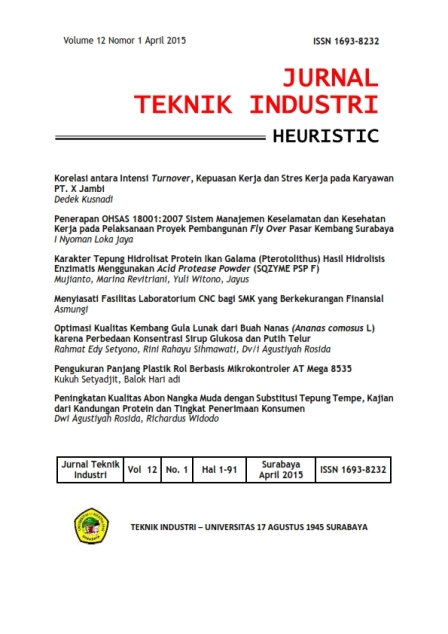
KORELASI ANTARA INTENSI TURNOVER, KEPUASAN KERJA DAN STRES KERJA PADA KARYAWAN PT. X JAMBI
DOI:
https://doi.org/10.30996/he.v12i01.621Abstract
This study was conducted to determine: (1) the correlation between job satisfaction and turnover intention of employees of PT. X Jambi, (2) the correlation between job stress and turnover intention of employees of PT. X Jambi and (3) the correlation between job satisfaction and job stress on employees of PT. X Jambi. The results of the study are (1) between job satisfaction and turnover intention has a negative correlation was weak and not significant, it is shown by the value of the correlation coefficient of -0.295 and opportunities are not mutually correlated 0.065 greater than the maximum terms are correlated by 0.025. It can be concluded between job satisfaction and turnover intention has not had a meaningful relationship, (2) the correlation between job satisfaction and job stress also has a weak positive correlation was not significant, it is shown by the value of the correlation coefficient of 0.024 and opportunities are not mutually correlation of 0.882 is greater than the maximum terms are correlated 0.025, (3) the correlation between job stress and turnover intention has a significant positive relationship, it is shown by the value of the correlation coefficient of 0.381 and opportunities are not mutually correlated by 0,015 less than the requirement maximum mutual correlation of 0.025. It can be concluded between job stress and turnover intention is to have a meaningful relationship.
Kata kunci : korelasi, intensi turnover, kepuasan kerja, stres kerja
Downloads
References
Widarto, L. & FX. Sudarto C. Ph. (2000, Teknologi Tepat Guna: Membuat Pompa Hidra.
Kanisius. Yogyakarta.
Wahyudi, S. I. dan Fachrudin, F. (2008), Korelasi Tekanan dan Debit Air Pompa Hidram Seba
gai Teknologi Pompa Tanpa Bahan Bakar Minyak. Jurnal Ilmiah Teknik Sipil ,
Universitas Sultan Agung, Semarang.
Diamer, Peter dan Prof. Ma Chi, 2002, Hydraulic Ram Handbook. Zhejiang University of
Technology, China.
Fox, R.W. and Mc. Donald Alan T., 1994, Introduction to Fluid Mechanics. New York:
John Wiley & Sons.
Kahangire, Patrick, 1990, The Hydraulic Ram Pump Project, Water Development Departement,
Uganda, Canada.
Matt, Robert L.,1990, Applied Fluid Mechanics. New York: Mac Millan Publishing
Company.
Hom, P. W., Griffeth, R. W. (1995). Employee Turnover. Ohio : South-West College Publishing.
Ivancevich, J. M., Robert Konopaske, dan M. T. Matteson. (2008). Organizational Behavior and Management. Jakarta: Gelora Aksara Pratama.
Jewell, L. W. & Siegall. (1998) Psikologi Industri dan Organisasi Modern. Jakarta: Arcan.
Manktelow, J. (2012). Work life Mengendalikan Stres. Jakarta: Esensi Erlangga Group.
Manullang, M. (1994). Dasar-dasar Manajemen. Jakarta : Yudhistira.
Mobley, W. H. (1986). Employee Turnover : Causes, Consequences & Control. Jakarta : PT. Gramedia.
Jurnal Teknik Industri HEURISTIC Vol 12 No 1 April 2015 ISSN 1693-8232
Moynihan, D.P & Pandey,S.K. (2007). The Ties That Bind: Sosial Network, Person-Organisation Value Fit, And Turnover Intention. Journal Of Public Administration Research And Theory. Madison :University Of Wisconsin.
Munandar, A. S. (2001). Psikologi Industri dan Organisasi. Jakarta: UI- Press
Novliadi, P. (2007). Intensi turnover karyawan ditinjau dari budaya perusahaan dan kepuasan kerja. Makalah. Medan: Fakultas Kedokteran, Jurusan Psikologi USU.
Riggio, R. E. (2000). Introducing to Industrial or Organizational Psychology. New Jersey : Prentice Hall, Inc.
Rivai. (2001). Pengaruh kepuasan gaji, kepuasan kerja dan komitmen organisasi terhadap motivasi keluar :pengujian empiris model turnover lum. Et. Al. Jurnal Bisnis & Akuntansi, 3 (1) p. 335-352.
Robbins, S. P. (2005). Organizational Behavior. New Jersey : Prentice Hall, Inc.
Robbins, Stephen P. dan Timothy A. Judge. (2008). Perilaku Organisasi. Edisi 12. Jakarta: Salemba Empat.
Santoso, Singgih. (2003). Buku Latihan SPSS Statistik Non Parametrik, PT. Elex Media Komputindo, Jakarta.
Smith & Speight. (2004). Antecedents of turnover intention and actual turnover among information sistems personnel in South Africa. Unpublished.
Toly, A. A. (2001). Analisis faktor-faktor yang mempengaruhi turnover intention pada staf akuntan public. Jurnal Akuntansi & Keuangan, 8 (2) p. 102-125.
Wexley, K. N. Dan Yukl, G. A. (1997). Perilaku organisasi dan psikologi personalia. Jakarta : PT. Rineka Cipta
Wijono, Sutarto. (2010). Psikologi industri dan organisasi: dalam suatu bidang gerak psikologi sumber daya manusia.. Jakarta: Prenada Media.
Downloads
Published
How to Cite
Issue
Section
License
Authors who publish with Heuristic agree to the following terms:
- Authors transfer the copyright and grant the journal right of first publication with the work simultaneously licensed under a Creative Commons Attribution-ShareAlike 4.0 International License.. that allows others to share the work with an acknowledgement of the work's authorship and initial publication in this journal.
- Authors are able to enter into separate, additional contractual arrangements for the non-exclusive distribution of the journal's published version of the work (e.g., post it to an institutional repository or publish it in a book), with an acknowledgement of its initial publication in this journal.
- Authors are permitted and encouraged to post their work online (e.g., in institutional repositories or on their website) prior to and during the submission process, as it can lead to productive exchanges, as well as earlier and greater citation of published work (See The Effect of Open Access)