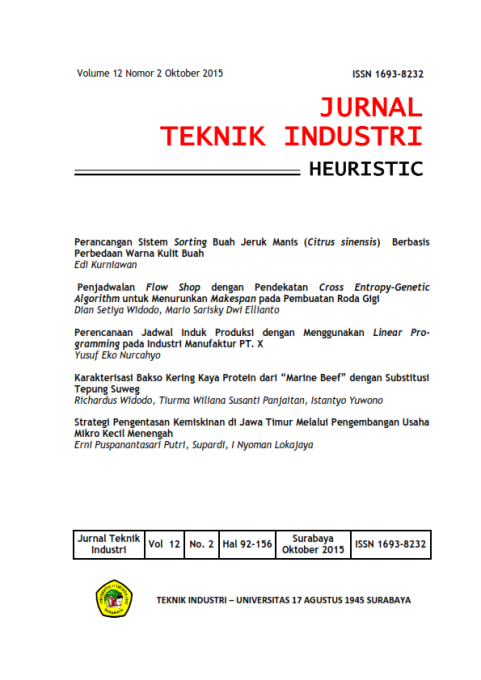
STRATEGI PENGENTASAN KEMISKINAN DI JAWA TIMUR MELALUI PENGEMBANGAN USAHA MIKRO KECIL DAN MENENGAH (UMKM)
DOI:
https://doi.org/10.30996/he.v12i02.632Abstract
The purpose of this study were (1) Identify the factors that impede business development of micro, small and medium enterprises in East Java, (2) identify strategies flagship relevant for micro, small and medium enterprises in East Java, (3) Develop a strategy formulation the development of micro, small and medium enterprises in East Java as the alleviation of poverty. by using the SWOT method, it can be concluded that (1) the factors that impede business development of micro, small and medium enterprises in East Java is the low marketing,
Jurnal Teknik Industri HEURISTIC, vol 12, no 2, Oktober 2015, halaman 142-156 ISSN: 1693-8232
143
promotion is still lacking, innovation competitor products quickly, the condition of the competitors are very strict, government policy to reduce public subsidies, high inflation, weak niai rupiah against the $ US, demands a quality product at a price that is increasingly Competitive, the decline of the country's economy, political situation in the country is not stable, (2) Strategy flagship relevant to micro, small and medium enterprises in East Java Growth strategy, showed no growth and product diversification efforts, micro, small and medium enterprises, Stability strategy, shows the strategy adopted without changing the strategic direction set. (3) The formulation of the development strategy of micro, small and medium enterprises in East Java as the fight against poverty is (a) Creating opportunities for new markets, for example, Open gallery to accommodate everyone who wants to learn about batik, designs, colors and patterns are new , Producing cotton batik arise, fabric doby, woven fabrics batik, fabric paris (semi ciffon), silk, production of herbal medicine in the form of sachets, Forms/ways of marketing, micro, small and medium enterprises : exhibitions, internet, stand at the site of micro, small, and intermediate, product marketing process: www. petismadura.com through on line, by telephone, came to the site of micro, small and medium enterprises, (b) Measures craftsmen of micro, small and medium enterprises to face competition, for example, cotton batik patterned producing contemporary craftsmen who work in Tanjungbumi invited back to the village in Sampang, designs, colors and patterns are new, it needs creative freedom batik, and according to standard batik, development capital, collecting batik former, For medicinal products: produce products with packaging per ounce, for product paste: improved quality, competitive prices, CSR for young, expanding the image to the public, To handicraft: should innovation models, especially the products of bags and wallets, information from the Internet, (c) Efforts craftsmen that demand the products increases, for example, promotion of one to the other, for batik products: create a new motive, the exhibition, plus employee and machine, plus shops, for the product chips fish : without chemicals, for products skull cap: rent for wholesale, product diversification is koko, exhibits 10 times per year.
Keywords: SWOT, micro small and medium enterprise, poverty alleviation
Downloads
References
Widarto, L. & FX. Sudarto C. Ph. (2000, Teknologi Tepat Guna: Membuat Pompa Hidra.
Kanisius. Yogyakarta.
Wahyudi, S. I. dan Fachrudin, F. (2008), Korelasi Tekanan dan Debit Air Pompa Hidram Seba
gai Teknologi Pompa Tanpa Bahan Bakar Minyak. Jurnal Ilmiah Teknik Sipil ,
Universitas Sultan Agung, Semarang.
Diamer, Peter dan Prof. Ma Chi, 2002, Hydraulic Ram Handbook. Zhejiang University of
Technology, China.
Fox, R.W. and Mc. Donald Alan T., 1994, Introduction to Fluid Mechanics. New York:
John Wiley & Sons.
Kahangire, Patrick, 1990, The Hydraulic Ram Pump Project, Water Development Departement,
Uganda, Canada.
Putri, E. P. dan I Nyoman Lokajaya, 2009, Peningkatan Kualitas Produk Pengrajin Industri Rumah Tangga Pedesaan Untuk Meningkatkan Daya Saing Pasar yang Semakin Kompetitif, Penelitian Dosen Muda, DP2M DIKTI.
Putri, E. P. dan I Nyoman Lokajaya, 2009, Strategi Pengembangan Bisnis Usaha Kecil Dan Menengah Untuk Memperluas Jaringan Pasar Yang Semakin Kompetitif, Penelitian Dosen Muda, DP2M DIKTI .
Putri, E. P. dan Istantyo Yuwono, 2009, Strategi Pengembangan Bisnis Usaha Kecil Dan Menengah Untuk Memperluas Jaringan Pasar Yang Semakin Kompetitif, Penelitian Dosen Muda, DP2M DIKTI .
Putri, E. P. dkk, 2012, Strategi Pengembangan Bisnis Pengrajin Usaha Kecil Dan Menengah Untuk Membangun Keunggulan Usaha Yang Kompetitif, Penelitian Hibah Bersaing, DP2M DIKTI.
Purwanto, 2007, Manajemen Strategi, Yrama Widya, Bandung. pp52-56.
Rangkuti, F., 2003, Business Plan: Teknik membuat Perencanaan Bisnis dan Analisis Kasus, Gramedia Pustaka Utama, Jakarta.
Sarasi V., 2011, Strategi Pengembangan Bisnis Berbasis Kualitas Produk pada Usaha Kecil dan Menengah di Jawa Barat, Usahawan No. 04 TH. XXX, hlm. 30-33.
Vanany I., 2002, Pilihan Strategi Unggulan Perusahaan Industri Manufaktur Kecil dan Menengah (IMKM), Usahawan No. 07 TH. XXXI, hlm. 22-27.
www.radarmadura.co.id/2015 diunduh pada 23 april 2015
Downloads
Published
How to Cite
Issue
Section
License
Authors who publish with Heuristic agree to the following terms:
- Authors transfer the copyright and grant the journal right of first publication with the work simultaneously licensed under a Creative Commons Attribution-ShareAlike 4.0 International License.. that allows others to share the work with an acknowledgement of the work's authorship and initial publication in this journal.
- Authors are able to enter into separate, additional contractual arrangements for the non-exclusive distribution of the journal's published version of the work (e.g., post it to an institutional repository or publish it in a book), with an acknowledgement of its initial publication in this journal.
- Authors are permitted and encouraged to post their work online (e.g., in institutional repositories or on their website) prior to and during the submission process, as it can lead to productive exchanges, as well as earlier and greater citation of published work (See The Effect of Open Access)