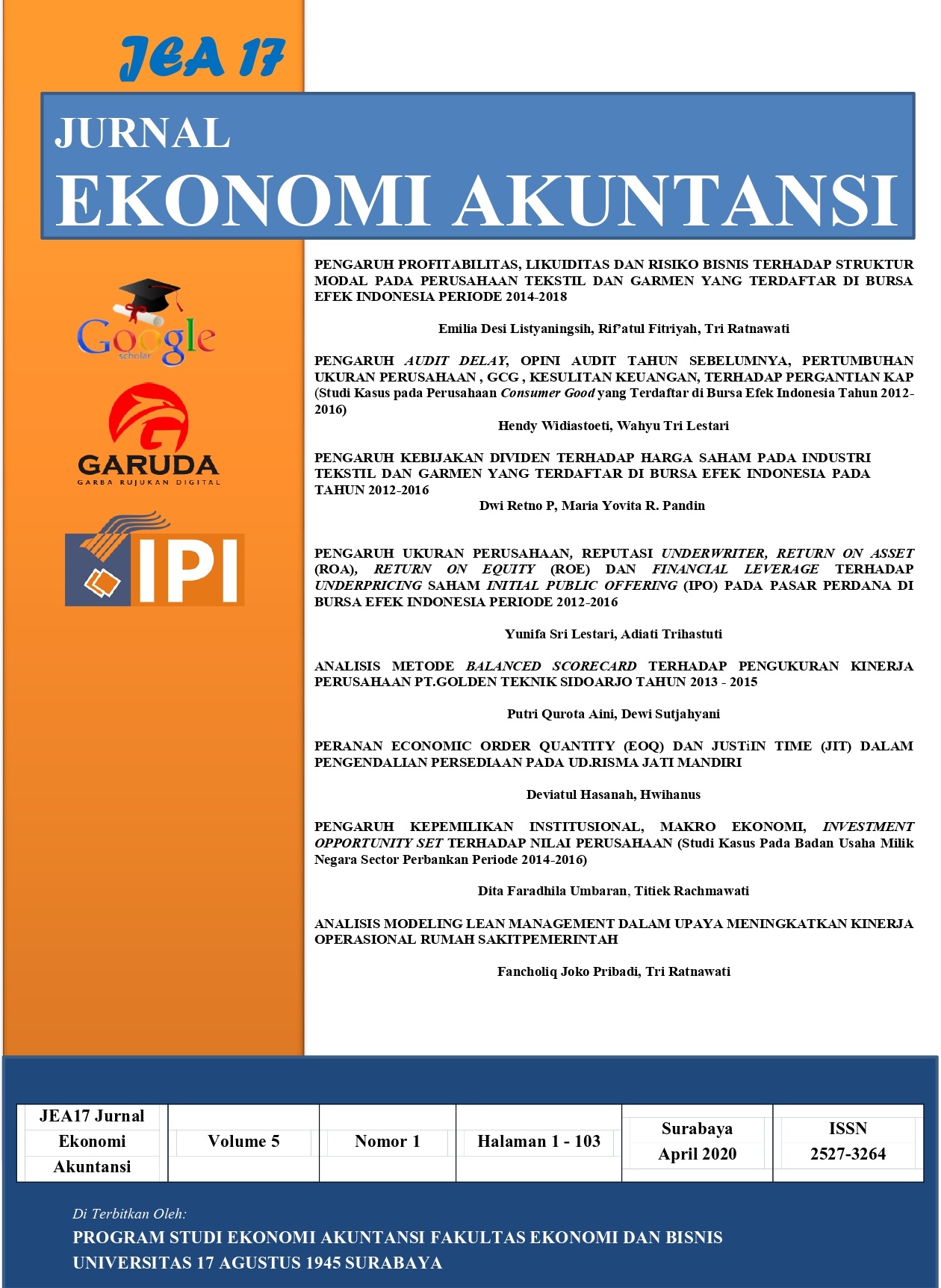
PENGARUH PROFITABILITAS, LIKUIDITAS DAN RISIKO BISNIS TERHADAP STRUKTUR MODAL PADA PERUSAHAAN TEKSTIL DAN GARMEN YANG TERDAFTAR DI BURSA EFEK INDONESIA PERIODE 2014-2018
DOI:
https://doi.org/10.30996/jea17.v5i1.4105Keywords:
Keywords, Profitability, Liquidity, Business Risk and Capital Structure.Abstract
ABSTRACTIndonesia is famous for its natural wealth with a variety of agricultural, plantation, mining, and forestry products. It is undeniable that many industries in Indonesia explore these fields, one of which is the growing textile industry. The purpose of this research is to test the influence of profitability, liquidity and business risk to the capital structure at textile companies which are listed in Indonesia Stock Exchange from 2014-2018. The multiple regressions analysis had been performed by using WarpPLS. The results of this study indicate that business risk affects the capital structure, while the profitability and liquidity variables do not affect capital structure with p-values 0.202 (profitability) and 0.235 (liquidity).
Downloads
Download data is not yet available.
References
Amy Dittmar, & Anjan Thakor. 2007.
Why Do Firms Issue Equity?
The Journal of Finance, Vol.
LXII, No. 1.
Bogna Ka?mierska-Jó?wiak, Jakub
Marsza?ek, Pawe? Seku?a. 2015.
Determinants of Debt-Equity
Choice - Evidence from
Downloads
Published
2020-09-02
Issue
Section
Articles
License
Authors whose manuscript is published will approve the following provisions:
- The right to publication of all journal material published on the JEA17: Jurnal Ekonomi Akuntansi website is held by the editorial board with the author's knowledge (moral rights remain the property of the author).
- The formal legal provisions for access to digital articles of this electronic journal are subject to the terms of the Creative Commons Attribution-ShareAlike (CC BY-SA) license, which means JEA17: Jurnal Ekonomi Akuntansi reserves the right to store, modify the format, administer in the database, maintain and publish articles without requesting permission from the Author as long as it keeps the Author's name as the owner of Copyright.
- Printed and electronically published manuscripts are open access for educational, research, and library purposes. In addition to these objectives, the editorial board shall not be liable for violations of copyright law.