
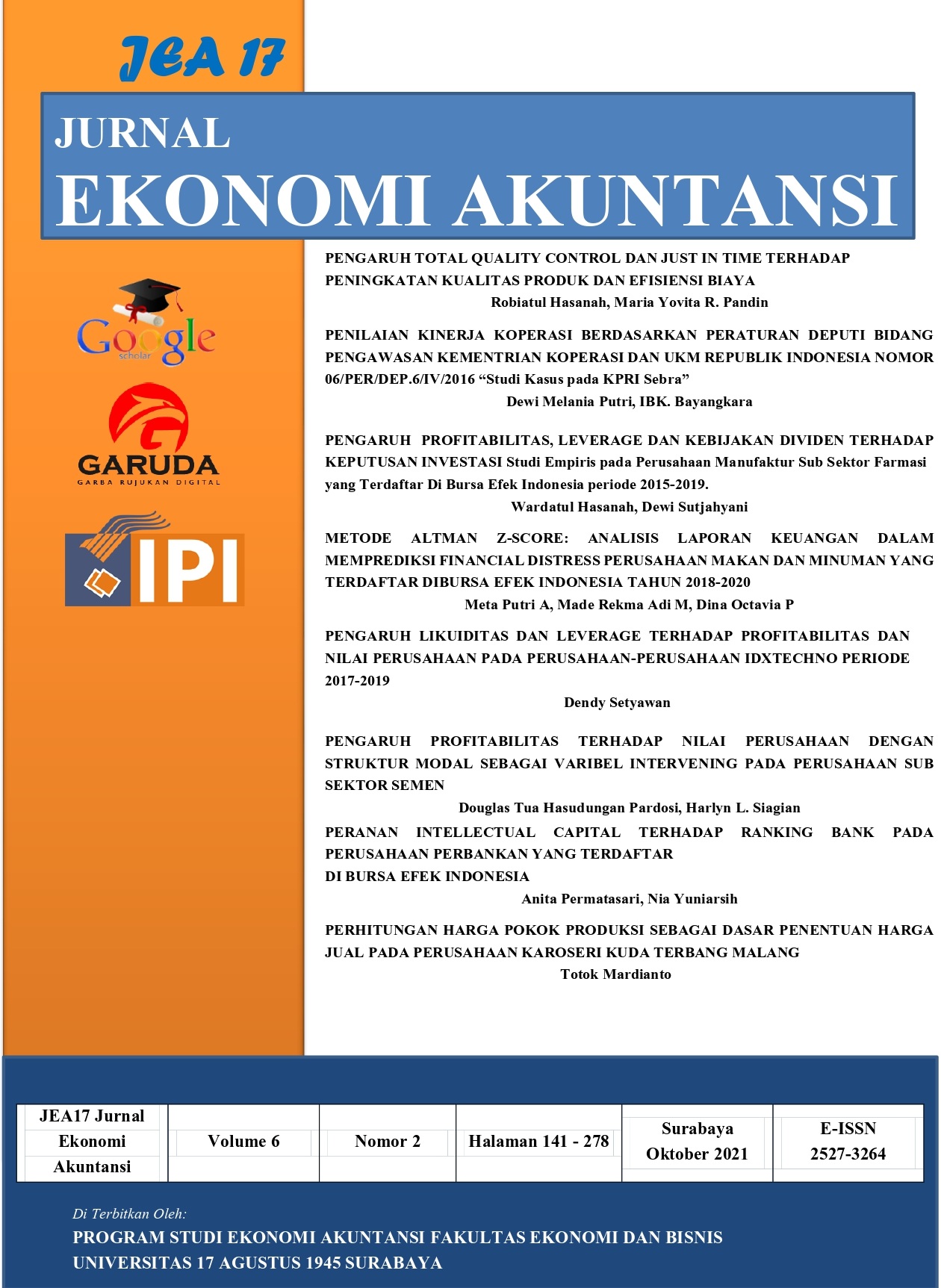
PENGARUH LIKUIDITAS DAN LEVERAGE TERHADAP PROFITABILITAS DAN NILAI PERUSAHAAN PADA PERUSAHAAN-PERUSAHAAN IDXTECHNO PERIODE 2017-2019
DOI:
https://doi.org/10.30996/jea17.v6i2.5966Keywords:
Liquidity, Leverage, Profitability, Firm Value, IDXTECHNOAbstract
This study was conducted to examine the effect of Liquidity and Leverage on Profitability and Firm Value of Companies listed at IDXTECHNO for the 2017-2019 period. Secondary data is obtained from the company's financial statements uploaded on the IDX's official website and the company's official website. The data used were selected based on the similarity of the available annual report data. The analysis method uses quantitative analysis methods using the SmartPLS 3.0 program. The results showed that the Liquidity and Leverage variables did not have an effect on the Profitability variable, but the Liquidity variable had a significant influence on the Firm Value variable, while the Leverage variable had no effect on the Firm Value variable. While the Profitability variable has a significant influence on the Firm Value variable.Downloads
References
Ananta, A. (2016). Penurunan body dissatisfaction pada perempuan dalam masa emerging
adulthood dengan gratitude intervention. Persona: Jurnal Psikologi Indonesia, 5(02).
Beken, L., Jacobs, N., Janssens, M., Peeters, S., Reijnders, J., Lechner, L., & Lataster, J.
(2019). Gratitude and health: An updated review. The Journal of Positive Psychology.
Cheng, S.-T., Tsui, P. K., & Lam, J. H. M. (2015). Improving mental health in health care
practitioners: Randomized controlled trial of a gratitude intervention. Journal of
Consulting and Clinical Psychology, 83(1), 177–186
Dunaev, J., Markey, C. H., & Brochu, P. M. (2018). An attitude of gratitude: The effects of
body-focused gratitude on weight bias internalization and body image. Body
image, 25, 9-13.
Emmons, R.A., McCullough, M. E. (2004). The psychology of gratitude. Oxford University
Press.
Esther. 2002. Hubungan antara sikap terhadap persuasi untuk bertubuh ideal menurut media
dan harga diri dengan body dissatisfaction. Skripsi, tidak diterbitkan, Fakultas
Psikologi Universitas Surabaya, Surabaya.
Grogan, S. (2007). Body image. Understanding body dissatisfaction in men, women , and
children. USA: Routledge.
Hall, M. (2009). Predictors of body dissatisfaction among adolescence females. Paper based
on program at the 2009 American Counseling Association Annual Conference And
Exposition, March 19-2003, Charlotte, North Carolina.
Nindita, M. (2018). Hubungan dukungan sosial dengan body dissatisfaction pada remaja
awal putri. Skripsi , tidak diterbitkan. Fakultas Psikologi dan Ilmu Sosial Budaya
Universitas Indonesia.
Polivy, J. and McFarlane, T. L. 1998. Dieting, exercise, and body weight. In E. A. Blechman
and K. D. Brownell (Ed.). Behavioral medicine and women: a comprehensive
handbook (pp. 369-373). New York: The Guilford Press.
Rice, F. P. dan Dolgin, K. G. 2002. The adolescent: development, relationships, and culture
(10th ed.). Boston: Allyn and Bacon.
Rosen, J., & Reiter J. C. (1995). Cognitive-behavioral body image therapy for body
dysmorphic disorder. Journal of Consulting and Clinical Psychology, 63(2), 263-269.
Sukmono, B. D. (2015). Eksploitasi Tubuh Perempuan di Televisi Sebagai Ironi Kepribadian
Indonesia. Komunikator, 4(01).
Wolfe, W. L., & Patterson, K. (2017). Comparison of a gratitude-based and cognitive
restructuring intervention for body dissatisfaction and dysfunctional eating behavior
in college women. Eating Disorders, 25(4), 330-344.
Wong, Y. J., McKean Blackwell, N., Goodrich Mitts, N., Gabana, N. T., & Li, Y. (2017).
Giving thanks together: A preliminary evaluation of the gratitude group program.
Practice Innovations, 2(4), 243–257
Zarrett, N., & Eccles, J. (2006). The passage to adulthood: challenges of late adolescence.
New directions for youth development, (111), 13–7.
Downloads
Published
Issue
Section
License
Authors whose manuscript is published will approve the following provisions:
- The right to publication of all journal material published on the JEA17: Jurnal Ekonomi Akuntansi website is held by the editorial board with the author's knowledge (moral rights remain the property of the author).
- The formal legal provisions for access to digital articles of this electronic journal are subject to the terms of the Creative Commons Attribution-ShareAlike (CC BY-SA) license, which means JEA17: Jurnal Ekonomi Akuntansi reserves the right to store, modify the format, administer in the database, maintain and publish articles without requesting permission from the Author as long as it keeps the Author's name as the owner of Copyright.
- Printed and electronically published manuscripts are open access for educational, research, and library purposes. In addition to these objectives, the editorial board shall not be liable for violations of copyright law.


