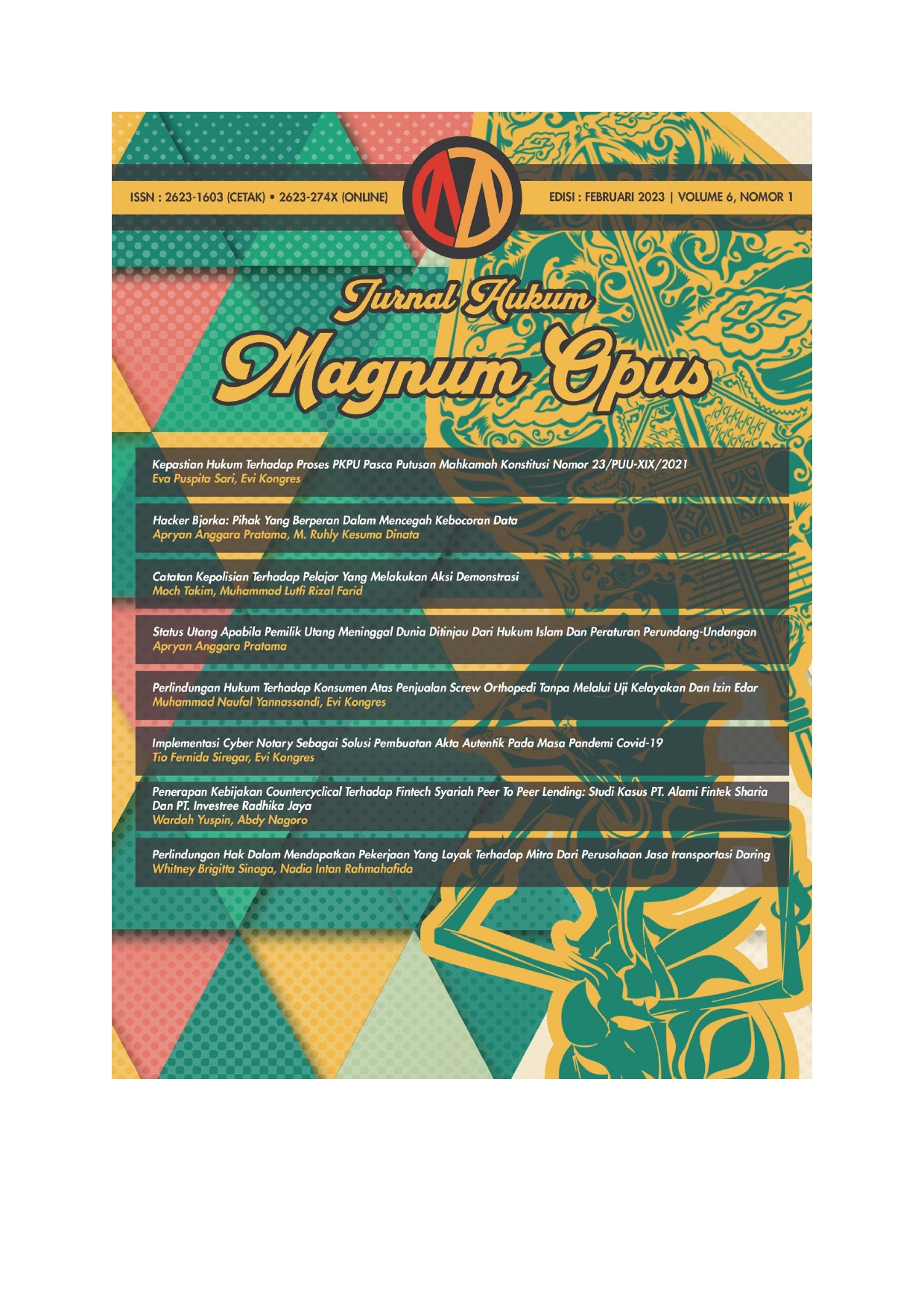
Status Utang Apabila Pemilik Utang Meninggal Dunia Ditinjau Dari Hukum Islam dan Peraturan Perundang-Undangan
DOI:
https://doi.org/10.30996/jhmo.v6i1.7437Abstract
Debt is an interesting loan agreement to discuss. In general, someone owes an debt caused by emergency needs, for example the need for medical expenses, school fees and so on, but not a few people owe it for business capital needs. Debt itself is common in society and includes something that is prone to problems in it, for example the case of the owner of the debt dies. Debt itself is common in society and includes something that is prone to problems in it, for example the case of the owner of the debt dies. Some people do not understand and end up ignoring the debt, of course, this is an unjustified action. The purpose of this study is to review the status of debt if in the condition that the owner of the debt has passed away from the perspective of Islamic law and laws and regulations. By using normative juridical research with a statutory study source approach and sourced from literature study materials from valid literature that is in accordance with the discussion and found that if the owner of the debt dies, the status of the debt must still be paid by the heirs by itself or automatically due to the law. Therefore the heirs can make repayment of the debt using the estate left by the heir who in this case is the owner of the debt. In the laws and regulations, the heirs can pursue legal remedies if the debt is deemed to be unable to be repaid, by refusing to accept the estate in court. Meanwhile, in Islamic law itself, it is highly emphasized that the debt is immediately repaid, especially by the heirs and if the heirs are incapacitated, the repayment can be assisted by relatives or acquaintances of the owner of the debt.
Keywords: debt status; islamic law; statutory law
Abstrak
Utang merupakan perjanjian pinjaman yang menarik untuk dibahas. Pada umumnya seseorang berutang di sebabkan kebutuhan darurat, misalkan kebutuhan biaya pengobatan, biaya sekolah dan lain sebagainya, tetapi tidak sedikit seseorang berutang untuk kebutuhan modal usaha. Utang sendiri sudah umum terjadi di masyarakat dan termasuk sesuatu yang rawan permasalahan di dalamnya, misalnya kasuspemilik utang meninggal dunia. Utang sendiri sudah umum terjadi di masyarakat dan termasuk sesuatu yang rawan permasalahan didalamnya, misalnya kasus pemilik utang meninggal dunia. Sebagian orang belum paham dan akhirnya mengabaikan utang tersebut, tentunya ini merupakan tindakan yang tidak dibenarkan. Tujuan penelitian ini adalah untuk meninjau status utang apabila dalam kondisi pemilik utang telah meninggal dunia dari perspektif hukum Islam dan peraturan perundang-undangan. Dengan menggunakan penelitianyuridis normatif dengan pendekatan sumber studi perundang-undangan dan bersumber pada bahan studi pustaka dari literatur-literatur valid yang sesuai bahasan dan menemukan bahwa apabila pemilik utang meninggal dunia, status utang tersebut tetap wajib dibayar oleh ahli warisdengan sendirinya atau secara otomatis dikarenakan hukum. Oleh karena itu ahli waris dapat melakukan pelunasan utang menggunakan harta warisan yang ditinggalkan pewaris yang di dalam hal ini adalah pemilik utang. Dalam peraturan perundang-undangan ahli waris dapatmelakukan upaya hukum apabila utang dirasa untuk tidak mampu dilunasi, dengan cara melakukan penolakan menerima harta warisan dipengadilan. Sedangkan di dalam hukum Islam sendiri, sangat ditekankan untuk utang tersebut segera dilunasi, khususnya oleh ahli waris danapabila ahli waris tidak mampu maka pelunasan dapat dibantu oleh kerabat atau kenalan si pemilik utang tersebut.
Kata kunci: hukum islam; hukum perundang-undangan; status utang
Downloads
Downloads
Published
Issue
Section
License
Authors who publish with Jurnal Hukum Magnum Opus agree to the following terms:
- Authors transfer the copyright and grant the journal right of first publication with the work simultaneously licensed under a Creative Commons Attribution-ShareAlike 4.0 International License.. that allows others to share the work with an acknowledgement of the work's authorship and initial publication in this journal.
- Authors are able to enter into separate, additional contractual arrangements for the non-exclusive distribution of the journal's published version of the work (e.g., post it to an institutional repository or publish it in a book), with an acknowledgement of its initial publication in this journal.
- Authors are permitted and encouraged to post their work online (e.g., in institutional repositories or on their website) prior to and during the submission process, as it can lead to productive exchanges, as well as earlier and greater citation of published work (See The Effect of Open Access)