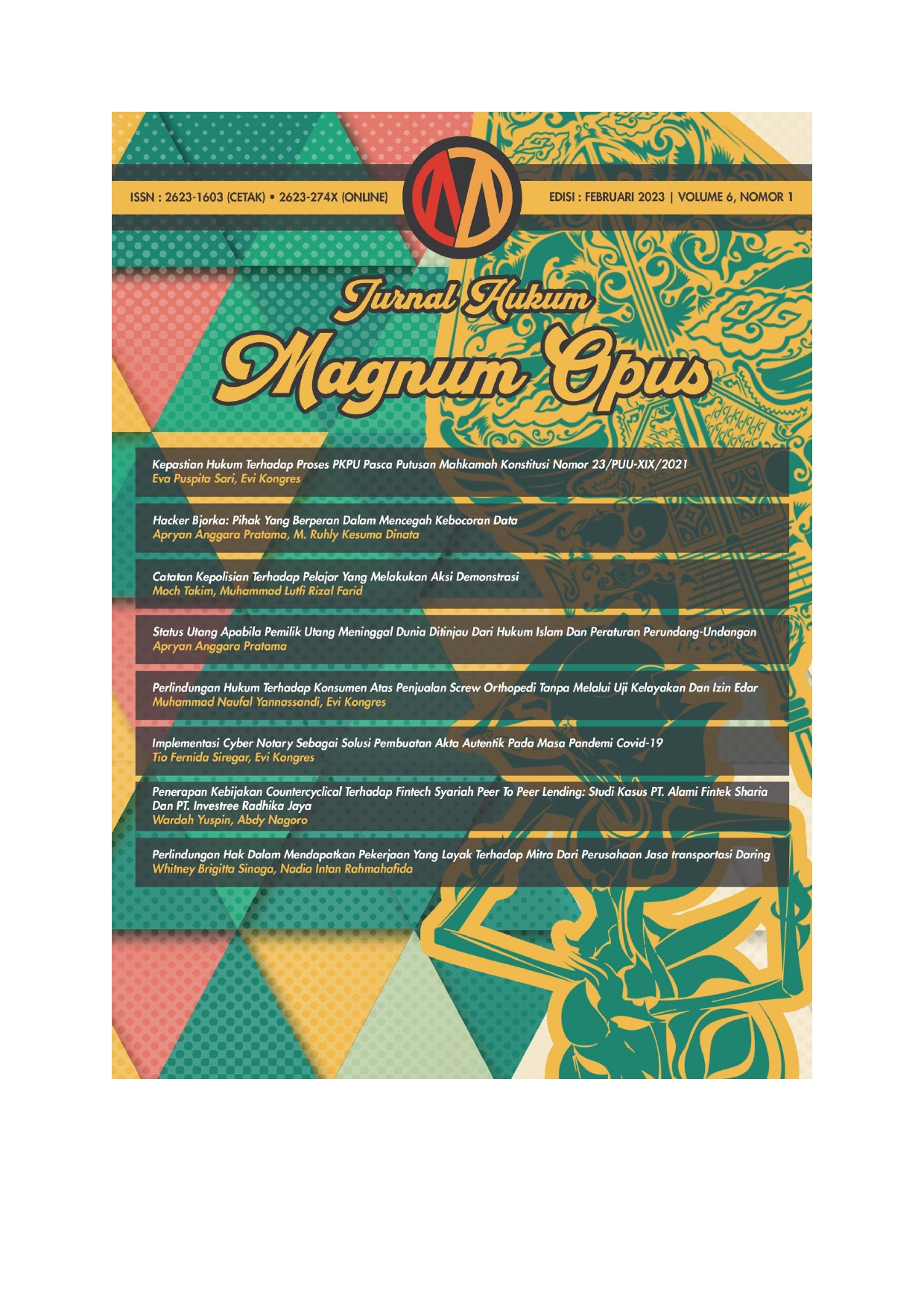
Hacker Bjorka: Pihak yang Berperan dalam Mencegah Kebocoran Data
DOI:
https://doi.org/10.30996/jhmo.v6i1.8293Abstract
Technological advances will give birth to new innovations and these various innovations will contribute to better living infrastructure. However, technological advances have a negative side, which can create crimes that are growing and varied. The variety of crimes we have never encountered before. This is due to changes in the way humans think and behave as a result of developments towards virtualization. The cybercrime committed by Bjorka hackers is an example of the variety of crimes from the many crime cases in the world due to technological advances. The Bjorka hacker case can interfere with the convenience of privacy of people's personal data, andeven this case can disrupt the stability of the Indonesian government. The purpose of this study is to review the Bjorka hacker case from the point of view of the party who played a role in preventing data leakage. This research used normative juridical research methods with qualitative analysis and found that the Bjorka hacker case was actually the responsibility of various parties. The Electronic System andTransaction Operator is a party that has a basic role in maintaining the personal data of the system being run to avoid data leakage as in the case of Bjorka or cyber attacks in general. From the government side, the Ministry of Communication and Informatics and the State Cyber and Password Agency are institutions that have a role in maintaining the security and comfort of cyber systems in Indonesia.
Keywords: data leakage; hacker bjorka; technological advances
Abstrak
Kemajuan teknologi akan melahirkan inovasi-inovasi baru dan berbagai inovasi tersebut akan memberikan kontribusi sarana prasaranakehidupan menjadi lebih baik. Walaupun demikian kemajuan teknologi memiliki sisi negatif yaitu dapat menciptakan kejahatan semakin berkembang dan bervariasi. Bervariasinya kejahatan yang belum pernah kita temui sebelumnya. Hal ini dikarenakan perubahan caraberpikir dan berperilaku manusia akibat dari perkembangan ke arah
virtualisasi. Kejahatan siber yang dilakukan oleh hacker Bjorka adalah satu contoh variasi kejahatan dari sekian banyaknya kasuskejahatan di dunia akibat kemajuan teknologi. Kasus hacker Bjorka dapat
mengganggu kenyamanan privasi terhadap data pribadi masyarakat, bahkan kasus ini dapat mengganggu stabilitas pemerintahan Indonesia. Tujuan dari penelitian ini adalah untuk meninjau kasus hacker Bjorka dari sudut pandang pihak yang berperan dalam mencegah terjadinya kebocoran data. Penelitian ini menggunakan metode penelitian yuridis normatif dengan analisis kualitatif dan menemukanbahwa kasus hacker Bjorka sebenarnya merupakan tanggung jawab berbagai pihak. Pihak Penyelenggara Sistem dan Transaksi Elektronik(PSTE) adalah pihak yang memiliki peran dasar dalam menjaga data-data pribadi sistem yang dijalankan agar terhindar dari kebocoran data seperti dalam kasus Bjorka atau serangan siber pada umumnya. Dari sisi pemerintah sendiri Kementerian Komunikasi dan Informatika (Kominfo) dan Badan Siber dan Sandi Negara (BSSN) menjadi lembaga yang memiliki peran dalam menjaga keamanan dankenyamanan sistem siber di Indonesia.
Kata kunci: hacker bjorka; kebocoran data; kemajuan teknologi
Downloads
Downloads
Published
Issue
Section
License
Authors who publish with Jurnal Hukum Magnum Opus agree to the following terms:
- Authors transfer the copyright and grant the journal right of first publication with the work simultaneously licensed under a Creative Commons Attribution-ShareAlike 4.0 International License.. that allows others to share the work with an acknowledgement of the work's authorship and initial publication in this journal.
- Authors are able to enter into separate, additional contractual arrangements for the non-exclusive distribution of the journal's published version of the work (e.g., post it to an institutional repository or publish it in a book), with an acknowledgement of its initial publication in this journal.
- Authors are permitted and encouraged to post their work online (e.g., in institutional repositories or on their website) prior to and during the submission process, as it can lead to productive exchanges, as well as earlier and greater citation of published work (See The Effect of Open Access)