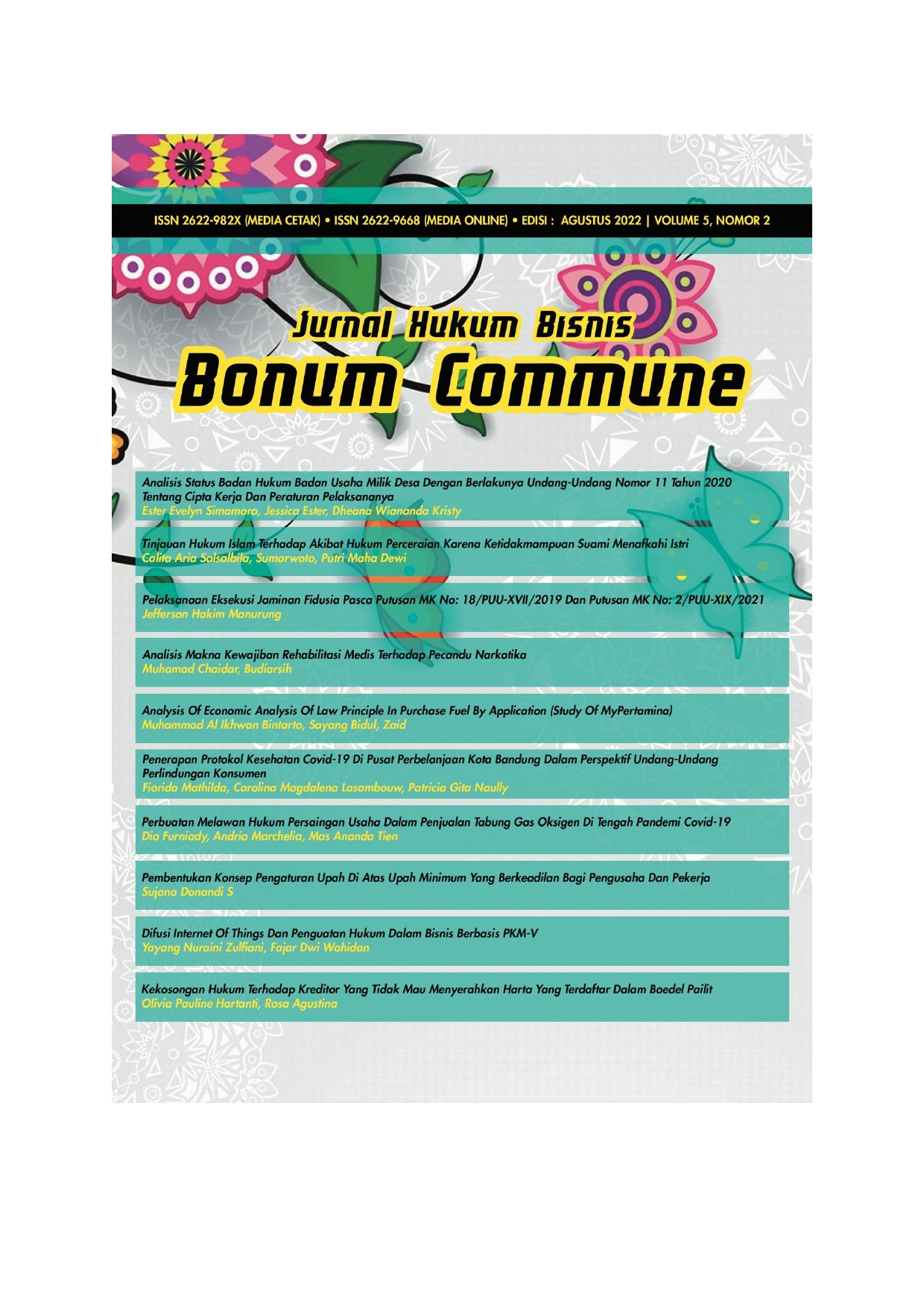
LARANGAN DAN PEMBATASAN EKSPOR DI MASA PANDEMI COVID-19 BERDASARKAN ATURAN WTO
DOI:
https://doi.org/10.30996/jhbbc.v3i2.3674Keywords:
pandemi Covid-19, pembatasan ekspor, WTOAbstract
Abstract
The research objective is to analyze decisions of countries that impose prohibition and restriction on exports during the Covid-19 pandemic. The method used in this research is normative legal research based on the rules of international trade law. In this research the researchers state that exports prohibition and restrictions imposed by countries during Covid-19 pandemic can be justified based on WTO law. The Covid-19 pandemic is undeniably bringing unprecedented challenges in the world of health, economy, and also international trade. The need for medical items, such as protective equipment, medicines, and other products that are important to deal with this pandemic has skyrocketed in almost every country in the world. As a result, there is a huge shock to global demand for medical products since practically all countries need the same product to deal with Covid-19 pandemic. However, all countries depend on international trade and global value chains to obtain medical goods. The situation is further complicated by the ongoing disruption of international transportation, particularly air cargo operations related to passenger travel. Basically, countries decisions on prohibitions and restrictions exports can be justified by the WTO law as long as these actions can be proven to be correlated as a reason to deal with Covid-19 pandemic.
Keywords: Covid-19 pandemic; export restrictions; WTO
Abstrak
Penelitian ini bertujuan untuk menganalisa mengenai tindakan negara dalam melakukan larangan dan pembatasan ekspor di masa pandemi Covid-19. Penelitian ini menggunakan metode penelitian yuridis normatif yang berdasarkan pada aturan-aturan hukum internasional. Melalui penelitian ini peneliti berpendapat bahwa larangan dan pembatasan ekspor yang dilakukan oleh negara pada masa pandemi Covid-19 dapat dijustifikasi berdasarkan aturan perdagangan internasional WTO. Pandemi Covid-19 tidak dapat dipungkiri membawa tantangan yang belum pernah terjadi sebelumnya dalam dunia kesehatan, ekonomi, termasuk dalam perdagangan internasional. Kebutuhan akan barang-barang medis, seperti peralatan pelindung, obat-obatan, dan produk-produk lain yang penting untuk memerangi pandemi Covid-19 ini telah meroket di hampir setiap negara di dunia. Akibatnya, ada guncangan besar pada permintaan global untuk produk medis, karena secara praktis semua negara membutuhkan produk yang sama untuk memerangi pandemi Covid-19. Namun, semua negara bergantung pada perdagangan internasional dan rantai nilai global untuk mendapatkan barang-barang medis. Keadaan semakin dipersulit mengingat adanya gangguan yang berkelanjutan pada transportasi internasional, khususnya operasi kargo udara yang terkait dengan perjalanan penumpang. Pada dasarnya tindakan negara berupa larangan dan pembatasan ekspor baik pada peralatan medis maupun bahan makanan dapat dibenarkan selama tindakan tersebut dapat dibuktikan korelasinya sebagai alasan untuk memerangi pandemi Covid-19.
Kata kunci: pandemi Covid-19; pembatasan ekspor; WTO
Downloads
References
Asscher, J. J., Wissink, I. B., Dekovic, M., Prinzie, P., & Stams, G. J. J. M. (2013). Delinquent behavior, poor relationship quality with parents, and involvement with deviant peers in delinquent and nondelinquent adolescents: Different Processes, Informant Bias, or Both? International Journal of Offender Therapy and Comparative Criminology, 58(9), 1001–1019. https://doi.org/10.1177/0306624X13491389
Azwar, S. (2015). Penyusunan Skala Psikologi (ke-2). Yogyakarta: Pustaka Pelajar.
Christiyanti, D. (2010). Memahami Komunikasi antar Pribadi Orang Tua Anak yang Terlibat Kenakalan Remaja. Universitas Diponegoro.
Crouter, A. C., & Head, M. R. (2002). Parental Monitoring and Knowledge of Children. In M. H. Bornstein (Ed.), Handbook of Parenting: Being and Becoming a Parent (2nd ed., pp. 461–483). Mahwah: Lawrence Erlbaum Associates Publishers.
Cutrona, C. E., & Russell, D. W. (1987). No Title. Advances in Personal Relationships, 1, 36–67.
Darling, N., Cumsille, P., Caldwell, L. L., & Dowdy, B. (2006). Predictors of Adolescents ’ Disclosure to Parents and Perceived Parental Knowledge : Between- and Within-Person Differences. Journal of Youth and Adolescence, 35(4), 667–678. https://doi.org/10.1007/s10964-006-9058-1
Esiri, M. O. (2016). The influence of peer pressure on adolescent misbehaviour in schools. Journal Of Humanities And Social Science, 21(1), 8–14. https://doi.org/10.9790/0837-21130814
Farrington, D. P., Loeber, R., Yin, Y., & Anderson, S. J. (2002). Are within-individual causes of delinquency the same as between-individual causes? Criminal Behaviour and Mental Health, 12(1), 53–68. https://doi.org/10.1002/cbm.486
Finkenauer, C., Engels, R. C. M. E., & Meeus, W. (2002). Keeping secrets from parents: Advantages and disadvantages of secrecy in adolescence. Journal of Youth and Adolescence, 31(2), 123–136. https://doi.org/10.1023/A:1014069926507
Fletcher, A. C., Steinberg, L., & Williams-Wheeler, M. (2004). Parental influences on adolescent problem behavior: Revisiting Stattin and Kerr. Child Development, 75(3), 781–796. https://doi.org/10.1111/j.1467-8624.2004.00706.x
Frijns, T., Keijsers, L., Branje, S., & Meeus, W. (2010). What parents don ’ t know and how it may affect their children : Qualifying the disclosure – adjustment link. Journal of Adolescence, 33(2), 261–270. https://doi.org/10.1016/j.adolescence.2009.05.010
Downloads
Additional Files
Published
Issue
Section
License
Authors who publish with Jurnal Hukum Bisnis Bonum Commune agree to the following terms:
- Authors transfer the copyright and grant the journal right of first publication with the work simultaneously licensed under a Creative Commons Attribution-ShareAlike 4.0 International License.. that allows others to share the work with an acknowledgement of the work's authorship and initial publication in this journal.
- Authors are able to enter into separate, additional contractual arrangements for the non-exclusive distribution of the journal's published version of the work (e.g., post it to an institutional repository or publish it in a book), with an acknowledgement of its initial publication in this journal.
- Authors are permitted and encouraged to post their work online (e.g., in institutional repositories or on their website) prior to and during the submission process, as it can lead to productive exchanges, as well as earlier and greater citation of published work (See The Effect of Open Access)