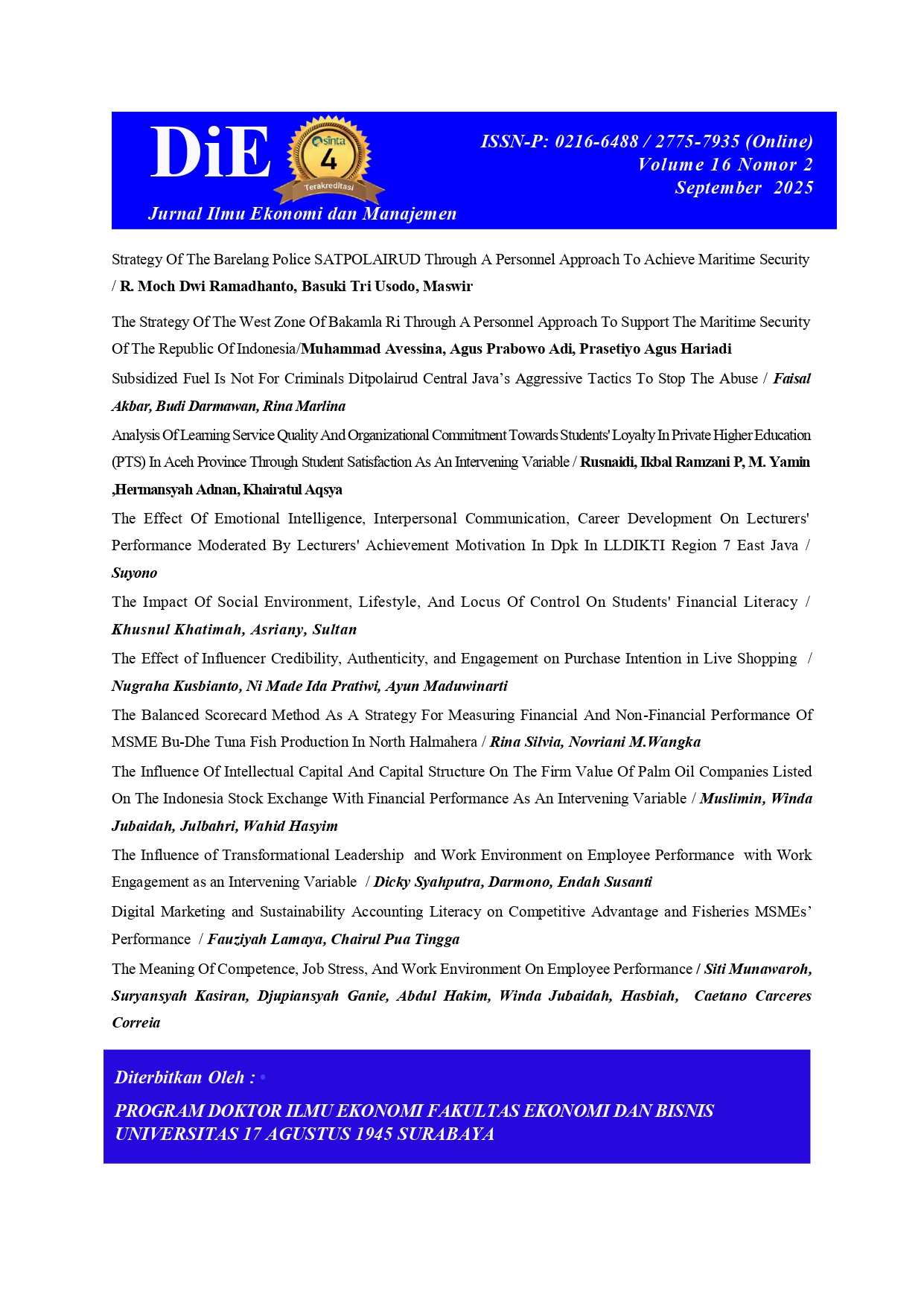
THE EFFECT OF EMOTIONAL INTELLIGENCE, INTERPERSONAL COMMUNICATION, CAREER DEVELOPMENT ON LECTURERS' PERFORMANCE MODERATED BY LECTURERS' ACHIEVEMENT MOTIVATION IN DPK IN LLDIKTI REGION 7 EAST JAVA
DOI:
https://doi.org/10.30996/die.v16i02.132063Keywords:
Emotional Intelligence, Competence, Career Development, Lecturer Performance, Achievement MotivationAbstract
The purpose of this study is to prove and analyze the influence of Emotional Intelligence, Interpersonal Communication, Career Development and the influence of Achievement motivation as a moderating variable on the relationship between Career Development and Lecturer Performance of DPK LLDIKTI Region 7 East Java, with a sample size of 278 and a data collection method using a Questionnaire. Data analysis used AMOS version 25. The results showed that Emotional Intelligence had no significant effect on Career Development. Emotional Intelligence had a significant effect on Lecturer Performance. Interpersonal Communication had no significant effect on Career Development. Interpersonal Communication had no significant effect on Lecturer Performance. Career Development had no significant effect on Lecturer Performance. Achievement motivation positively moderated the relationship between competence and Lecturer Performance of DPK LLDIKTI Region 7 East Java. Achievement motivation positively moderated the relationship between Career Development and Lecturer Performance of DPK LLDIKTI Region 7 East Java. Suggestions for further research are to use qualitative methods, and/or use different sample populations for insignificant research results.Downloads
References
Abdel Aziz, M., Abdel Aal, M., & Ibrahim, S. (2019). Relationship between Emotional Intelligence and Self- Efficacy among Psychiatric Mental Health Nurses in Clinical Practice. Menoufia Nursing Journal, 4(1), 1–8. https://doi.org/10.21608/menj.2019.152594
Adam, E. E. (1994). Alternative quality improvement practices and organization performance. Journal of Operations Management, 12(1), 27–44. https://doi.org/10.1016/0272-6963(94)90004-3
Adamides, E., & Karacapilidis, N. (2020). Information technology for supporting the development and maintenance of open innovation capabilities. Journal of Innovation and Knowledge, 5(1), 29–38. https://doi.org/10.1016/j.jik.2018.07.001
Adekola, B. (2012). The Impact of Organizational Commitment on Job Satisfaction: A Study of Employees at Nigerian Universities. International Journal of Human Resource Studies, 2(2), 1. https://doi.org/10.5296/ijhrs.v2i2.1740
Adinda Yasmine, P. K. (2023). Program Studi Akuntansi , Fakultas Ekonomi dan Bisnis , Universitas Pembangunan. 12(2), 143–150.
Adinegara, G. N. J., Suprapti, N. W. S., Yasa, N. N. K., & Sukaatmadja, I. P. G. (2017). Factors That Influences Tourist’s Satisfaction and Its Consequences. European Journal of Business and Management, 9(8), 39–50. https://www.iiste.org/Journals/index.php/EJBM/article/view/35898/36893%0Ahttps://www.iiste.org/Journals/index.php/EJBM/article/download/35898/36893%0Ahttps://lens.org/000-384-956-578-823
Downloads
Published
Issue
Section
License
Copyright (c) 2025 Suyono Suyono Suyono

This work is licensed under a Creative Commons Attribution-ShareAlike 4.0 International License.
The author who will publish the manuscript at DiE: Jurnal Ilmu Ekonomi dan Manajemen, agree to the following terms:
1. Authors retain copyright and grant the journal right of first publication with the work simultaneously licensed under a Creative Commons Attribution ShareAlike License that allows others to share the work with an acknowledgment of the work's authorship and initial publication in this journal.
2. Authors are able to enter into separate, additional contractual arrangements for the non-exclusive distribution of the journal's published version of the work (e.g., post it to an institutional repository or publish it in a book), with an acknowledgment of its initial publication in this journal.
3. Authors are permitted and encouraged to post their work online (e.g., in institutional repositories, pre-prints sites or on their website) prior to and during the submission process, as it can lead to productive exchanges, as well as earlier and greater dissemination of published work