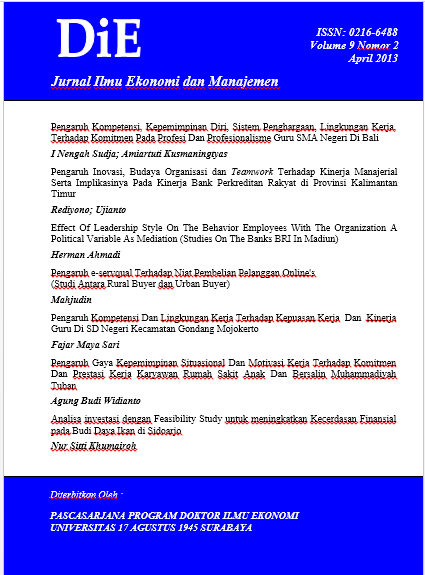
Analisa investasi dengan Feasibility Study untuk meningkatkan Kecerdasan Finansial pada Budi Daya Ikan di Sidoarjo
DOI:
https://doi.org/10.30996/die.v9i2.215Abstract
Potential of each region in Indonesia from region to region and different. Indonesia has many islands and is surrounded by sea certainly has the potential of natural resources are not unlimited. One of the areas in Indonesia that fish is also a producer of Sidoarjo regency. Sidoarjo regency in East Java is located between two major rivers namely River Porong and Surabaya River so famous as the city of Delta. Which of the three investment potential of the aquaculture of milkfish, shrimp and Tilapia vaname who earn higher incomes?, Does investment analysis with feasibility studies to improve financial intelligence on aquaculture farmers. Whether or not a project implemented successfully in this case could provide economic benefits or provide financial benefits to the company the necessary analysis or assessment of the situation and the prospects of a project taking into account several criteria such as objectives, benefits and aspects related to the project in research project feasibility analysis. To find out more about the three types of resources are then conducted a field study. From the data collected by the theory of feasible study capital budgeting and financial analysis, data is processed to find out from the three farms that produce high profits. While the capital budgeting analysis that is used is the net present value (NPV), internal rate of return (IRR), payback period (PP), average rate of return (ARR) and Profitability Index (PI). From the calculation results can be seen that when viewed from the side of the capital vaname shrimp cultivation requires a smaller capital. in terms of earnings before interest and tax of tilapia aquaculture generate greater revenues. Pay back period of milkfish cultivation period of more rapid return of investment when compared with the cultivation of other woods. Internal rate of return calculations show that the cultivation of fish internal rate of returnnya higher than other cultivation. If you look at the results of the study fish ponds can be used as an investment option, because the investments are in need of smaller and faster payback periodnya. Another thing that underlies this selection of fish culture management easier and more powerful survival compared with other cultivation.
Â
Keywords: Investment Analysis, Fisheries, financial intelligence.Downloads
References
Abdul, A. H. Kecerdasan Emosi dan Hubungan-nya dengan Pencapaian Akademik dan Ting-kah Laku Pelajar. E-journal of UTM. Univer-siti Teknologi Malaysia Skudai: Fakultas Pendidikan
Ali, M. dan Asrori, (2012). Psikologi Remaja. Jakarta: PT Bumi Aksara
Asih, G. Y. dan Pratiwi, M. M. S. Perilaku Pro-sosial ditinjau dari Empati dan Kematangan Emosi. Jurnal Psikologi Universitas Muria Kudus Volume 1, no 1, Desember 2010
Astiko, G. A. dan Budiani, M. S. (2008). Hubu-ngan Kecerdasan Emosi dan Self Efficacy dengan Tingkat Stres Mahasiswa. Jurnal Psikologi Pendidikan dan Bimbingan. Uni-versitas Negeri Surabaya: Fakultas Psikologi.
Azwar, S. (2005). Reliabilitas dan Validitas (eds 3). Yogyakarta: Pustaka Pelajar
Azwar, S. (2010). Penyusunan Skala Psikologi. Yogyakarta: Pustaka Pelajar
Baumrind, D. Pola Asuh. http://aryeducation. blogspot.com/2009/03/karya-ilmiah-penga ruh-pola-asuhorang.html
Baron, R. A dan Byrne, D, (2005). Psikologi Sosial (edisi Kesepuluh, jilid 2). Jakarta: Erlangga
Farid, M (2011). Penalaran moral, Kecerdasan Emosi, Religiusitas, dan Pola Asuh Orangtua Otoritatif. Disertasi. UGM: Fakultas Psiko-logi
Goleman, D. (2000). Kecerdasan Emosional untuk Mencapai Puncak Prestasi. Jakarta: Gramedia Pustaka Utama
Goleman, D. (2007). Social Intelligence. Jakar-ta: Gramedia Pustaka Utama
Hudaniah dan Dayakini, T (2012), Psikologi Sosial, Malang: UMM Press
Hurlock, E. B. (2007) Psikologi Perkembangan (edisi kelima), Jakarta: Erlangga
Iskandar (2008). Kecerdasan Emosi dan Komit-men Pekerjaan Dosen di Jambi Universitas Batanghari Jambi: Skripsi. FKIP
Iswantiningtyas, V. R, Pasca A, Santi dan Evita, D. (2012). Pola Asuh Orangtua Demokratis, Kreativitas dan Adversity Quotient Remaja Awal. Jurnal Psikologi Persona Volume 01 no. 01 Juni 2012
Laksana, K. D. (2009). Hubungan empati de-ngan perilaku prososial pada peer educator universitas Katolik Soegijapranata. Skripsi. Universitas Katolik Soegijapranata: Fakultas Psikologi
Malik, M. A. (2003). Masalah Emosional dan Perilaku pada Anak dan Remaja di poliklinik jiwa anak dan remaja RSUPN dr. Cipto-mangunkusumo (RSCM). Jurnal Intelektual, Februari 2003, Vulome 1, no 1. Jakarta
Mulyati. (2007). Hubungan Pola Asuh Demo-kratis Orang Tua Dengan Kemampuan Pe-mecahan Masalah pada Remaja. Jurnal In-tervensi Psikologi (JIP). Universitas Islam Indonesia: Fakultas Psikologi.
Monks, F. J dan Knoers, A. M. P (2006) Psiko-logi Perkembangan (edisi keenambelas), Yogyakarta: Gadjah Mada Universitas Press
Purnamasari, A. E, Endang dan Fadhila, A. (2004). Perbedaan intensi Prososial Siswa SMUN dan MAN di Yogyakarta. Huma-nitas: Indonesia Psychologycal Jurnal Vol.1 No. 1 Januari 2004: 32-42 . UGM: Fakultas Psikolog. Universitas Ahmad Dahlan: Fakul-tasPsikologi
Santrock, John W. (2012). Life-Spand Develop-ment (Perkembangan Masa-Hidup). (edisi Ketigabelas, jilid 1), Jakarta: Erlangga
Downloads
Published
Issue
Section
License
The author who will publish the manuscript at DiE: Jurnal Ilmu Ekonomi dan Manajemen, agree to the following terms:
1. Authors retain copyright and grant the journal right of first publication with the work simultaneously licensed under a Creative Commons Attribution ShareAlike License that allows others to share the work with an acknowledgment of the work's authorship and initial publication in this journal.
2. Authors are able to enter into separate, additional contractual arrangements for the non-exclusive distribution of the journal's published version of the work (e.g., post it to an institutional repository or publish it in a book), with an acknowledgment of its initial publication in this journal.
3. Authors are permitted and encouraged to post their work online (e.g., in institutional repositories, pre-prints sites or on their website) prior to and during the submission process, as it can lead to productive exchanges, as well as earlier and greater dissemination of published work