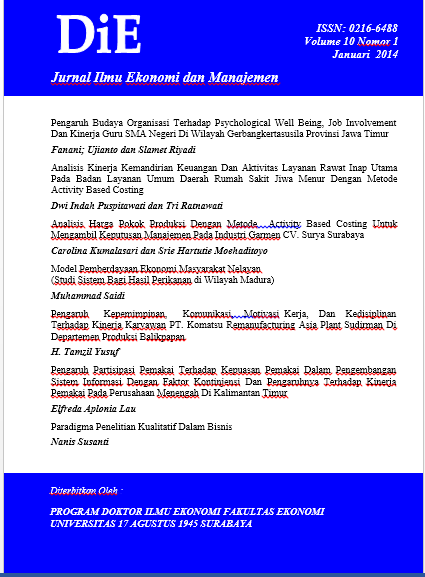
Analisis Kinerja Kemandirian Keuangan Dan Aktivitas Layanan Rawat Inap Utama Pada Badan Layanan Umum Daerah Rumah Sakit Jiwa Menur Dengan Metode Activity Based Costing
DOI:
https://doi.org/10.30996/die.v10i1.231Abstract
Background : As the Government Hospital of East Java Province, Menur Mental Hospital provide inpatient main public services with tariff that set by the Director of the hospital. Status of Badan Layanan Umum Daerah (BLUD) requires hospitals to improve financial independence along with improved quality of service, so that the necessary cost analysis as the basis for calculating rates and cost efficiency in order to make the right and accurate decisions. Determination of the major inpatient services rates using Activity Based Costing will track activity based on those costs. Objective: Calculate the unit cost per class, analyze the activity and performance of financial independence of the main inpatient services. Methods : The study design applied in a descriptive cross-sectional field.Results : The unit cost per day of hospitalization after activity analysis, are: VIP 1 Rp1.264.940,29; VIP 2 Rp982.913,63; Main 1 Rp513.692,85; Main 2 Rp423.506,13, and Main 3 Rp282.026,07. Fixed cost are Rp1.490.013.692,04; while the variable cost per class are 1 VIP Rp257.777,48; VIP 2 Rp229.777,48; Main 1 Rp195.582,48; Main 2 Rp164.852,48; and Main 3 Rp126.125,33.Conclusion : Unit Cost of all classes of treatment before analysis of activity are higher than current tariff. Non value-added activities cost are Rp341.235.192,80; so that the unit cost of each class is reduced by an average 9.25% when including the salaries of civil servants, and 12.47% without the salaries of civil servants. Level of financial independence after the analysis of activity increased to 94.88%  from 80,00% if the salaries of civil servants still subsidized by the government. Suggestion : Keep the understanding and commitment, especially in cost efficiency through further analysis of activities. If civil servants salaries are not subsidizied anymore, Main 2 and Main 3 class are not able to reach the Break Even Point (BEP), although with Bed Occupancy Rate (BOR) to be considered for a 100% rate increase.
Â
Keywords : Activity Based Costing, financial independence, hospital
Downloads
References
Andayani, A. 2007. “Indian Pancatantra and Old Javanese Tantri Kamandaka: Comparative Literature Studyâ€. Thesis unpublished. Prodi Bahasa-Sastra, Program Pascasarjana, Univ. Negeri Surabaya.
Andayani, A. 2008. “Comparison of Indian Pancatantra and Balinese Tantri Kamandaka in Multiperspectivesâ€. Parafrase 8(1) Februari.
Andayani, A. 2009. â€Hindu-Brahma pada Pancatantra dan Hindu Shiwa-Tantrisme pada Tantri Kamandaka Jawa Kuno: Kajian Sastra Bandinganâ€. Makalah Seminar Interdisipliner Fakultas Sastra, Untag Surabaya, 30 Juli 2009.
Brown, W.N. 1981. “Folk Talesâ€. The Encyclopedia Americana. Vol. 14. International Edition. Connecticut: Grolier Incorporated. Page 923.
Coomaraswamy, A.K. 1985. History of Indian and Indonesian Art. New York: Dover Publications, Inc.
Darmayasa, M. 1998. Pancatantra Buku Pertama: Perselisihan di antara Sahabat. Denpasar: Manik Geni.
Dundes, A. 1980. Interpreting Folklore. Bloomington: Indiana Univ. Press.
Hooykaas, C. 1929. Tantri, de Middel-Javaansche Pancatantra-Bewerking. Leiden: A. Vros.
Hooykaas, C. 1931. Tantri Kamandaka: Een Oudjavaansche Pantjatantra-Bewerking in Tekst en Vertaling Uitgegeven. Bibliotheca Javanica. Bandoeng: AC Nix & Co.
Hunter, T.M. 1995. “Animal Motifs in Indonesian Architecdtural Reliefs: Three Stages in Textual and Visual Evokutionâ€. American Committee for South Asian Art (ACSAA), Annual Meeting, N.Y. City, Spring.
Klokke, M.J. 1993. The Tantri Reliefs on Ancient Javanese Candi. Leiden: KITLV Press, Royal Institute of Linguistics and Anthropology.
Somvir. 2003. “A One Man Army Out to Propagate Hinduismâ€. www.hindustantimes.com/ news/5967_ 407680,001600060001.htm
Spencer, D.M. & W.N. Brown. 1981. “India: The People and Way of Lifeâ€. The Encyclopedia Americana. Vol. 14: 866—869. Connecticut: Grolier Incorporated.
Sudikan, S.Y. 2001. Metode Penelitian Sastra Lisan. Surabaya: Citra Wacana.
Thieme, P. 1981. “India: Arts & Science: Literatureâ€. The Encyclopedia Americana. Vol. 14. International Edition. Connecticut: Grolier Incorporated. Page 915—919.
Thompson, S. 1966. Motif-Index of Literature: A Classification of Narative Elements in Folktales, Ballads, Myths, Fables, Mediaeval Romances, Exempla, Fabliaux, Jest-Books, and Local Legends. Volume 1-6. Bloomington: Indiana Univ. Press.
Peraturan Pemerintah Republik Indonesia Nomor 23 Tahun 2005 Tentang Penge-lolaan Keuangan Badan Layanan Umum.
Peraturan Pemerintah Republik Indonesia Nomor 58 Tahun 2005 Tentang Penge-lolaan Keuangan Daerah.
Peraturan Menteri Kesehatan Republik Indo-nesia Nomor 12 Tahun 2013 Tentang Pola Tarif Badan Layanan Umum Rumah Sakit.
Undang-Undang Republik Indonesia Nomor 17 Tahun 2003 Tentang Keuangan Daerah
Wardoyo, Paulus., 2007, Activity Based Cost System Sebagai Alternatif Evaluasi Metode Penetapan Harga Pokok Rawat Inap Pasien (Studi Kasus pada RS Panti Wilasa Citarum Semarang, Jurnal Solusi Volume 6 Nomor 4, Semarang.
Yasri Dewi, Rima Semiarty, Ratni Prima Lita, 2010, Metode Activity Based Costing Sebagai Penentuan Tarif Rawat Inap di RS Jiwa Puti Bungsu, Jurnal 2010.
Downloads
Published
Issue
Section
License
The author who will publish the manuscript at DiE: Jurnal Ilmu Ekonomi dan Manajemen, agree to the following terms:
1. Authors retain copyright and grant the journal right of first publication with the work simultaneously licensed under a Creative Commons Attribution ShareAlike License that allows others to share the work with an acknowledgment of the work's authorship and initial publication in this journal.
2. Authors are able to enter into separate, additional contractual arrangements for the non-exclusive distribution of the journal's published version of the work (e.g., post it to an institutional repository or publish it in a book), with an acknowledgment of its initial publication in this journal.
3. Authors are permitted and encouraged to post their work online (e.g., in institutional repositories, pre-prints sites or on their website) prior to and during the submission process, as it can lead to productive exchanges, as well as earlier and greater dissemination of published work