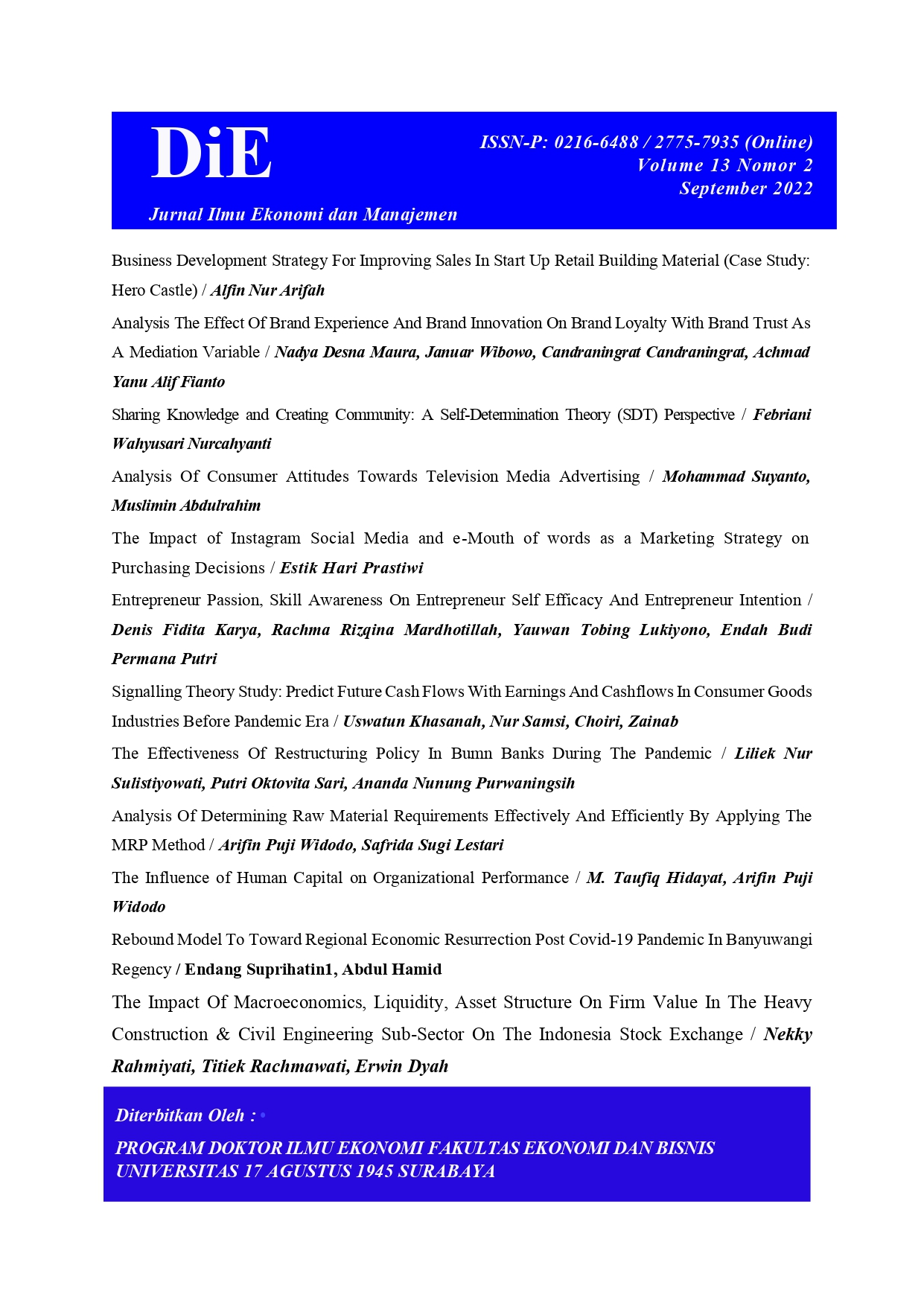
ANALYSIS THE EFFECT OF BRAND EXPERIENCE AND BRAND INNOVATION ON BRAND LOYALTY WITH BRAND TRUST AS A MEDIATION VARIABLE
DOI:
https://doi.org/10.30996/die.v13i2.7293Keywords:
Brand experience, Brand Innovation, Brand Loyalty, Brand TrustAbstract
Technological developments have had a great influence on competition in the industrial world, especially in the beauty industry. To win the competition, it is important for a company to build customer loyalty. Several studies that have been conducted have found a significant relationship between brand experience and brand innovation on brand loyalty. Apart from the many studies examining the effect of brand experience and brand innovation on brand loyalty, inconsistency of results is still found where there is a group of researchers who find that there is a significant effect between brand experience and brand innovation on brand loyalty and there are other groups of researchers who find no significant effect between brand experience and brand innovation on brand loyalty. To fill this gap, this study will use the brand trust variable as a mediating variable. The purpose of this study was to further investigate the relationship between brand experience and brand innovation on brand loyalty with the brand trust variable as a mediating variable. This study uses a quantitative approach using the structural equation modeling (SEM) method to analyze the data. The object of this research is the grace and glow brand using 160 respondents located in Surabaya.
Downloads
References
Undang – Undang
Undang-Undang Dasar 1945.
Undang-Undang Nomor 21 Tahun 2007 tentang Pemberantasan Tindak Pidana Perdagangan Orang
Undang-Undang Nomor 18 Tahun 2017 tentang Pelindungan Pekerja Migran Indonesia.
Peraturan Badan Pelindungan Pekerja Migran Indonesia Nomor 9 Tahun 2020 tentang Pembebasan Biaya Penempatan Pekerja Migran Indonesia
Keputusan Menteri Tenaga Kerja Nomor 151 Tahun 2020 tentang Pengentian Sementara Penempatan Pekerja Migran Indonesia
Keputusan Kepala Badan Pelindungan Pekerja Migran Indonesia Nomor 214 Tahun 2021 tentang Petunjuk Pelaksanaan Pembebasan Biaya Penempatan Pekerja Migran Indonesia
Keputusan Deputi Bidang Penempatan BNP2TKI Nomor : Kep.59/PEN/VI/2010 tentang Petunjuk Teknis Penyuluhan Jabatan Tenaga Kerja Indonesia.
Keputusan Direktur Jenderal Pembinaan Penempatan Tenaga Kerja dan Perluasan Kesempatan Kerja Nomor 3/5410/PK.02.02/XI/2021 tentang Perubahan Ketujuh Atas Keputusan Direktur Jenderal Pembinaan Penempatan Tenaga Kerja dan Perluasan Kesempatan Kerja Nomor : 3/20888/PK.02.02/VIII/2020 tentang Penetapan Negara Tujuan Penempatan Tertentu Bagi Pekerja Migran Indonesia Pada Masa Adaptasi Kebiasaan Baru.
Buku
Asshidiqie, Jimly, Hukum Tata Negara dan Pilar-pilar Demokrasi, Sinar Grafika, Jakarta, 2012.
Hardum, S. Edi Hardum, S. Edi, Perdagangan Manusia Berkedok Pengiriman TKI, Ar-Ruzz Media, Yogyakarta, 2016.
Indraningsih, Karasapoetra G dan Rience, Pokok-pokok Hukum Perburuhan, Armico, Bandung, 1982.
Marzuki, Peter Mahmud, Penelitian Hukum, Kencana Prenada Group, Jakarta, 2007.
Soekanto, Soeryono, Pengantar Penelitian Hukum, UI Press, Jakarta, 1984.
Jurnal
Aronowitz, Alexis A., Human Trafficking, Human Misery : The Global Trade in Human Beings, Westpoint Connecticut : Greenwood Publishing Group.
Downloads
Published
Issue
Section
License
The author who will publish the manuscript at DiE: Jurnal Ilmu Ekonomi dan Manajemen, agree to the following terms:
1. Authors retain copyright and grant the journal right of first publication with the work simultaneously licensed under a Creative Commons Attribution ShareAlike License that allows others to share the work with an acknowledgment of the work's authorship and initial publication in this journal.
2. Authors are able to enter into separate, additional contractual arrangements for the non-exclusive distribution of the journal's published version of the work (e.g., post it to an institutional repository or publish it in a book), with an acknowledgment of its initial publication in this journal.
3. Authors are permitted and encouraged to post their work online (e.g., in institutional repositories, pre-prints sites or on their website) prior to and during the submission process, as it can lead to productive exchanges, as well as earlier and greater dissemination of published work