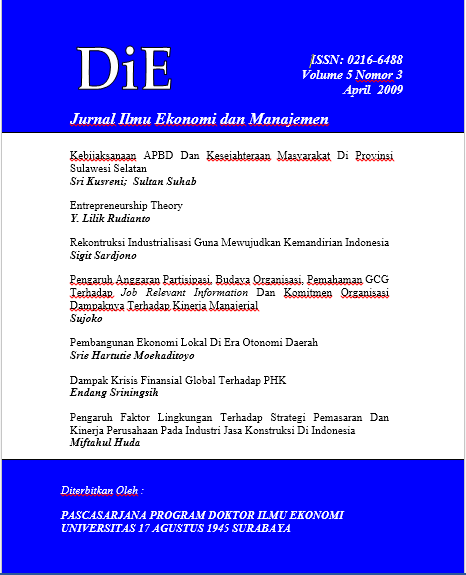
Rekontruksi Industrialisasi Guna Mewujudkan Kemandirian Indonesia
DOI:
https://doi.org/10.30996/die.v5i3.73Abstract
In the globalization era nowadays, the increase of interdependence among the states becomes unavoidable. But, this dependence has to be minimized a little by little. It makes what to do limited. The imported product dependence makes goods price more expensive. Meanwhile, the map of economy and business world atmosphere is colored with increasingly higher competence. All of them effect no option for us, except increase ability and superiority of all national economic potency in order to achieve the continuous national development. In welcoming the commitment explanation, it is time to reinforce the strategy for building the industry sector by featuring our own strength to increase independence in implementing the national development. It can especially be personified by eliminating the problems in the sector. The most important thing is also to increase nationalism sense. The new nationalism is not chauvinism and isolated nationalism, but nationalism for domestic product appreciation rather than imported product. Although the action for constructing industrialization is slow, but it is better to be late than not at all.
Â
Keywords:Â Industrial, Development, Oligopoly, Nasionalism
Downloads
References
Armala (2011). Meraih Sukses itu (tidak) Gampang. Jakarta: PT Gramedia Pusta-ka Utama.
Collins, F.S. (2004). The Joy of Success. Alih bahasa oleh Juni Prakoso. Batam Centre: Penerbit Interaksara.
De Bono, E. (1991). Taktik: Kiat dan Ilmu Sukses. Alih bahasa oleh Agus Maulana. Jakarta: Bina Aksara.
Goleman, D.(1995). Emotional Intelligence: Why it can matter more than IQ. New York: Bantam Books.
Maltz, M.(2004). The New Psycho-Cyber-netics. Alih bahasa oleh Arvin Saputra dan Lyndon Saputra. Batam Centre: Inte-raksara.
McRae, H. (1995). The Wordl in 2020. Alih bahasa oleh Anton Adiwijoto. Jakarta: Bina Aksara.
Sternberg, R.J. (1997). Successful Intelli-gence: How Practical and Creative Intelli-gence Determine Success. NY: A Plume Book.
Stoltz, P.G.(2000). Adversity Quotient (AQ). Alih bahasa oleh T.Hermaya. Jakarta: PT Gramedia Widiasarana Indonesia.
Suharnan (1997). Pemberdayaan Masya-rakat Global dalam Kerangka Pemikiran Psiko-logis. Anima, Jurnal Psikologi Indonesia, 12, 290-295.
Suharnan (2002). Mempersiapkan Diri untuk Meraih Sukses di dalam Karir. Makalah, disampaikan pada kuliah umum Fakultas Psikologi Universitas Merdeka, Malang, 10 September.
Suharnan (2003). Peran Potensi Diri di dalam Meraih Sukses: Suatu Kajian Psikologi. Pidato Ilmiah, disampaikan pada Upacara Dies Natalis ke-38 dan Wisuda Sarjana dan Pascasarjana Universitas Darul Ulum, Jombang, 07 September.
Suharnan (2006). Membangun Pribadi Menu-ju Sukses. Makalah, disampaikan pada kuliah umum mahasiswa FAI Universitas Darul Ulum, Jom-bang, 12 Nopember.
Suharnan (2011). Kreativitas: Teori dan pengembangan. Surabaya: Laros
Suharnan (2012). Pengembangan Skala Ke-mandirian. Persona, Jurnal Psikologi In-donesia, vol. 1, no. 2, 66-76.
Downloads
Published
Issue
Section
License
The author who will publish the manuscript at DiE: Jurnal Ilmu Ekonomi dan Manajemen, agree to the following terms:
1. Authors retain copyright and grant the journal right of first publication with the work simultaneously licensed under a Creative Commons Attribution ShareAlike License that allows others to share the work with an acknowledgment of the work's authorship and initial publication in this journal.
2. Authors are able to enter into separate, additional contractual arrangements for the non-exclusive distribution of the journal's published version of the work (e.g., post it to an institutional repository or publish it in a book), with an acknowledgment of its initial publication in this journal.
3. Authors are permitted and encouraged to post their work online (e.g., in institutional repositories, pre-prints sites or on their website) prior to and during the submission process, as it can lead to productive exchanges, as well as earlier and greater dissemination of published work