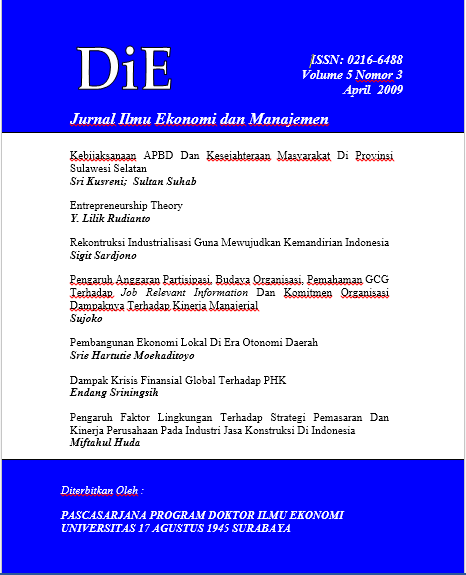
PEMBANGUNAN EKONOMI LOKAL DI ERA OTONOMI DAERAH
DOI:
https://doi.org/10.30996/die.v5i3.75Abstract
Past experience on the economic crisis the important priority agenda is recovery sustainability and effective economic the implementative whose relevance on region autonomy is the pattern of citizen economic development.
The short term priority of economic national development after economic crisis focused on the faster of economic recovery with citizen empowerment, and several programs for anticipated the problem of hegher poverty and unemployment on the economic crisis.
The approach of citizen empowerment activity in small business enterprise must be focused to relevance implementation. Local government is designer of strategic economic sector emporment through build of modelling with appropriate.
The position of micro, small and medium business is very important because this endure depressed in real business economic sector government is institution whose responsive to captive, development and empowerment.
Economic development strategy used primary concept of local autonomy with accomodate citizen economic development concepts. Economic activity is business whose done by citizenship in the self management of resources, called micro, small, and medium business enterprises.
Â
Keyword :   Strategic of business – Empowerment of citizenship – economic development.Â
Downloads
References
Agustiani, H. (2009). Psikologi Perkemba-ngan (Pendekatan Ekologi Kaitannya dengan Konsep Diri dan Penyesuaian Diri pada Remaja). Cetakan Kedua. Penerbit PT Refika Aditama. Bandung
Burns, R.B. (1993). Konsep Diri Teori, Pengukuran, Perkembangan dan Perila-ku. Arcan. Jakarta.
Data kenakalan remajaPolda Jatim selama tahun 2011. (Jawa Pos, 6 Pebruari 2012)
Hidayati, N.W. (2009). Hubungan Antara Harga Diri Dan Konformitas Teman Sebaya Dengan Kenakalan Remaja. Tesis. Universitas Tujuh belas Agustus 1945. Surabaya.
Hurlock, E.B. (1988). Perkembangan Anak Jilid 1.Edisi keenam. Erlangga. Jakarta.
Kartono, K. (2010). Kenakalan Remaja Pato-logi Sosial 2. Jakarta: Raja Grafindo Re-maja.
Lamri, (2011). Hubungan Antara Perhatian Orang Tua Dan Konformitas Teman Seba-ya Terhadap Kenakalan Remaja. Tesis. Universitas Tujuh belas Agustus 1945. Surabaya.
Maria,U.(2007). Peran Persepsi Keharmoni-san Keluarga dan Konsep Diri Terhadap Kecenderungan Kenakalan Remaja. Nas-kah Publikasi. http:// www. damandiri.or. id/file.pdf.Tesis diunduh, 20 Juli 2012.
Mulyasri. D. (2010). Kenakalan Remaja Di-tinjau Dari Persepsi Remaja Terhadap Ke-harmonisan Keluarga Dan Konformitas Teman Sebaya. Tesis. Universitas 11 Ma-ret. Surakarta.
Perkelahian pelajar SMK Pasundan dengan gabungan SMK Siliwangi dan SMK Karti-ka di lapangan Merdeka, Sukabumi, Jawa Barat. inilah.com/Budiyanto, 11 Pebruari 2012.
Pieter, H.Z, Janiwarti B, Saragih Ns.M (2011). Pengantar Psikopatologi Untuk Keperawatan. Kencana Prenada Media Group.Jakarta.
Rahim, A. (2009). Pengaruh Persepsi Kehar-monisan Keluarga Dan Konsep Diri Ter-hadap Kecenderungan Kenakalan Remaja. Jurnal. Fenomena, Vol 8, no 1. Maret 2009. http://isjd.pdii.lipi.go.id/admin/jur nal/8109131162_1412-5420. pdf Diunduh 5 Juni 2012.
Santrock, J.W. (2003). Perkembangan Rema-ja. Penerbit Erlangga Jakarta.
Sofia, K. (2007). Pengaruh Konsep Diri Ter-hadap Tingkat Kecemasan Menghadapi Masa Pensiun Pada Pegawai Negeri Sipil Dinas Perindustrian, Perdagangan dan Pe-nanaman Modal Kabupaten Sumenep. Skripsi. Fakultas Psikologi Universitas Islam Negeri Malang.
Sukmawati. (2012). Konsep Diri dengan Konformitas Teman Sebaya pada Akti-vitas Clubing. Jurnal Undip.
Tedeschi,Lindskold,Rosenfelt,(1985). Introduction to Social Psychology. West Publishing Company. St.Paul. New york. Los Angelos. San Franscisco
Tohir, S. (2011). Hubungan Antara Religiusi-tas Dan Konsep Diri Dengan Kenakalan Remaja.Tesis. Universitas Tujuh Belas Agustus 1945. Surabaya.
Downloads
Published
Issue
Section
License
The author who will publish the manuscript at DiE: Jurnal Ilmu Ekonomi dan Manajemen, agree to the following terms:
1. Authors retain copyright and grant the journal right of first publication with the work simultaneously licensed under a Creative Commons Attribution ShareAlike License that allows others to share the work with an acknowledgment of the work's authorship and initial publication in this journal.
2. Authors are able to enter into separate, additional contractual arrangements for the non-exclusive distribution of the journal's published version of the work (e.g., post it to an institutional repository or publish it in a book), with an acknowledgment of its initial publication in this journal.
3. Authors are permitted and encouraged to post their work online (e.g., in institutional repositories, pre-prints sites or on their website) prior to and during the submission process, as it can lead to productive exchanges, as well as earlier and greater dissemination of published work