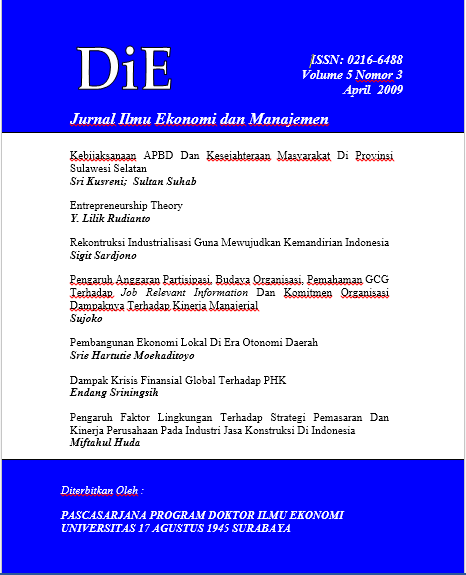
DAMPAK KRISIS FINANSIAL GLOBAL TERHADAP PHK
DOI:
https://doi.org/10.30996/die.v5i3.76Abstract
Crisis financial happened in latter months truly begin inUnited States. But the impact or effect to other nations, includingIndonesia, cannot be obviated. Many circle of predicting this crisis inIndonesiawill start felt in the year next. Possibly continue until year 2010. The decline of material requisition inAmericanStateand Japan for State of purpose ofIndonesiaexporting result the light sectors this exporting and result threat disconnection of job everywhere. So also some the companies inSurabaya, there is about 11 company, they have raised PHK to the employees, is mostly is medium scale company.
Â
Crisis knocking over in this time still early. Estimate, crisis culminate at mid of knowing 2009. In this time sector is real will feel guncangan very heavy. For anticipating kemungkinahn crisis obsolesce financial the is global have to be looked by the solution, is more than anything else cure of economics inIndonesianot so strong. This thing is seen fromIndonesiaforeign exchange reserve which still weakens. At least, butuh time of two until three year for returning was normal. To break this financial crisis impact of government require to do inter alia: (1) Government have to pay attention to UMKM, (2) Program Nasional Pemberdayaan Masyarakat (PNPM), (3) Reinforcement Of Performance Exported, and (4) Strengthen Economics Base on independence.
Â
Keyword: Global crisis impact and PHK
Downloads
References
Aditama, T (2006). Efek self leadership terhadap efektivitas pengendalian ab-sensi pada Karyawan di PT. Telkom Divisi Regional Jawa Timur. Skripsi, tidak diterbitkan, Fakultas Psikologi Universitas Surabaya, Surabaya.
Ahmadi, A (2002). Psikologi Sosial. Ja-karta: Penerbit P.T. Rineka Cipta.
Alwisol, (2005) Psikologi Kepribadian. Malang: Universitas Muhammadiyah
Azwar, S. (2003). Sikap manusia: Teori dan pengukurannya (edisi kedua, ceta-kan keempat). Yogyakarta: Pustaka Pelajar.
Azwar, S. (2005). Penyusunan skala Psi-kologi (edisi pertama, cetakan kedua). Yogyakarta : Pustaka Pelajar.
Boutler, L.T (2008). Self concept as pre-dictor of college freshman academic adjustment. College Student Journal. vol 36, p. 234–246. diambil dari http:// www.findarticles.com/p/-articles/ mi_moFCR/is_2_36/ai_89809974
Chaplin, W (1995), Kamus Psikologi. Ja-karta : Radja Grafindo Persada.
Costin, W & Dragun, M. (2001). Citizen, Organisation of Behaviour Learning Theory.. diakses 26 Maret 2006.dari Http://www.idealibrary.-com/on_arti cles_htm.
Friedlander, L., Graham, R.J,. Naomi, S., & Cribbie, R., (2007). Social Support, Self Esteem, and Stress as Predictors of Adjustment Among First-Year Under-graduates. Journal of College Student Development, Volume 48, Number 3, pp. 259-274.
Grasha, A.F & Kirschenbaum, D.S. (1980). Psychology of adjustment and compe-tence. Cambridge, massachucetts : Win-throp publisher, Inc
Hadi, S. (2000). Statistik 2. Jogjakarta : Andi Offset
Hartana, S (2004). Menerapkan Sistem Kredit di Sekolah. www.suaramer-deka. com/wacana/pendidikan-indon/ html
Hutabarat, J, dan Sudibyo, A (2007). Cara belajar. Pedoman praktis untuk belajar secara efektif dan efisien pegangan bagi siapa saja yang belajar di perguruan tinggi. Jakarta : PT. BPK Gunung Mu-lia.
Karinasari, (2009). Self imposed strategy pada mahasiswa yang terlambat menye-lesaikan studi. Skripsi, Sarjana Strata 1, tidak diterbitkan, Surabaya: Fakultas Psikologi Universitas Surabaya.
Kartono, K dan Rooijakkers (1997). Ka-mus Psikologi. Cetakan pertama. Ban-dung : Penerbit CV. Pionir Jaya.
Kenenbudy, S.M (2008). Penyesuaian aka-demik dan dukungan sosial pada tahun pertama menjadi mahasiswa. Skripsi, Sarjana Strata 1, tidak diterbitkan, Su-rabaya: Fakultas Psikologi Universitas Katolik Widya Mandala Surabaya.
Kens, J.F & Manz, C.C (1996). Thought self-leadership: the impact of mental strategies training on employee beha-vior, cognition and emotion, Journal of Organizational Behavior, Vol. 17, pp. 445-67.
Mahardika, (2003). “30 menit mengenal cara belajar efektif di perguruan tinggiâ€. Solo : Pondok Edukasi.
Manz, C. C. (2006). The Art of Self Lea-dership. New Jersey: Prentice-Hall.
Matsumoto (2005). Pengantar Psikologi Lintas Budaya. Yogyakarta: Pustaka Pelajar.
McGinnis, L. A. (1998). Kekuatan Opti-misme. Jakarta: PT. Gramedia Pustaka.
Mujiran.P., (2002). Pernak-pernik Pen-didikan–Manifestasi dalam Kelarga, Sekolah, dan Penyadaran Gender. Yog-yakarta: Penerbit Pustaka Pelajar
Munandar, AS. (2004). Psikologi Indus-tri dan Organisasi. Lembaga Pengem-bangan Sarana Pengukuran dan Pendi-dikan Psikologi (LPSP3) Jakarta: Fa-kultas Psikologi Universitas Indonesia.
Nawawi. M (2000). Manajemen Sumber Daya Manusia: Untuk Bisnis Yang Kompetitif. Yogyakarta: Universitas Gajah Mada Press
Neck, C.P., N, Manz, C.C & Godwin, J.L (1996). "Thought self-leadership: the impact of mental strategies training on employee behavior, cognition and emo-tion", Journal of Organizational Beha-vior, Vol. 17, pp. 445-67.
Downloads
Published
Issue
Section
License
The author who will publish the manuscript at DiE: Jurnal Ilmu Ekonomi dan Manajemen, agree to the following terms:
1. Authors retain copyright and grant the journal right of first publication with the work simultaneously licensed under a Creative Commons Attribution ShareAlike License that allows others to share the work with an acknowledgment of the work's authorship and initial publication in this journal.
2. Authors are able to enter into separate, additional contractual arrangements for the non-exclusive distribution of the journal's published version of the work (e.g., post it to an institutional repository or publish it in a book), with an acknowledgment of its initial publication in this journal.
3. Authors are permitted and encouraged to post their work online (e.g., in institutional repositories, pre-prints sites or on their website) prior to and during the submission process, as it can lead to productive exchanges, as well as earlier and greater dissemination of published work