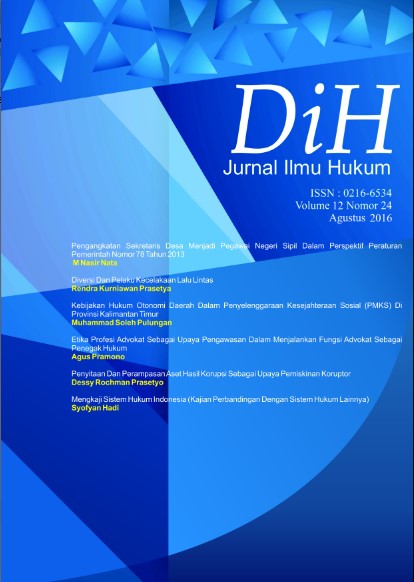
PENGANGKATAN SEKRETARIS DESA MENJADI PEGAWAI NEGERI SIPIL DALAM PERSPEKTIF PERATURAN PEMERINTAH NOMOR 78 TAHUN 2013
DOI:
https://doi.org/10.30996/dih.v12i24.2239Keywords:
ratio, legis, village secretaryAbstract
Since the enactment of the Act Number 32 of the Year 2004 regarding Regional Government, especially after the enactment of the Government Regulation Number 48 of the Year 2005 regarding the Appointment of the Honorary Employees to become the candidates of civil servants, the implementation of village administration began to be problematic. This problem is caused by the demands of the Village Head and Village Secretary for equal rights to be equalized with the Civil Servants. This demand implicates the birth of the Government Regulation Number 45 of the Year 2007 on the Requirements and Procedures for the Appointment of a Village Secretary to be a Civil Servant, and theoretically this regulation contradicts the Government Regulation Number 78 of the Year 2013 on the Second Amendment of the Government Regulation Number 98 of the Year 2000 on the Procurement of Civil Servants. Based on the background of this study, the problems are formulated as follows: 1) What is the ratio legis of the appointment of the Village Secretary to be a civil servant in the perspective of the Government Regulation Number 78 of the Year 2013, and 2) What is the reason of the appointment of the Village Secretary to be a civil servant? The formulation of this problem aims to analyze and to find the ratio of legis and the ratio decidendi of the appointment of the Village Secretary to be a Civil Servant in the perspective of the Government Regulation Number 78 of the Year 2013. Problem analysis of this study indicates that the ratio legis of the appointment of the Village Secretary to be a civil servant is based on the reason that government has an authority to appoint a civil servant, while the reason of the appointment of the Village Secretary to become a civil servant is that it is in accordance with justice principle and legal certainty, that is to satisfy the sense of justice in the society. In order not to cause multiple interpretations, the appointment of civil servants in all sectors should be based on common ground regulation, and the Secretary of the Village should indeed be appointed from the element of civil servants.
Downloads
References
DAFTAR PUSTAKA
Abdullah, Syukriy dan Halim Abdul, 2004. “Pengaruh Dana Alokasi Umum (DAU) dan Pendapatan Asli Daerah (PAD) terhadap Belanja Pemerintah Daerah : Studi Kasus Kabupaten/ Kota di Jawa dan Baliâ€, Proceeding Simposium Nasional Akuntansi VI, 16-17 Oktober 2003, Surabaya, hal. 1140.
Abdul Halim.2008. Auditing (dasar-dasar Audit Laporan Keuangan). UUP STIM
Adi Priyo Hari, 2006. “Hubungan Antara Pertumbuhan Ekonomi Daerah, Belanja Pembangunan dan Pendapatan Asli Daerah, Studi pada Kabupaten dan Kota se Jawa-Baliâ€, Simposium Nasional Akuntansi IX. Padang.
Adi, Priyo Hari. 2007. “Kemampuan Keuangan Daerah dan Relevansinya dengan Pertumbuhan Ekonomiâ€. The 1st National Accoounting Conference. Departemen Akuntansi, Fakultas Ekonomi Universitas Indonesia. Jakarta.
Ahyani, Wahid. 2010. Analisis Pengaruh Pendapatan Asli Daerah Dan Belanja Daerah Terhadap Pertumbuhan Ekonomi Daerah, Dan Pengganguran Pasca Pelaksanaan Otonomi Daerah (Studi Kasus Pada Kabupaten Dan Kota Provinsi Jawa Tengah). Skripsi, Tidak Dipublikasikan. Universitas Brawijaya
Bastian, Indra. 2001. Akuntansi Sektor Publik. Penerbit BPFE, Universitas Gajah Mada, Yogyakarta.
BPS, Statistik Jawa Timur dalam Angka, Surabaya: Jawa Timur, Badan Pusat Statistik.
Darsono dan Ashari. 2010. Pedoman Praktis Memahami Laporan Keuangan (Tips Bagi
Investor, Direksi, dan Pemegang Saham). Penerbit Andi. Yogyakarta. Ghozali, I. 2007.
Jaya, W.K., 1996, “Analisis Keuangan Daerah; Pendekatan Makroâ€, Model Program PMSES, Kerjasama Ditjrn PUOD Depdagri dengan Pusat Penelitian dan Pengkajian Ekonomi dan Bisnis, UGM, Yogyakarta
Kawedar, warsito dkk, 2008. Akuntansi Sektor Publik, Semarang UNDIP
Maharani, Astri Dhiah, Analisis Pengaruh Kepercayaan dan Kepuasan Terhadap Loyalitas Nasabah Tabungan Bank Mega Syariah Cabang Semarang, Semarang: Universitas Diponegoro Semarang, 2010
Mamesah DJ Sistem Administrasi Keuangan Daerah Gramedia Pustaka Utama Jakarta 1995
Mardiasmo, 2002. “Otonomi Daerah Sebagai Upaya Memperkokoh Basis Perekonomian Daerahâ€. Makalah. Seminar Pendalaman Ekonomi Rakyat.
Mardiasmo, 2004. Otonomi dan Manajemen Keuangan Daerah. Andi. Yogyakarta.
Penyusunan dan penetapan APBN dan APBD menurut UU No. 17 Tahun 2003
Republik Indonesia Peraturan Pemerintah Nomor 105 tahin 2000 tentang dana perimbangan
Republik Indonesia Peraturan Pemerintah Nomor 105 tahin 2000 tentang pengelolaan dan pertanggung jawaban keuangan daerah
Thesaurianto, Kuncoro. 2007. “Analisis Pengelolaan Keuangan Daerah Terhadap Kemandirian Daerahâ€. Tesis S2 Program Pasca Sarjana Fakultas Ekonomi Universitas Diponegoro Semarang
Undang-Undang No. 33 Tahun 2004, Tentang Perimbangan Keuangan Antara Pemerintah Pusat dan Pemerintah Daerah
______________. 2004. Jurnal Ekonomi Pembangunan. Vol. 5, No. 2, Desember 2004, hal. 147-159.
______________, 2004, Ekonomi Pembangunan, Edisi Keempat, Yogyakarta: STIE YKPN.
______________, Statistik Propinsi Jawa Timur dalam Angka, Surabaya: Jawa Timur, Badan Pusat Statistik.
______________. 2004. Jurnal Ekonomi Pembangunan. Vol. 5, No. 2, Desember 2004, hal. 147-159.
______________, 2004, Ekonomi Pembangunan, Edisi Keempat, Yogyakarta: STIE YKPN.
BPS, Statistik Jawa Timur dalam Angka, Surabaya: Jawa Timur, Badan Pusat Statistik.
______________, Statistik Propinsi Jawa Timur dalam Angka, Surabaya: Jawa Timur, Badan Pusat Statistik.
(http://tesismanajemen.com/manajemen-keuangan-daerah)
(http://chandraekapurwanto.blogspot.co.id/2013/03/normal-0-false-false-false-en-us-x-none.html)
(https://www.scribd.com/doc/98370085/ Analisis-Apbd-Provinsi-Jawa-Timur)
Downloads
Published
Issue
Section
License
Authors who publish with DiH: Jurnal Ilmu Hukum agree to the following terms:
- Authors transfer the copyright and grant the journal right of first publication with the work simultaneously licensed under a CC BY-SA 4.0 that allows others to share the work with an acknowledgement of the work's authorship and initial publication in this journal.
- Authors are able to enter into separate, additional contractual arrangements for the non-exclusive distribution of the journal's published version of the work (e.g., post it to an institutional repository or publish it in a book), with an acknowledgement of its initial publication in this journal.
- Authors are permitted and encouraged to post their work online (e.g., in institutional repositories or on their website) prior to and during the submission process, as it can lead to productive exchanges, as well as earlier and greater citation of published work (See The Effect of Open Access)