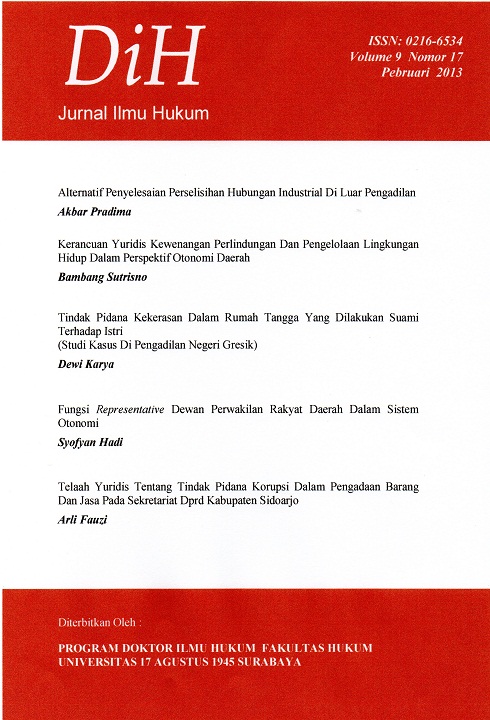
TINDAK PIDANA KEKERASAN DALAM RUMAH TANGGA YANG DILAKUKAN SUAMI TERHADAP ISTRI (Studi Kasus Di Pengadilan Negeri Gresik)
DOI:
https://doi.org/10.30996/dih.v9i17.248Abstract
Korban kekerasan dalam rumah tangga yang kebanyakan adalah perempuan harus mendapat perlindungan dari negara dan atau masyarakat, agar terhindar dan terbebas dari kekerasan penyiksaan atau perlakuan yang merendahkan derajad dan martabat kemanusiaan. Kekerasan dalam rumah tangga khususnya kekerasan yang dilakukan suami terhadap istri , tidak hanya menimbulkan penderitaan fisik tetapi juga penderitaan psikis. Oleh karena itu korban KDRT harus mendapat perlindungan secara maksimal.Kekerasan dalam rumah tangga yang dilakukan suami terhadap istrinya dikategorikan sebagai perbuatan pidana karena terdapat kelakuan yang dilarang dan bersifat melanggar hukum, sehingga perbuatan itu mengandung sanksi yang dikenakan bagi yang melanggar larangan tersebut. Penelitian ini berusaha membahas permasalahan apakah ketentuan Pasal 44 Undang-undang Nomor 23 Tahun 2004 Tentang Penghapusan Kekerasan dalam Rumah Tangga menjadi dasar bagi hakim dalam memutus perkara kekerasan dalam rumah tangga di Pengadilan Negeri Gresik serta apakah yang mempengaruhi terjadinya kekerasan dalam rumah tangga.
Kata kunci : tindak pidana, kekerasan dalam rumah tangga
Downloads
References
Adelman, G. 1992. Jude the Obscure: A Paradise of Despair. New York: Twayne Publisher.
Brennecke, H. J. & Amick, G. R. 1978. Personality Adjustment. Canada: Glencoe Publishing Lo. Inc.
Garlikov, R. June 21, 2000. Guilt and Forgiveness. March 23, 2011. http://www.garlikov. com/guilt.html
Hall, E. 1983. Psychology Today: An Introduction. New York: Random House Inc.
Hardy, T. 1998. Jude the Obscure. New York: Oxford University Press Inc.
Hasan, N. 1982. Jude the Obscure. United Kingdom: The Macmillan Press.
Holloway, I. 1997. Concept for Qualitative Research. Oxford: Blackwell Science Ltd.
Holman, C. H. 1986. A Handbook to Literature. New York: Macmillan Publishing Company.
Johnson, B. & Christensen, L. 1941. Eduucational Research: Quantitative, Qualitative, and mixed Approaches. London: Sage Publication Ltd.
Katchadourian, H. 2010. Guilt: The Bite of Conscience. California: Stanford University Press.
Lazarescu, R. L. 2003. Elements of Literature. March 10, 2011. http://www.cocc.edu/lisal/ literaryterms/elements¬_of_literature.html
Little, G. 1969. Approach to Literature. Boston: Houghten Nifflin Company.
Mayhead, R. 1978. Thomas Hardy. Melbourne, Sydney, Australia: Cambridge University.
Millgate, M. 1982. Thomas Hardy: A Biography. United States of America: Oxford University Press.
Paris, B.J. 1997. Imagined Human Beings: A Psychological Approach to Character and Conflict in Literature. New York and London: New York University Press.
Sterk, F. & Swan, S. 2009. Quit Feeling so Guilty!. Netherland: The Hague.
Tucker, E. C. Theory about the Causes of Depression. March 23, 2011. http://www. mentalhelp.net/psyhelp/chap6/chap6i.htm
Perrine, L. 1970. Story and Structure. New York: Harcourl, Brace and World Inc.
Pickering, H. J. & Hoeper, D. J. 1981. Concise Companion to Literature. New York: Mac Millan Publishing Co.
Pooley, R. C. 1975. England in Literature: Exploring Life through Literature. New York: Scott Foresmen.
Roberts, V. E. 1977. Writing Themes about Literature. London: Prentice-Hall, Inc.
Roberts, V. E. & Henry, J. A. 1986. An Introduction to Reading and Writing. New Jersey: Prentice Hall Inc.
Downloads
Published
Issue
Section
License
Authors who publish with DiH: Jurnal Ilmu Hukum agree to the following terms:
- Authors transfer the copyright and grant the journal right of first publication with the work simultaneously licensed under a CC BY-SA 4.0 that allows others to share the work with an acknowledgement of the work's authorship and initial publication in this journal.
- Authors are able to enter into separate, additional contractual arrangements for the non-exclusive distribution of the journal's published version of the work (e.g., post it to an institutional repository or publish it in a book), with an acknowledgement of its initial publication in this journal.
- Authors are permitted and encouraged to post their work online (e.g., in institutional repositories or on their website) prior to and during the submission process, as it can lead to productive exchanges, as well as earlier and greater citation of published work (See The Effect of Open Access)