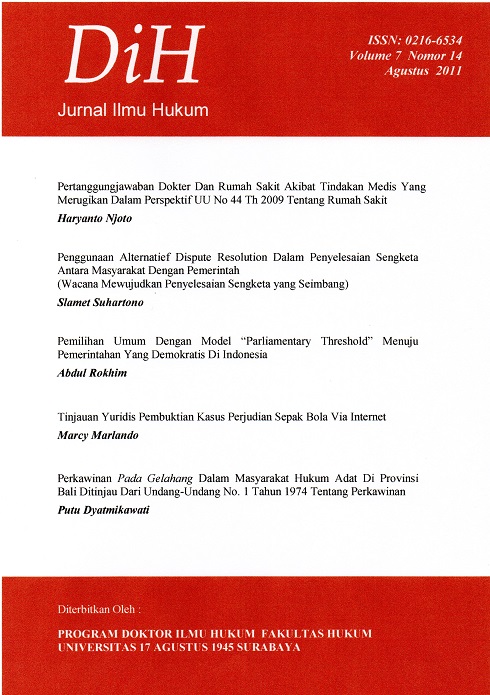
PEMILIHAN UMUM DENGAN MODEL “PARLIAMENTARY THRESHOLD†MENUJU PEMERINTAHAN YANG DEMOKRATIS DI INDONESIA
DOI:
https://doi.org/10.30996/dih.v7i14.266Abstract
Law Number 10 of 2008 as organic statute, as more comprehensive statute and comply with answering problem challenge in running general election.General election as democratic party, as symbol and also as democracy landmark. In the other side, general election as one of foremost means to reinforcing democracy living order which function as health instrument and accomplishing democracy, not as democracy aims. General election with parliamentary threshold 25% unable to realizes democratic government in Indonesia. Cause combination between presidential government system and multiparty system proved that emerging instability political, then president position become weak. Indonesia democratic parliamentary threshold in order to form legitimate governmental, by improving parliamentary threshold from 2,5 percent gradually.
Keywords: general election, democracy, parliamentary thresholdDownloads
References
Ahmadi, Abu., Psikologi Sosial, Jakarta, PT Rineka Cipta.
Alwi, Syafaruddin, 2001. Manajemen Sumber Daya Manusia Strategi Keunggulan Kom-petitif. Edisi Pertama. Yogyakarta: BPFE- Yogyakarta.
Ariyasa I Gede, 2007. Analisis Determinasi Tentang Kompetensi, Komitmen Karir, Pengendalian Kerja, dan Kepuasan Kerja Guru Terhadap Pengembangan Profesi Guru SMA Negeri di Kabupaten Karang-asem. Tesis, Universitas Pendidikan Gane-sha Negeri Singaraja.
Anoraga, Panji, 1992. Psikologi Kerja. Jakar-ta: Rineka Cipta.
Anderson, J.S., & Prussia, G.E., 1997. The Self Leadership Questionare. The Journal Self Leadership Studies, 4. 119 – 143.
Balanchard, K. et al., 2006. Self Leadership and the One Minute Manager. Jakarta: PT. Gramedia Pustaka Utama.
Beck, Ulrich, 2002. Losing the Traditional: Individualization and Precarious Free-doms. Individualization. London: SAGE Publications. pp. 1-21.
Beer, M, Spector, B, Lawrence, P, Quinn Mills, D and Walton, R, 1984, Managing Human Assets, The Free Press, New York
Buchari Alma, 2010. Guru Profesional (Me-nguasai Metoda dan Terampil Menga-jar). Bandung: Alfabeta.
Byars, L. L. dan Rue. I. W.(1997). Human Resource Management.5th Edition. Chicago: The McGraw-Hill Companies, Inc.
Cooper, D.R & Emory, W., 1996.Metoda Pe-nelitian Bisnis. (Terjemahan), I, II, Jakarta: Erlangga.
Covey, Stephen R. 1997.The 7 Habits of Highly Effective People (7 Kebiasaan Ma-nusia yang Sangat Efektif).Jakarta: Bina-rupa Aksara.
Ghozali, H. Imam, 2012. Model Persamaan Struktural Konsep dan Aplikasi dengan Pro-gram Amos 19.00. Semarang : Badan Pe-nerbit Undip.
Ivancevich, J.M. (2005). Human Resource Management: Foundations of Personnel.5th Edition. Boston: Richard F. Irwm, Inc.
Kunandar, 2007.Guru Profesional. Implemen-tasi Kurikulum Tingkat Satuan Pendidikan (KTSP) dan Sukses dalam Sertifikasi Guru. Rajawali Pers Divisi Buku Perguruan Tinggi PT.RajaGrafindo Persada.
Kreitner, Robert &Kiniki Angelo, 2003, Peri-laku Organisasi, Buku I, Salemba Empat, Jakarta.
Meyer, J.P., & Allen, N. J. 1997 Commitment in the Workplease Theory Research and Application. California : Academic Press.
Robbins, SP., 2006. Prilaku Organisasi: Kontroversi, Aplikasi, Edisi Bahasa Indone-sia, Jilid 2, Jakarta : Penerbit PT. Preha-lindo, Jakarta.
Sahertian dan Aleida Sahertian, 1990, Super-visi Pendidikan dalam Rangka Program Inservice Education; Jakarta. Rineka Cipta.
Sugiyono. 2012. Metode Untuk Penelitian Administrasi Dilengkapi dengan Metode R&D. CV. Alfabeta. Bandung.
Sutrisno, Hadi, 2004, Pengaruh Faktor Kepe-mimpinan Transformasional terhadap Ke-puasan Kerja, Komitmen Organisasi, dan Perilaku Ekstra Peran, Laporan Penelitian, STIE Al-Anwar, Mojokerto.
Schuster, F. E. (1985). Human Resource Management: Concept, Cases and Rea-dings.2nd Edition.Virgini: Rest and Publi-shing Company, Inc. A Prentice-Hall Com-pany.
Published
Issue
Section
License
Authors who publish with DiH: Jurnal Ilmu Hukum agree to the following terms:
- Authors transfer the copyright and grant the journal right of first publication with the work simultaneously licensed under a CC BY-SA 4.0 that allows others to share the work with an acknowledgement of the work's authorship and initial publication in this journal.
- Authors are able to enter into separate, additional contractual arrangements for the non-exclusive distribution of the journal's published version of the work (e.g., post it to an institutional repository or publish it in a book), with an acknowledgement of its initial publication in this journal.
- Authors are permitted and encouraged to post their work online (e.g., in institutional repositories or on their website) prior to and during the submission process, as it can lead to productive exchanges, as well as earlier and greater citation of published work (See The Effect of Open Access)