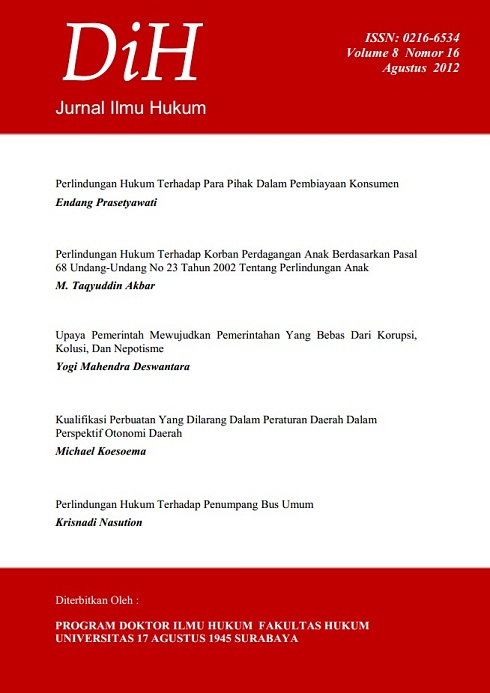
KUALIFIKASI PERBUATAN YANG DILARANG DALAM PERATURAN DAERAH DALAM PERSPEKTIF OTONOMI DAERAH
DOI:
https://doi.org/10.30996/dih.v8i16.270Abstract
Abstrak Era reformasi membawa perubahan paradigma dari pemerintahan yang sentralistik ke pemerintahan yang desentralisasi. Pergeseran paradigma ini menyebabkan perencanaan pembangunan yang dulunya bersifat top down menjadi buttom up. Pembangunan yang bersifat top down ditetapkan oleh pusat, perencanaan maupun pembiayaannya juga ruang lingkup kewenangan pusat, daerah sebagai obyek daripada pembangunan kondisi ini sering menyebabkan pembangunan yang dilaksanakan di daerah bersifat asing ataua tidak bermanfaat bagi perkembangan maupun kesejahteraan masyarakat. Dalam era otonomi daerah, daerah diberi kesempatan seluas-luasnya untuk mengatur urusan rumah tangga, disamping hal-hal yang menjadi urusan pemerintahan pusat. Dalam rangka pelaksanaan otonomi daerah, daerah diberi kewenangan untuk membuat Perda, Perda tersebut merupakan penjabaran dari Undang-Undang, delegasi Undang-Undang maupun inisiatif daerah untuk mengatur urusan rumah tangga. Dengan adanya Perda Pemerintah Daerah diberi kesempatan untuk mengembangkan potensi daerah seluas-luasnya untuk kesejahteran daerah dalam bingkai NKRI.
Keywords : Perbuatan, Peraturan Daerah, Otonomi Daerah.
Downloads
References
Abels, E. G, White, M. D. and Hann, K. (1999) “A user-based design process for Web sites, †OCLC Systems & Services, 15 (1), pp.35-44.
Bollen, K. A. (1989). Structural equations with latent variables. New York: John Wiley & Sons.
Byrne, B. M. (2001), Structural Equation Modeling with AMOS: Basic Concepts, Applications, and Programming, Lawrence Erl baum Associates, Mahwah, NJ.
Chang, H. H. (2005). “The influence of continuous improvement and performance factors in total quality organization,†Total Quality Management & Business Excel-lence, 16 (3), pp.413-437.
Corritore C., Kracher B., & Wiedenbeck S. (2003). On-line trust: Concepts, evolving themes, a model. International Journal of Human Computer Studies, 58, 737-58.
Cronin Jr., J. J., Taylor, S. A. (1994). “SERVPERF Versus SERVQUAL: Recon-ciling Performance-Based and Perceptions-Minus-Expectations Measurement of Servi-ce Quality,†Journal of Marketing, 58 (1), pp.125-131.
Cyr, D. (2008) “Modeling Web Site Design Across Cultures Relationships to Trust, Satisfaction, and E-loyalty,†Journal of Management Information Systems, 24 (4), pp.47-72.
Davis, F. D. (1989). “Perceived Usefulness, Perceived Ease of Use, and User Accep-tance of Information Technology,†MIS Quarterly September, pp.319-340.
Fornell, C. R. and D. F. Larcker (1981), “Evaluating Structural Equation Models with Unobservable Variables and Measure-ment Error.†Journal of Marketing Rese-arch, 18 (1), pp.39-50.
Hair, J. F. Jr., Anderson, R. E. Tatham, R. L., and Black, W. C. (1992). “Multivariate data analysis with reading, 3rd edition,†New York, NY: Macmillan Publishing Compa-ny.
Henderson, R., Rickwood, D., & Roberts, P. (1998). “The beta test of an electronic supermarket,†Interacting with Computers, 10(6), pp.385-399.
Hofstede, G. & Bond, M. (1988). “The Confu-cius Connection: From Cultural Roots to Economic growth,†Organizational Dyna-mics, 16 (4), pp.4-21.
Hofstede, G. (1984). Culture’s consequences: International differences in work-related values. Newbury Park, CA: Sage.
Hofstede, G. Cultural Dimensions, Retrieved from: http://www.geert-hofstede.com/
Hofstede, G. Retrieved from: http://www.geer-thofstede.nl/index.aspx.
Internet Usage and World Population Statis-tics, Retrieved from: http://www.internet-worldstats.com/stats.htm.
Jarvenpaa, S. L., Tractinsky, N., and Vitale, M. (2000), “Consumer Trust in an Internet Store,†Information Technology and Mana-gement, 1, pp.45-71.
Kim, D. J. (2008) “Self-Perception-Based Versus Transference-Based Trust Deter-minants in Computer-Mediated Transac-tions: A cross-Cultural Comparison Study,†Journal of Management Information Sys-tems, 24(4), pp.13-45.
Kuo, Y. F., Wu, C. M. & Deng, W. J. (2009). "The Relationships among Service Quality, Perceived Value, Customer Satisfaction, and Post-Purchase Intention in Mobile Value-added Services,†Computers in Human Behavior 25, pp. 887-896.
Lohse, G.L. and Spiller, P. (1998). “Electronic shopping,†Communications of the ACM, 41(7), pp.81-87.
Malaysia Communications and Multimedia Commission, “Household Use of Internet Survey 2008â€, Retrieved date (2010/05/15).
Malaysia Crunch, Malaysia's E-Commerce Statistics, Retrieved from http://malaysia-crunch.blogspot.com/2009/09/malaysias-e-commerce-statistics.html
Nielson, Retrieved from: http://www.nielsen-online.com/intlpage.html. Oliver, R. L. (1981). “Measurement and Evaluation of Satisfaction Processes in Retail Settings,†Journal of Retailing, 57(3), pp.25-48.
Parasuraman, A., V. A. Zeithaml & L. L. Berry (1985), “A Conceptual Model of Service Quality and Its Implications for Future Research,†Journal of Marketing, 49, pp. 41-50.
Parasuraman, A., Zeithaml, V.A. and Berry L.L. (1988) “SERVQUAL: a multiple-item scale for measuring consumer perceptions of service qualityâ€, Journal of Retailing, 64, Spring, pp.12-40.
Rust, R. T., and R. C. Oliver. 1994. Service quality: Insights and managerial implica-tions from the frontier. In Service Quality: New Directions in Theory and Practice, ed. Rust, R. T., and R. C. Oliver. London: Sage Publications.
Santos, J. (2003). “E-service quality: a model of virtual service quality dimensions,†Managing Service Quality, 13(3), pp.233-246.
Szymanski, David M., & Hise, Richard T. (2000). E-satisfaction: An initial exami-nation. Journal of Retailing, 76(3), 309-322.
Yang, Z. (2001) “Consumer perceptions of service quality in Internet-based electronic commerce,†Proceedings of the 30th EMAC conference, 8-11 May Bergen.
Downloads
Published
Issue
Section
License
Authors who publish with DiH: Jurnal Ilmu Hukum agree to the following terms:
- Authors transfer the copyright and grant the journal right of first publication with the work simultaneously licensed under a CC BY-SA 4.0 that allows others to share the work with an acknowledgement of the work's authorship and initial publication in this journal.
- Authors are able to enter into separate, additional contractual arrangements for the non-exclusive distribution of the journal's published version of the work (e.g., post it to an institutional repository or publish it in a book), with an acknowledgement of its initial publication in this journal.
- Authors are permitted and encouraged to post their work online (e.g., in institutional repositories or on their website) prior to and during the submission process, as it can lead to productive exchanges, as well as earlier and greater citation of published work (See The Effect of Open Access)