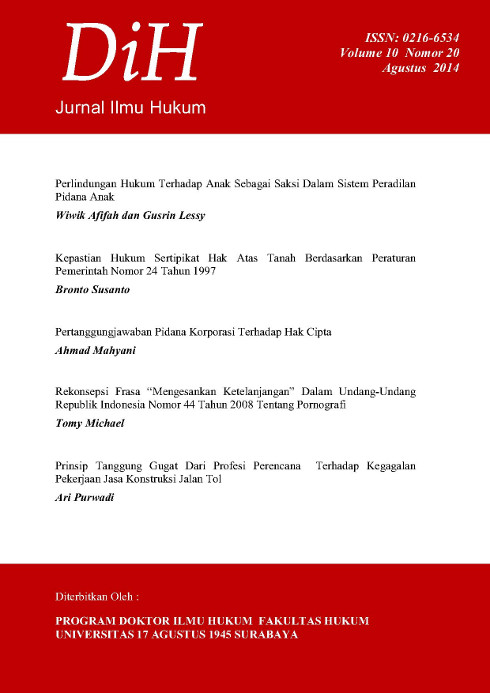
Kepastian Hukum Sertifikat Hak Atas Tanah Berdasarkan Peraturan Pemerintah Nomor 24 Tahun 1997
DOI:
https://doi.org/10.30996/dih.v10i20.359Abstract
Abstrak. Pendaftaran tanah untuk pertama kali berdasarkan PP No. 24 Tahun 1997 tidak menggunakan sistem publikasi negatif murni, tetapi sistem publikasi negatif bertendensi positif. Walaupun demikian, tidak merubah makna bahwa sistem publikasi pendaftaran tanahnya adalah sistem publikasi negatif, artinya Negara tidak menjamin kebenaran data sertipikat, buku tanah, dan surat ukur. Sertipikat hak atas tanah merupakan surat tanda bukti hak yang kuat tetapi tidak mutlak, artinya sertipikat hak atas tanah menjamin kepastian hukum bagi pemiliknya sepanjang sertipikat tersebut: a) diterbitkan atas nama yang berhak, b) hak atas tanahnya diperoleh dengan itikat baik, c) dikuasai secara fisik, dan d) tidak ada pihak lain dapat yang membuktikan sebaliknya. Penelitian ini adalah penelitian hukum yuridis normatif yang bertujuan menganalisis, mengetahui dan memahami penyelenggaraan pendaftaran tanah untuk pertama kali berdasarkan PP No. 24 Tahun 1997 yang menganut sistem publikasi negatif bertendensi positif, dan kepastian hukum sertipikat hak atas tanah yang terbit berdasarkan PP No 24 Tahun 1997.
Kata kunci : PP No. 24 Tahun 1997, Sertipikat Hak Atas Tanah, Pendaftaran Tanah
Downloads
References
Agustiono, L. 2008. Dasar-Dasar Kebijakan Publik. Bandung: CV Alfabeta.
Ahrani, Yair. 1986. Evolution and anagement of State Owned Enterprises. Cambridge, M.A, Ballinger.
Akharuzzaman, Mohammad dan Atsushi Deguchi, Atsushi. 2010. Public Manage-ment for Street Vendor Problems in Dhaka City, Bangladesh. Japan: Proc. of Internati-onal Conference on Environmetal Aspects of Bangladesh (ICEAB10)
Ansell, Chris dan Gash, Alison. 2007. Colla-borative Governance in Theory and Prac-tice, Journal of Public Administration Research and Theory. November, 13, 2007.
Bache, Ian dan Matthew Flinders (eds) 2005. Multi Level Governance. Oxford, USA.
Bardach, E. 1977. The Implementation Game. What Happenes After a Bill Becomes a Law. Cambridge; MIT Press.
Berry, Tanja. 2009. Challenges and Coping Strategies of Female Street Vendors in the Informal Economyâ€. Pretoria: Gordon Institute of Business Science University of Pretoria.
Bogdan, Robert C. & Biklen, Sari Knopp. 1982. Qualitative Research for Education: An Introduction to Theory and Methods. Boston: Allyn and Bacon, Inc.
Borzel, Tinja A. 1998. Organizing Babylon-on the Different Conceptions of Policy Networks. Public Administration, Vol 76, pp.233-73
Bungin, Burhan. 2007. Penelitian Kualitatif: Komunikasi, Ekonomi, Kebijakan Publik, dan Ilmu Soaial Lainnya. Jakarta: Kencana Prenada Media Group.
Brinkerhoff, Derick. W. dan Benyamin L. Crosby. 2002. Managing Policy Reform: Concepts and Tools for Decision-Makers in Developing and Transitioning Countries. Kumarian Press. Bloomfield.
Bryce, Herrington J. 2005. Player in the Public Policy Process: Nonprofits as Social Capital and Agents. Palgrave, McMillan.
Champion D. 1999. Metode dan Masalah Penelitian Sosial, Refika Aditama, Ban-dung.
Collebatch, H. 2002. Policy. Buckingham: Open University Press. London.
Compston, Hugh. 2009. Policy Network and Policy Change: Putting Theory to the Test. Palgrave MacMillan, New York.
Connick, Sarah, and Judith Innes. 2003. Outcomes of Collaborative Water Policy Making: Applying Complexity Thinking to Evaluation. Journal of Enviromental Plan-ning and Management, Vol. 46 pp. 177-97.
Creswell, W. John. 2005. Educational Rese-arch: Planning, Conducting, and Evalua-ting Quantitative and Qualitative Research. Pearson Education International. New Jer-sey. USA.
Downloads
Published
Issue
Section
License
Authors who publish with DiH: Jurnal Ilmu Hukum agree to the following terms:
- Authors transfer the copyright and grant the journal right of first publication with the work simultaneously licensed under a CC BY-SA 4.0 that allows others to share the work with an acknowledgement of the work's authorship and initial publication in this journal.
- Authors are able to enter into separate, additional contractual arrangements for the non-exclusive distribution of the journal's published version of the work (e.g., post it to an institutional repository or publish it in a book), with an acknowledgement of its initial publication in this journal.
- Authors are permitted and encouraged to post their work online (e.g., in institutional repositories or on their website) prior to and during the submission process, as it can lead to productive exchanges, as well as earlier and greater citation of published work (See The Effect of Open Access)