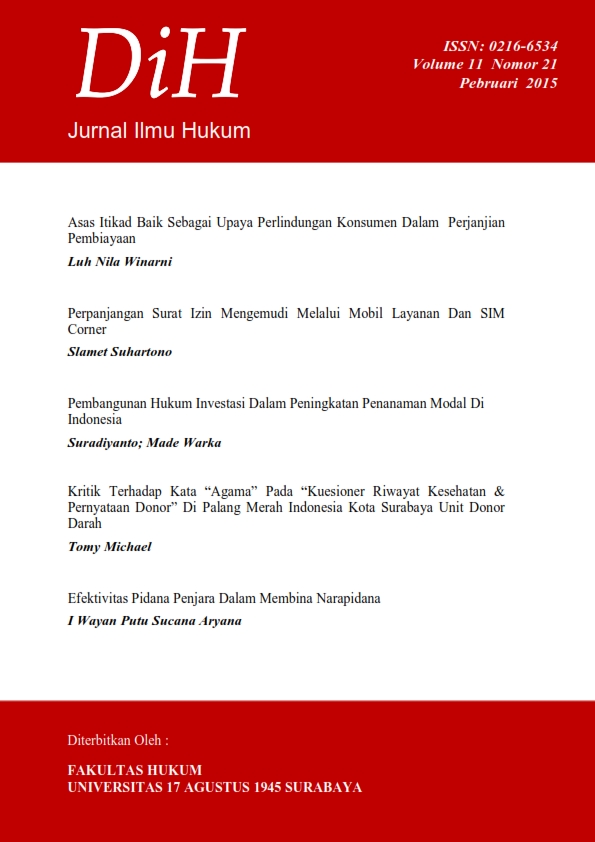
PEMBANGUNAN HUKUM INVESTASI DALAM PENINGKATAN PENANAMAN MODAL DI INDONESIA
DOI:
https://doi.org/10.30996/dih.v11i21.444Abstract
Abstrak: Penanaman modal suatu asing, sangat memepunyai peran yang penting, mengingat suatu Negara yang maju masing membutuhkan penanaman modal, apalagi suatau Negara yang sedang berkembang. Pemerintah Kabupaten dan Kota di seluruh Indonesia, menggali potensi daerahnya masing-masing dalam rangka melakukan promosi-promosi, sehingga akan dapat menarik gaerah penanaman modal dalam berinvestasi. Menindak lanjuti keinginan tersebut, maka Pemerintah Kabupaten/Kota masing-masing mengeluarkan Peraturan Daerah (disebut Perda), dalam rangka meningkatkan Pendapatan Asli Daerah (PAD), tanpa melihat kepentingan masyarakat serta dampak lainnya, Sasaran peningkatan PAD adalah masyarakat dan investor pada umumnya. atas kewenangan daerah Kabupaten/Kota, akhirnya berlomba-lomba mengeluarkan peraturan daerah (Perda) tanpa memperhitungkan aspek-aspek lainnya, yang dapat menghambat penanaman modal di wilayahnya masing-masing. Antara lain peraturan daerah tentang retribusi parkir, retribusi penerangan jalan dan perizinan bidang industri perdagangan dan penanaman modal.
Keywords: Pembangunan Hukum Investasi, Peningkatan Penanaman Modal
Â
Downloads
References
Agus. Teori-teori Motivasi. http://agus.blog chandra.com/teori-teori motivasi.
Agustina, ND. (2012). Perkembangan Kreati-vitas, (Online). http://dheanurulagustina. blogspot.com/2012/01/makalah-perkembang an-kreativitas.html diakses 19 Pebruari 2013
Amabile, T.M. (1985). Motivation and create-vity; Effect of motivational orientation on creative writer. Journal of Personality and social Psychology, 48, 393-399.
Amabile, T. (1987). The motivation to be crea-tive. In S. Isaksen (Ed.), Frontiers of Crea-tivity Research: Beyond the basics, 223-254. Buffalo, NY: Bearly Limited.
Ayan, J. (1997). AHA! 10 ways to free your creative spirit and find your
great ideas. New York; Crown Trade Paper Backs.
Basuki, H. (2006). “pengembangan kreativitas†melalui, http://www.heru.staff. Guna darma .ac.id
Binnewies, Ohly, Niessen (2008). Age and Creativity at Work.The interplay between job recources, age and idea creativity. Journal of Managerial Psychology; 23, 4; 438 – 457
Caray. (2008). Motivasi. http://makalahdans kripsi.bligspot.com/2008/10/motivasi.html
Dewing, K., & Taft, R. (1973). Some Charac-teristics of the parens of creative twelve-year-olds. Journal of Personality, 41, 1, 71-85.
Eisenberger, R., & Shanock, L. (2003). Rewards, intrinsic motivation, and create-vity: A case study of conceptual and metho-dological isolation. Creativity Research Journal,15, 121-130.
European University Association. (2007). Cre-ativity in Higher Education: Report on the UEA Creativity Project 2006 – 2007. Brussels: EUA.
Faye & Sharpe. (2008). Academic Motivation in University: The Role of Basic Psycho-logycal Needs and Identity Formation. Cana-dian Journal of Behaviuoral Science; 40,4; 189 – 199
Flaherty, A.W. (2011). Brain Illness ang Creati-vity: Mechanisms and Treatment Risks. Canadian Journal of Psychiatry; 56, 3; Pg. 132-143
Garliah, Lili dan Nasution, Fatma Kartika Sari. (2005) Peran Pola Asuh Orangtua dalam Motivasi Berprestasi. Psikologia, Volume 1, Nomor 1, Juni 2005
Kiehn, M.T. (2003). Development of Music Creativity among Elementary School Stu-dents. Journal of Research in Music Educa-tion; 51,4; 278 – 288.
Kustiyah. (2010). Pengaruh pola asuh orang tua terhadap kreativitas anak. Naskah Publi-kasi. Depok: Fakultas Psikologi Universitas Gunadarma.
Milyavskaya & McClure. (2012). Attachment Moderates the Effects of Autonomy-Suppotive and Controlling Interpersonal Primes on Intrinsic Motivation. Canadian Journal of Behavioural Science. 44,4 . 278 – 285
Mumford, M.D., Hunter, S.T., & Byrne, C.L. (2009). What Is the Fundamental? TheRole of Cognition in Creativity and innovation. Industrial and Organizational Psychology, 2,3, 353 – 356.
Munandar, U. (1999). Pengembangan Kreativi-tas anak berbakat. Jakarta: Rineka Cipta.
Munandar, S.C.U. (1999). Kreativitas dan Keterbakatan, Strategi
Mewujudkan Bakat Kreatif. Jakarta: Gramedia.
M.M Sutopo, Tjetjep. (2005). Pengembangan Kreativitas Anak. Bandung: Depdiknas.
Niu, W, & Sternberg, R.J. (2003). Societal and School Influences on student creativity: The case of China. Psychology in the schools, 80, 1, 103-114.
Rahman, L.,& Savitri, S. (2011). Krisis Krea-tivitas. http:// www.eillenrachman.com/ index.php? Option=com content&task= view&id=125 &itemnid=9. Unduh 25 Agustus 2011.
Runco, M.A. (2005). Motivation, competence, and creativity. In A. Elliot and C. Dweck (Eds.). Handbook of competence and motiva-tion, 609-623. New York: Guilford Press.
Schellenbach-Zell & Grasell. (2010). Teacher motivation for participating in school inno-vations-supporting factors. Journal For Edu-cational Research Online, Vol.2 No.2, 34-54
Skinner, E., Johnson, S., & Snyder, T. (2005). Six Dimention of Parenting: AMotivational Model. Parenting: Science and Praciice, 5, 175 – 235.
Smalls. (2009). African American Adolescent Engagement in the Classroom andbeyond: The rules of mother’s Racial Socialization and democratic-involved Parenting. Empi-rical Research. J Youth Adolescence 38; 204-213
Sternberg, Robert J. (2006) The Nature of Creativity. Creativity Research Journal Vol. 18, No. 1, 87 – 98.
Suharnan. (1998). Motivasi dan Kreativitas: Peran motivasi intrinsik dan ekstrinsik da-lam kreativitas. Anima, Indonesian Psy-chological Journal , 14, 18-27.
Suharnan (2000). Teori Komponen Tentang Kreativitas. Jurnal Anima, 15, 166 – 179
Suharnan. (2002). Skala C.O.R.E sebagai alter-native mengukur kreativitas; Suatu pende-katan kepribadian. Anima Indonesia Psycho-logical Journal, 18,1,36-56.
Suharnan. (2011). Kreativitas: Teori dan Pengembangan. Surabaya: Laros.
Then, J. (2011). Three Basic Parenting Styles. http; Ezine Articles. Com. Experr Joseph Then. Unduh 31 agustus 2011.
Vallerrand, (2012). From Motivation to Passion: In Search of the Motivational Processes Involved in a Meaningful Life. Canadian Psychology; 53; 42 – 52
Yeni, R. dan Euis, K. (2010). Strategi Pengem-bangan Kreativitas Pada Anak. Jakarta: Kencana.
Downloads
Published
Issue
Section
License
Authors who publish with DiH: Jurnal Ilmu Hukum agree to the following terms:
- Authors transfer the copyright and grant the journal right of first publication with the work simultaneously licensed under a CC BY-SA 4.0 that allows others to share the work with an acknowledgement of the work's authorship and initial publication in this journal.
- Authors are able to enter into separate, additional contractual arrangements for the non-exclusive distribution of the journal's published version of the work (e.g., post it to an institutional repository or publish it in a book), with an acknowledgement of its initial publication in this journal.
- Authors are permitted and encouraged to post their work online (e.g., in institutional repositories or on their website) prior to and during the submission process, as it can lead to productive exchanges, as well as earlier and greater citation of published work (See The Effect of Open Access)