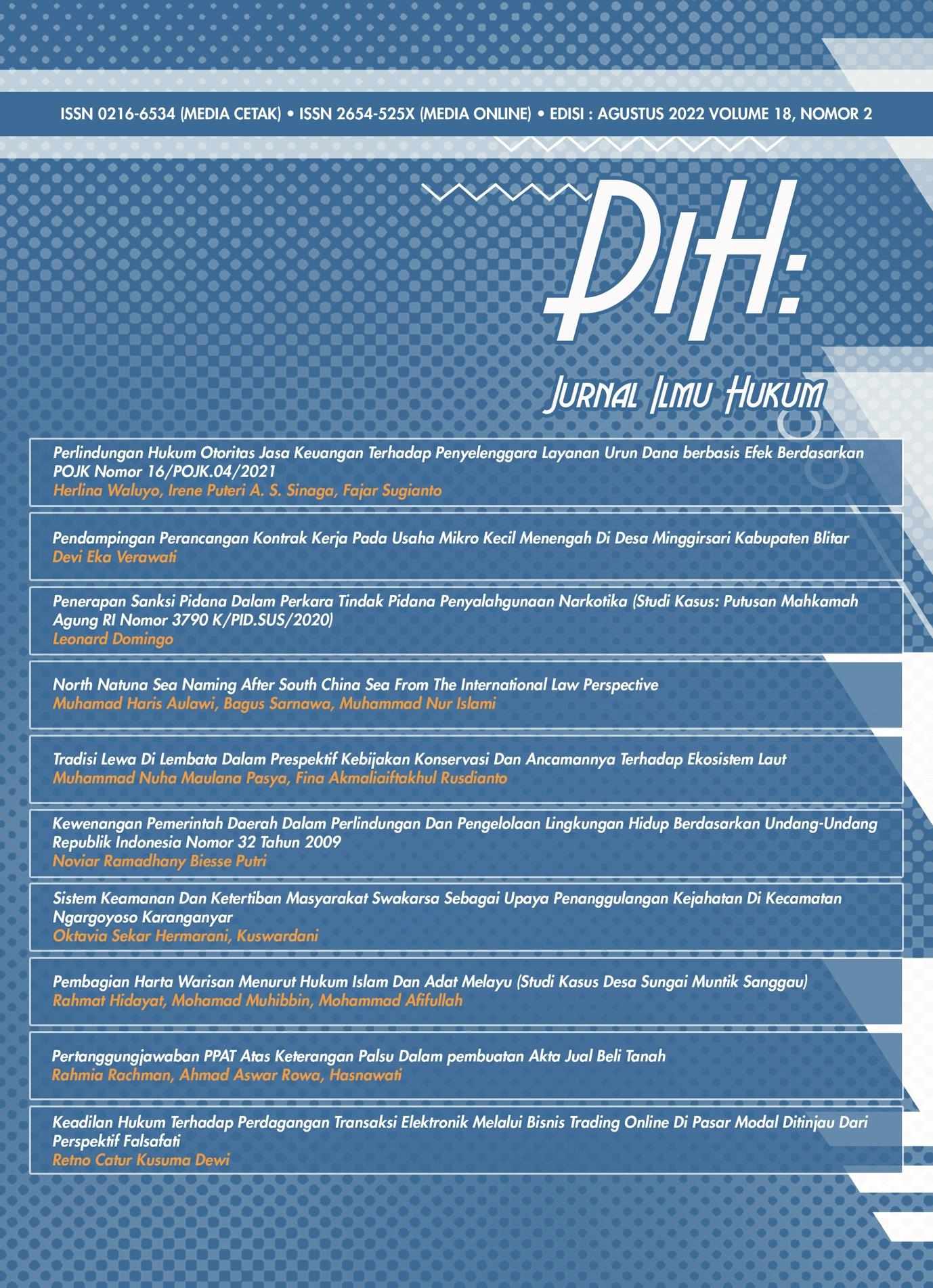
Kewenangan Pemerintah Daerah Dalam Perlindungan Dan Pengelolaan Lingkungan Hidup Berdasarkan Undang-Undang Republik Indonesia Nomor 32 Tahun 2009
DOI:
https://doi.org/10.30996/dih.v0i0.6587Abstract
The purpose of this study is to describe problems related to environmental protection and management that occur in Minggirsari Village. This research is a normative legal research with a statutory and conceptual approach. The results of the study found that in Minggirsari Village there are many tourist attractions where tourists can enjoy these tourist destinations. However, there are various kinds of problems regarding the environment of these tourist attractions. There are various tourist attractions that still do not have a clear permit. Then there are various empty buildings even though if these buildings are addressed they can potentially become buildings that can be used as tourist attractions. Referring to Law Number 32 of 2009 concerning Environmental Protection and Management, local governments can manage the place into a clean tourist spot while taking into account the aspirations of the community and being participatory by involving all interested parties in environmental management so that the place can be attractive. the attention of the tourists. Going forward to the government and local governments, it is recommended that in issuing provisions in the form of environmental permits, they should always pay attention to human needs and environmental limitations in meeting current and future needs based on the concept of sustainable development that is environmentally sound through accurate and responsible environmental assessment and analysis answer.
Keywords: environment; licensing; tourist attraction
Abstrak
Tujuan penelitian ini adalah untuk menggambarkan permasalahan terkait perlindungan dan pengelolaan lingkungan yang terjadi di Desa Minggirsari. Penelitian ini adalah penelitian hukum normatif dengan pendekatan perundang-undangan dan konseptual. Hasil penelitian menemukan bahwa di Desa Minggirsari terdapat banyak sekali tempat wisata di mana para wisatawan dapat menikmati destinasi wisata tersebut. Akan tetapi, terdapat berbagai macam permasalahan mengenai lingkungan dari tempat wisata tersebut. Terdapat berbagai tempat wisata yang masih belum memiliki izin yang jelas. Kemudian terdapat berbagai bangunan yang kosong padahal jika bangunan tersebut dibenahi dapat berpotensi sebagai bangunan yang dapat dijadikan objek wisata. Mengacu pada Undang-Undang Nomor 32 Tahun 2009 tentang Perlindungan dan Pengelolaan Lingkungan Hidup, pemerintah daerah dapat mengelola tempat tersebut menjadi tempat wisata yang bersih dengan tetap memperhatikan aspirasi dari masyarakat dan bersifat partisipasif dengan melibatkan semua pihak yang berkepentingan dalam pengelolaan lingkungan agar tempat tersebut dapat menarik perhatian para wisatawan. Ke depan kepada pemerintah dan pemerintah daerah, disarankan agar dalam mengeluarkan ketetapan berbentuk izin lingkungan hendaknya senantiasa memperhatikan kebutuhan manusia serta keterbatasan lingkungan dalam memenuhi kebutuhan masa kini dan masa mendatang dengan berlandaskan pada konsep pembangunan berkelanjutan yang berwawasan lingkungan melalui pengkajian dan analisis lingkungan yang akurat dan bertanggung jawab.
Kata Kunci: lingkungan; perizinan; tempat wisata
Downloads
References
Anisahwati, P. (2016). The Effect of Perfectionism and Social Support on Academic Procrastination in Completing Thesis and Dissertation. Tazkiya Journal of Psychology Vol. 4 No. April 1, 2016
Arikunto, S. (2006). Research Procedure a Practice Approach. Revised edition VI. Jakarta: PT. Rineka Cipta.
Azwar, S. (2008). Psychological Scale Compilation. Yogyakarta: Student Library.
Azwar, Saifuddin. (2011). Reliability and Validity, 3rd Edition. Yogyakarta: Student Heritage
Azwar, S. (2013). Psychological Scale Compilation. Yogyakarta: Student Heritage.
Azwar, S. (2017). Psychological Research Methods. Yogyakarta: Student Library.
Burka, J.B. & Yuen, L. M. (1983). Procrastination: Why You Do It, What To Do About It. Newyork: Perseus Books.
Proceeding
International Seminar of Multicultural Psychology (ISMP 1st)
Faculty of Psychology Universitas 17 Agustus 1945 Surabaya
Chen, S.C. (2002). Self-regulated learning strategies and achievement in an introduction to information systems course. Journal of Information Technology, Learning, and Performance, 20, (1).
Chung, M.K. (2000). The development of self-regulated learning. The Institute of Asia Pacific Education Development, 1, (1), 55-56.
Cobb, R.J., (2003). The relationship between self-regulated learning behaviors and academic performance in web-based courses. Dissertation, Virginia: Blacksburg.
Creswell, John W. 2016. Research Design: Qualitative, Quantitative, and Mixed Methods Approaches 4th Edition. Jakarta: Pustaka Pelajar.
Dewi, S.S & Alfita, L. (2015). The Difference of Academic Procrastination Between Dating and Non-Dating Students. Diversita's Journal, 1 (1)
Dluha, S. (2016). The Influence of Perfectionism, Achivement Goal Orientation and Gender on Student Academic Procrastination.
Dowson, M., Brickman, S., MCInerney, D., & Gonzalez, S. (2005). The psychometric structure of the self-regulation of academic motivation (R). Educational Psychologist, 38,189-205.
Dwi, L., Rahayu, A. (2018). Relationship between Social Support and Self-Efficacy with Academic Procrastination of Overseas Students Studying in Jakarta. IKRAITH-HUMANIORA, Vol. 2, No.2, March 2018.
Downloads
Published
Issue
Section
License
Authors who publish with DiH: Jurnal Ilmu Hukum agree to the following terms:
- Authors transfer the copyright and grant the journal right of first publication with the work simultaneously licensed under a CC BY-SA 4.0 that allows others to share the work with an acknowledgement of the work's authorship and initial publication in this journal.
- Authors are able to enter into separate, additional contractual arrangements for the non-exclusive distribution of the journal's published version of the work (e.g., post it to an institutional repository or publish it in a book), with an acknowledgement of its initial publication in this journal.
- Authors are permitted and encouraged to post their work online (e.g., in institutional repositories or on their website) prior to and during the submission process, as it can lead to productive exchanges, as well as earlier and greater citation of published work (See The Effect of Open Access)