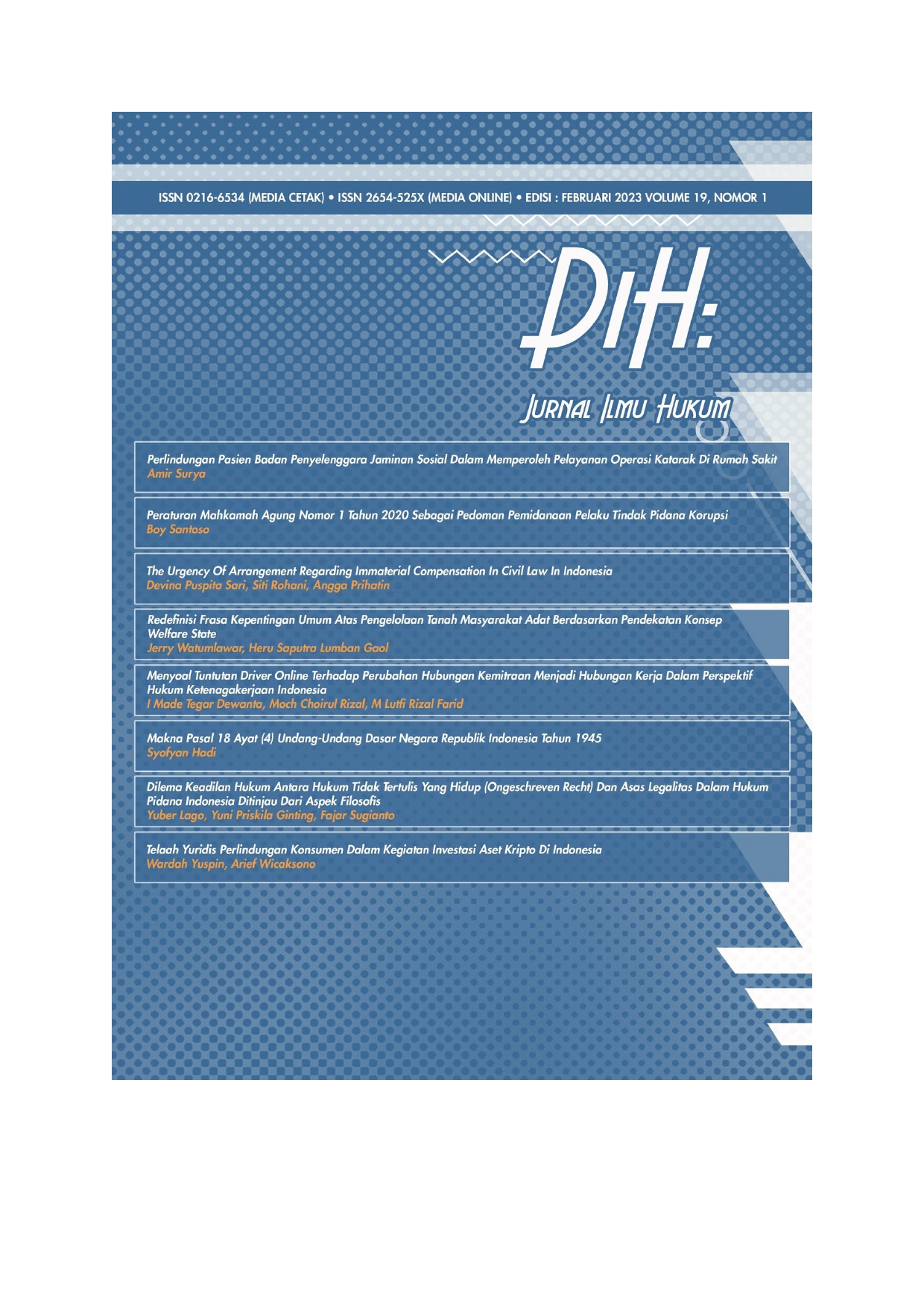
Redefinisi Frasa Kepentingan Umum Atas Pengelolaan Tanah Masyarakat Adat Berdasar-kan Pendekatan Konsep Welfare State
DOI:
https://doi.org/10.30996/dih.v19i1.6629Abstract
Indonesia as a developing country requires maximum infrastructure development for the public interest or in other words for the realization of people's welfare. Indigenous peoples' land which is used as the object of infrastructure development without prior approval can result in violation of the rights of indigenous peoples. By using a normative juridical method, this research focuses on reviewing the approval of indigenous peoples whose land is the object of infrastructure development in the public interest. This then becomes important because to what extent is the definition of public interest formulated in the phrase the interests of the State and common interests often lead to prolonged conflicts. The redefinition of public interest by using the concept of the welfare state approach is then deemed relevant for the creation of a responsive land law politics.
Keywords: culture; development infrastructure; public interest
Abstrak
Indonesia sebagai negara berkembang memerlukan pembangunan infrastruktur yang maksimal demi kepentingan umum atau dengan kata lain demi mewujudkan kesejaheraan rakyat. Tanah masyarakat adat yang dijadikan objek pembangunan infrastruktur tanpa adanya persetujuan terlebih dahulu dapat menimbulkan pencideraan hak masyarakat adat. Dengan menggunakan metode yuridis normatif, peneltian ini fokus mengkaji terkait persetujuan dari masyarakat hukum adat yang tanahnya dijadikan objek dalam pembangunan infrastruktur demi kepentingan umum. Hal ini kemudian menjadi penting karena sejauh apa definisi kepentingan umum yang dirumuskan dalam frasa kepentingan Negara dan kepentingan bersama itu sering kali meimbulkan konflik berkepanjangan. Redefinisi kepentingan umum dengan menggunakan pendekatan konsep welfare state kemudian dianggap relevan untuk tercipata politik hukum pertanahan yang responsif.
Kata kunci: kepentingan umum; masyarakat adat; pembangunan infrastruktur
Downloads
References
Barros, A. S. (2017). Subjective Well-Being (Sb) And Burnout Syndrome (Bns): Correlational Analysis Teleworkers Education Sector . Procedia - Social And Behavioral Sciences, 1012- 1018.
Carver, C. (1997). You Want To Measure Coping But Your Protocol's Too Long: Consider The Brief Cope. International Journal Of Behavioral Medicine, 92-100.
Carver, C. S., Scheier, N. F., & Weintraub, J. K. (1989). Assessing Coping Strategies. Journal Of Personality And Social Psychology, 267-283.
Gaol, N. T. L. (2016). Teori stres: stimulus, respons, dan transaksional. Buletin psikologi, 24(1), 1-11.
Lazarus, R. S., & Folkman, S. (1984). Stress, Appraisals, And Coping. Springer Publishing Company.
RR. Meiti Asmorowati, “Konsep Kepentingan Umum Dalam Pengadaan Tanah Dihubungkan Dengan Kepastian Hukum”, 2020.
V. Hadiyono, “Indonesia dalam Menjawab Konsep Negara Welfare State dan Tantangannya”, Semarang: Universitas Katolik Soegijapranata, Jurnal Hukum Politik dan Kekuasaan, Volume 1 Nomor 1, 2020.
Undang-Undang Dasar Negara Republik Indonesia Tahun 1945.
Undang-Undang Nomor 5 Tahun 1960 tentang Peraturan Dasar Pokok Agraria.
Undang-Undang Nomor 2 Tahun 2012 tentang Pengadaan Tanah Bagi Pembangunan Untuk Kepentingan Umum.
Herman, “KPA Catat 207 Konflik Agraria Sepanjang 2021”, https://www.beritasatu.com/ekonomi/875603/kpa-catat-207-konflik-agraria-sepanjang-2021 (sabtu, 19/02/2022, pukul 14:00 WIB)
CNN (https://www.cnnindonesia.com/nasional/20200427200605-20-497847/konflik-agraria-klhk-memihak-warga-jika-ada-bukti-tanah-adat) diakses pada tanggal 26 Mei 2022
Downloads
Published
Issue
Section
License
Authors who publish with DiH: Jurnal Ilmu Hukum agree to the following terms:
- Authors transfer the copyright and grant the journal right of first publication with the work simultaneously licensed under a CC BY-SA 4.0 that allows others to share the work with an acknowledgement of the work's authorship and initial publication in this journal.
- Authors are able to enter into separate, additional contractual arrangements for the non-exclusive distribution of the journal's published version of the work (e.g., post it to an institutional repository or publish it in a book), with an acknowledgement of its initial publication in this journal.
- Authors are permitted and encouraged to post their work online (e.g., in institutional repositories or on their website) prior to and during the submission process, as it can lead to productive exchanges, as well as earlier and greater citation of published work (See The Effect of Open Access)