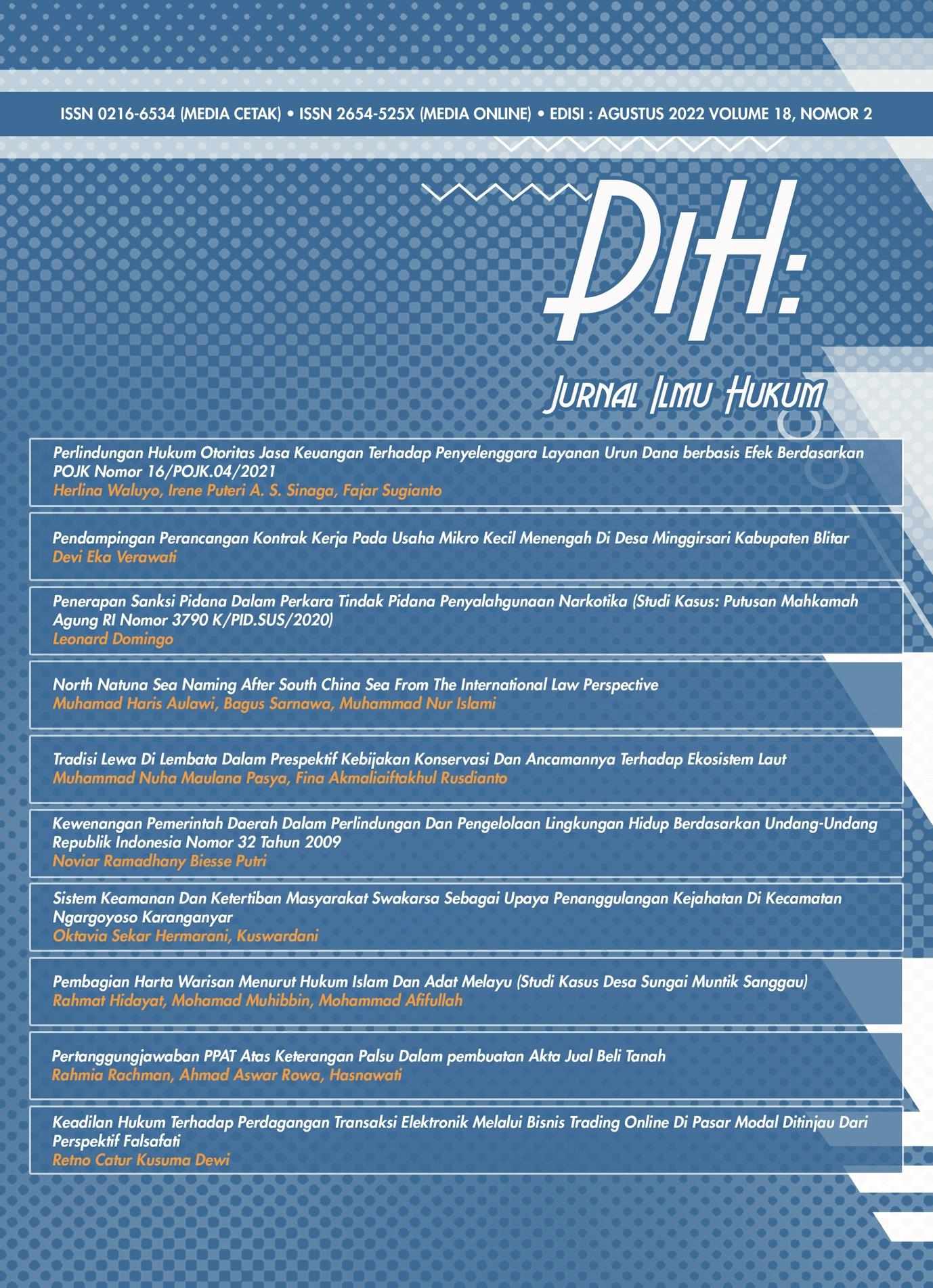
Sistem Keamanan Dan Ketertiban Masyarakat Swakarsa Sebagai Upaya Penanggulangan Kejahatan Di Kecamatan Ngargoyoso, Karanganyar
DOI:
https://doi.org/10.30996/dih.v0i0.6962Abstract
Crime has existed since a long time ago. The advancement of civilization has made the crime growing and more developed in various forms and modes. The rise of various kinds of crimes that occur in society needs to be a concern for all parties. The existence of a crime has implications for the conditions of security and order in the community. Therefore, community participation is needed and meaningful in order to create safe and comfortable conditions in the community, nation and state environment. As citizens, maintaining order and environmental security is a shared responsibility. This research uses descriptive research method and literature study, where as the researcher tries to describe the phenomena and social realities that occur. The results showed that the regulation of the security and public order sistem (siskamtibmas) could overcome crime in Ngargoyoso District, Karanganyar Regency, Central Java. Siskamling is a community effort in improving the security and order sistem that provides protection and security for residents. Awareness is needed from community members in the Ngargoyoso sub-district in order to prevent and ward off forms of threats and disturbances to kamtibmas (community security and order). This public awareness is a potential for self-defense that needs to be preserved and improved.
Keywords: crime; independent society; security & order sistem
Abstrak
Kejahatan sudah ada sejak zaman dahulu. Majunya peradaban membuat kejahatan semakin berkembang dalam berbagai bentuk modus dan variatif. Maraknya berbagai macam kejahatan yang terjadi di masyarakat perlu menjadi perhatian bagi semua pihak. Adanya tindak kejahatan sangat berimplikasi terhadap kondisi keamanan dan ketertiban di tengah masyarakat. Oleh karena itu, peran serta masyarakat sangat dibutuhkan dan berarti guna mewujudkan kondisi yang aman dan nyaman dalam lingkungan bermasyarakat, berbangsa, dan bernegara. Sebagai warga negara, menjaga ketertiban dan keamanan lingkungan merupakan tanggung jawab bersama. Penelitian ini menggunakan metode penelitian deskriptif dan studi kepustakaan, di mana peneliti berusaha untuk mendeskripsikan fenomena dan realitas sosial yang terjadi. Hasil penelitian menunjukkan bahwa sistem keamanan dan ketertiban masyarakat (siskamtibmas) dapat menanggulangi kejahatan di Kecamatan Ngargoyoso, Kabupaten Karanganyar, Jawa Tengah. Siskamling merupakan upaya masyarakat dalam meningkatkan sistem keamanan dan ketertiban yang memberikan perlindungan dan pengamanan bagi warga. Diperlukan kesadaran dari warga masyarakat di kecamatan Ngargoyoso guna mencegah dan menangkal bentuk-bentuk ancaman dan gangguan kamtibmas (keamanan dan ketertiban masyarakat). Kesadaran masyarakat ini merupakan potensi pengamanan swakarsa yang perlu dilestarikan dan ditingkatkan.
Kata Kunci: kejahatan; masyarakat swakarsa; sistem keamanan dan ketertiban
Downloads
References
Balaji, V., & Kuppusamy, K. S. (2016). Accessibility analysis of e-governance oriented mobile applications. 2016 International Conference on Accessibility to Digital World (ICADW), 141–144. https://doi.org/10.1109/ICADW.2016.7942529
Fuadi, A. (2018). Pembangunan Piranti Lunak Pembantu Pemetaan Urusan Pemerintah Daerah. Techno.Com, 17(3), 230–241. https://doi.org/10.33633/tc.v17i3.1696
Ganapati, S. (2015). Using Mobile Apps in Government. IBM Center for The Bussiness Goverment, 53.
Klalaf, S. (2015). Seven Years Into The Mobile Revolution: Content is King… Again. http://yahoodevelopers.tumblr.com/post/127636051988/seven-years-into-the-mobilerevolution-content-is
lyons, K. (2020). Governments around the world are increasingly using location data to manage the coronavirus. https://www.theverge.com/2020/3/23/21190700/eu-mobile-carriers-customer-data-coronavirus-south-korea-taiwan-privacy
Pandey, R., & Sekhar, K. S. V. (2011). From e-Governance to m-Governance—The Way Forard. In E-Governance: Techno-Behavioral Implications (pp. 117–128). the 8 ICEG 2011 on the theme “Government Transformation: Agenda for EGov 2.0”.
Ramganesh, E., Kirubakaran, E., Ravindran, D., & Gobi, R. (2017). Effectiveness of transformation from e-Governance to mGovernance of a HEI on its communication services to the stakeholders. IOSR Journal of Computer Engineering, 19(04), 01–08. https://doi.org/10.9790/0661-1904010108
Rozikin, M., Hesty, W., & Sulikah, S. (2020). Kolaborasi dan E-Literacy: Kunci Keberhasilan Inovasi E-Government Pemerintah Daerah. Jurnal Borneo Administrator, 16(1), 61–80. https://doi.org/10.24258/jba.v16i1.603
Schadler, T. J., Bernoff, & J., A. (2014). The Mobile Mind Shift: Engineer Your Business to Win in the Mobile Moment. Groundswell Press.
United Nations. (2020). E-Government Survey 2020. https://publicadministration.un.org/egovkb/en-us/Reports/UN-E-Government-Survey-2020
Yunita, N. P., & Aprianto, R. D. (2018). Kondisi Terkini Perkembangan Pelaksanaan E-government di Indonesia: Analisis Website. Seminar Nasional Teknologi Informasi Dan Komunikasi (SENTIKA).
Polri, Mabes. 2003. “Prosedur Operasional Sistem Keamanan Lingkungan.” Jakarta.
Pribadi, Slamet. 2020. “Revitalisasi Pos Kamling Berbasis Komunitas Di Masa Pandemi Covid-19.” Jurnal Keamanan Nasional 6 (2): 304–21.
Reid, Sue Titus. 2017. Crime and Criminology. Wolters Kluwer Law & Business.
Sutherland, Edwin H, Donald R Cressey, and David F Luckenbill. 1992. Principles of Criminology. Altamira Press.
Wirayuda, Arya W, and Koko Srimulyo. 2018. “Praktik Sistem Keamanan Swakarsa Pada Masa Pascakolonial Di Jawa Timur.” Mozaik Humaniora 18 (2): 137–48.
Zaidan, M Ali, and M SH. 2021. Kebijakan Kriminal. Sinar Grafika (Bumi Aksara).
Downloads
Published
Issue
Section
License
Authors who publish with DiH: Jurnal Ilmu Hukum agree to the following terms:
- Authors transfer the copyright and grant the journal right of first publication with the work simultaneously licensed under a CC BY-SA 4.0 that allows others to share the work with an acknowledgement of the work's authorship and initial publication in this journal.
- Authors are able to enter into separate, additional contractual arrangements for the non-exclusive distribution of the journal's published version of the work (e.g., post it to an institutional repository or publish it in a book), with an acknowledgement of its initial publication in this journal.
- Authors are permitted and encouraged to post their work online (e.g., in institutional repositories or on their website) prior to and during the submission process, as it can lead to productive exchanges, as well as earlier and greater citation of published work (See The Effect of Open Access)