
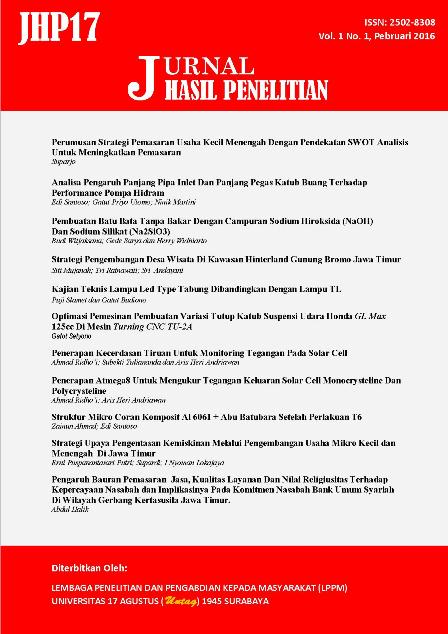
STRATEGI UPAYA PENGENTASAN KEMISKINAN MELALUI PENGEMBANGAN USAHA MIKRO KECIL DAN MENENGAH DI JAWA TIMUR
Abstract
The purpose of this study were (1) Identify the factors that impede business
development of micro, small and medium enterprises in East Java, (2) identify
strategies flagship relevant for micro, small and medium enterprises in East
Java, (3) Develop a strategy formulation the development of micro, small and
medium enterprises in East Java as the alleviation of poverty. by using the
SWOT method, it can be concluded that (1) the factors that impede business
development of micro, small and medium enterprises in East Java is the low
marketing, promotion is still lacking, innovation competitor products quickly,
the condition of the competitors are very strict, government policy to reduce
public subsidies, high inflation, weak niai rupiah against the $ US, demands a
quality product at a price that is increasingly Competitive, the decline of the
country's economy, political situation in the country is not stable, (2) Strategy
flagship relevant to micro, small and medium enterprises in East Java Growth
strategy, showed no growth and product diversification efforts, micro, small
and medium enterprises, Stability strategy, shows the strategy adopted without
changing the strategic direction set. (3) The formulation of the development
strategy of micro, small and medium enterprises in East Java as the fight
against poverty is (a) Creating opportunities for new markets, for example,
Open gallery to accommodate everyone who wants to learn about batik,
designs, colors and patterns are new , Producing cotton batik arise, fabric
doby, woven fabrics batik, fabric paris (semi ciffon), silk, production of herbal
medicine in the form of sachets, Forms / ways of marketing, micro, small and
medium enterprises : exhibitions, internet, stand at the site of micro, small, and
intermediate, product marketing process: www. petismadura.com through on
line, by telephone, came to the site of micro, small and medium enterprises, (b)
Measures craftsmen of micro, small and medium enterprises to face
competition, for example, cotton batik patterned producing contemporary
craftsmen who work in Tanjungbumi invited back to the village in Sampang,
designs, colors and patterns are new, it needs creative freedom batik, and
according to standard batik, development capital, collecting batik former, For
medicinal products: produce products with packaging per ounce, for product
paste: improved quality, competitive prices, CSR for young, expanding the
image to the public, To handicraft: should innovation models, especially the
products of bags and wallets, information from the Internet, (c) Efforts
craftsmen that demand the products increases, for example, promotion of one to
Strategi Upaya Pengentasan Kemiskinan Melalui Pengembangan Usaha Mikro Kecil dan Menengah
Di Jawa Timur
106
the other, for batik products: create a new motive, the exhibition, plus employee
and machine, plus shops, for the product chips fish : without chemicals, for
products skull cap: rent for wholesale, product diversification is koko, exhibits
10 times in 1 year.
Keywords: SWOT, micro small and medium enterprise, poverty alleviation
Downloads
References
Abdillah. (2013). Manusia dan Kebahagiaan. Jurnal Aqidah. Vol 1 No 1.
Ancok, Djamaluddin dan Suroso. (2001). Psikologi Islami. Yogyakarta: Pustaka Belajar.
Ancok, Djamaluddin. (2005). Religiusitas Sebagai Keberagaman. Yogyakarta: Pustaka Belajar.
Anggoro. (2010). Kebahagiaan. Jurnal Psikologi UGM. Jurnal.psikologi. ugm. ac. id/index.php/fpsi/article/21.
Argyle & Crosland. (1987). The Dimension of Positive Emotions. Jurnal Social
Psychology. Jun 26. Vol 2. 127-137.
Argyle, S. (2000). Psychology and Religion: An Introduction. California: Taylor &
Francis Routledge Press.
Argyle,M. (2001). The Psychology of Happiness.USA: Routledge.
Cohen, Sheldon and Wils, Thomas Ashby. (1985). Stress, Social Support, and The Buffering Hypothesis. Psychology Bulletin. Vol 2. P 310-57.
Purwanto, 2007, Manajemen Strategi, Yrama Widya, Bandung..
Rangkuti Freddy, 2003, Business Plan: Teknik membuat Perencanaan Bisnis dan Analisis
Kasus, Gramedia Pustaka Utama, Jakarta.
Sarasi V., 2011, Strategi Pengembangan Bisnis Berbasis Kualitas Produk pada Usaha Kecil
dan Menengah di Jawa Barat, Usahawan No. 04 TH. XXX, hlm. 30-33.
Vanany I., 2002, Pilihan Strategi Unggulan Perusahaan Industri Manufaktur Kecil dan
Menengah (IMKM), Usahawan No. 07 TH. XXXI, hlm. 22-27.
www.radarmadura.co.id/2015 diunduh pada 23 april 2015
Downloads
Published
Issue
Section
License
COPYRIGHT NOTICE
The copyright in this website and the material on this website (including without limitation the text, computer code, artwork, photographs, images, music, audio material, video material and audio-visual material on this website) is owned by JHP17and its licensors.
Copyright license
JHP17 grants to you a worldwide non-exclusive royalty-free revocable license to:
- View this website and the material on this website on a computer or mobile device via a web browser;
- Copy and store this website and the material on this website in your web browser cache memory; and
- Print pages from this website for your
- All articles published by JHP17are licensed under the creative commons attribution 4.0 international license. This permits anyone to copy, redistribute, remix, transmit and adapt the work provided the original work and source is appropriately cited.
JHP17does not grant you any other rights in relation to this website or the material on this website. In other words, all other rights are reserved.
For the avoidance of doubt, you must not adapt, edit, change, transform, publish, republish, distribute, redistribute, broadcast, rebroadcast or show or play in public this website or the material on this website (in any form or media) without appropriately and conspicuously citing the original work and source or JHP17prior written permission.
Permissions
You may request permission to use the copyright materials on this website by writing to jhp17@untag-sby.ac.id
Enforcement of copyright
JHP17takes the protection of its copyright very seriously.
If JHP17discovers that you have used its copyright materials in contravention of the license above, JHP17 may bring legal proceedings against you seeking monetary damages and an injunction to stop you using those materials. You could also be ordered to pay legal costs.
If you become aware of any use of JHP17's copyright materials that contravenes or may contravene the license above, please report this by email to jhp17@untag-sby.ac.id
Infringing material
If you become aware of any material on the website that you believe infringes your or any other person's copyright, please report this by email to jhp17@untag-sby.ac.id
target="_blank"


