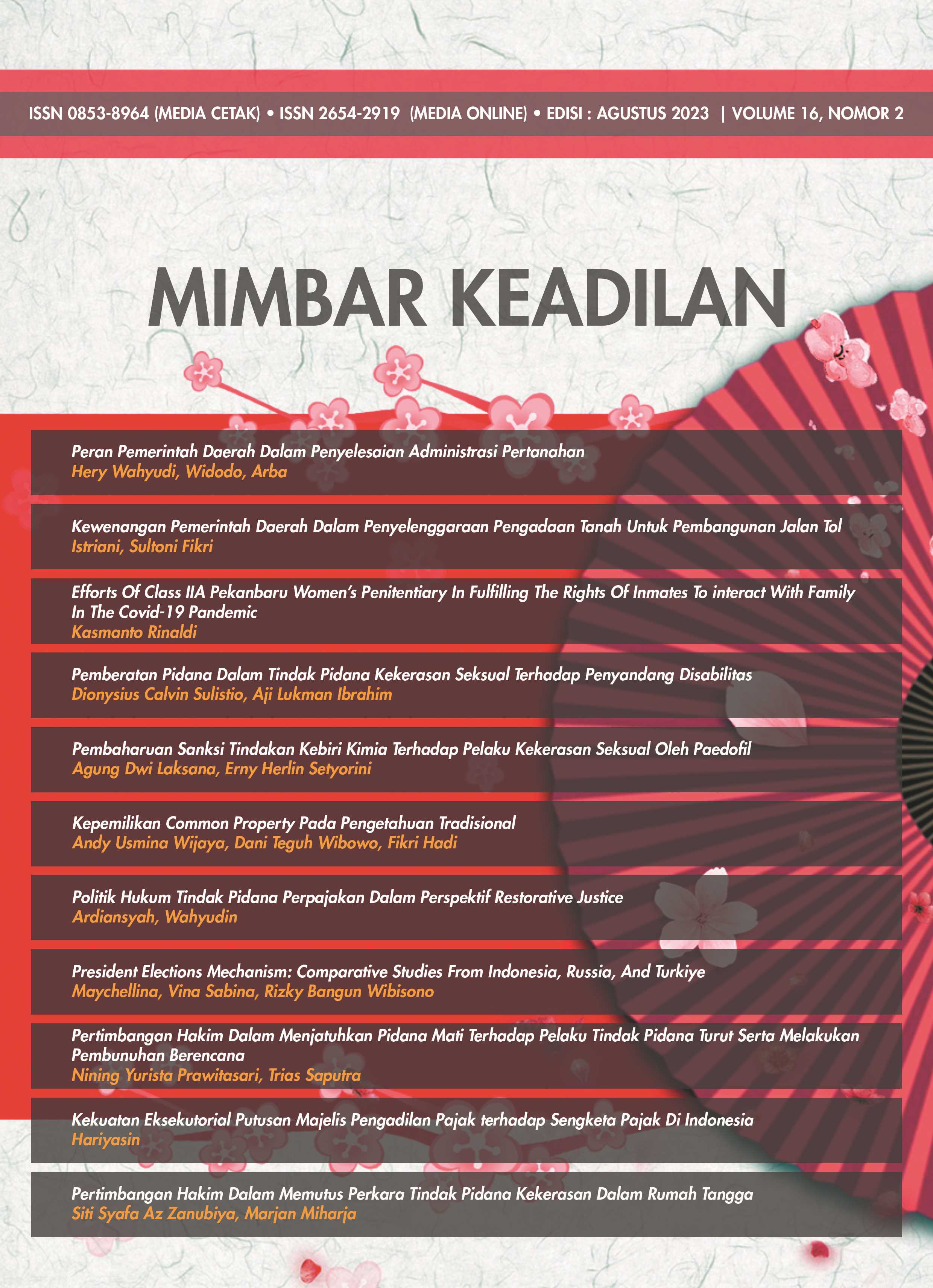
Kepemilikan Common Property Pada Pengetahuan Tradisional
DOI:
https://doi.org/10.30996/mk.v16i2.8519Keywords:
common property, intellectual property rights, traditional knowledgeAbstract
This article discusses the concept of traditional knowledge and examines policy directions related to common property in Indonesia. Protection of traditional knowledge is not only the existence of intellectual works produced by indigenous peoples, but solely due to environmental factors and indigenous peoples which give special characteristics to products produced by an indigenous community. Thus traditional knowledge can provide protection to an object that is part of common property and not part of private property. This research is normative juridical research with a conceptual approach related to copyright and common property. The results of the study show that the concept of collective-communal ownership basically originates from the existence of a community unit that feels a sense of togetherness in owning something with the same interests and refers to the existence of rights that can be enjoyed by many people or groups. Meanwhile, in relation to traditional knowledge as part of common property, it can be interpreted that society as a whole has the same opportunity to enjoy the potential contained in this traditional knowledge. From the study of collective and communal concepts in the realm of customary law, the ownership of traditional knowledge is inherent in collective communal characteristics. The existence of this special characteristic of ownership indicates the need for the development of principles in the realm of copyright. Therefore, Indonesia should have a law specifically related to common property.
Downloads
Downloads
Published
Issue
Section
License
Authors who publish with Mimbar Keadilan agree to the following terms:
- Authors transfer the copyright and grant the journal right of first publication with the work simultaneously licensed under a Creative Commons Attribution-ShareAlike 4.0 International License.. that allows others to share the work with an acknowledgement of the work's authorship and initial publication in this journal.
- Authors are able to enter into separate, additional contractual arrangements for the non-exclusive distribution of the journal's published version of the work (e.g., post it to an institutional repository or publish it in a book), with an acknowledgement of its initial publication in this journal.
- Authors are permitted and encouraged to post their work online (e.g., in institutional repositories or on their website) prior to and during the submission process, as it can lead to productive exchanges, as well as earlier and greater citation of published work (See The Effect of Open Access)