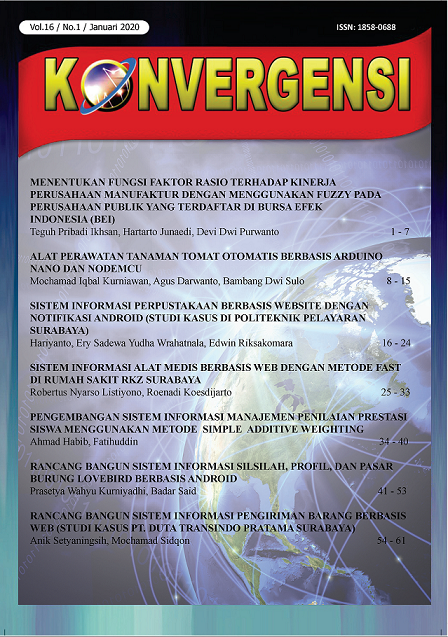
RANCANG BANGUN SISTEM INFORMASI PENGIRIMAN BARANG BERBASIS WEB (STUDI KASUS PT. DUTA TRANSINDO PRATAMA SURABAYA)
DOI:
https://doi.org/10.30996/konv.v1i1.3294Keywords:
pengiriman barang, sistem informasi, ongkos kirim, tracking barangAbstract
Jasa pengiriman barang adalah sesuatu pelayanan yang memberi kemudahan proses mengirim barang dari satu tempat ke tempat lain dengan aman serta dipertanggungjawabkan keamanannya oleh pihak penyedia jasa. Pengiriman barang dapat berupa logistik, produk elektrok, dokumen dan lain lain. Jalur yang digunakan untuk kiriman barang bisa melalui jalur udara, laut dan darat. Semakin berkembangnya teknologi maka dibutuhkan sistem yang dapat meningkatkan pelayanan kinerja dalam pencacatan pengiriman barang, pengecekan ongkos kirim dan juga tracking barangkiriman. Dengan adanya system informasi pengiriman barang ini diharapkan dapat memberikan solusi atas permasalahan yang ada di PT Duta Transindo Pratama Surabaya yaitu terkomputerisasinya data pengiriman barang, adanya sistem yang bias mengecek ongkos kirim dan tracking barang.
Downloads
References
D. B. Deshmukh and Y. Pandey, “A Review on Hierarchical Document Clustering,†J. Data Min. Knowl. Discov., vol. 3, no. 5, pp. 65–68, 2012.
F. A. Hermawati and D. A. Zuhdi, “Aplikasi Sistem Temu Kembali Dokumen dengan Metode Vector Space Model,†KONVERGENSI, vol. 5, no. 2, pp. 38–49, 2009.
F. Z. Tala, “A Study of Stemming Effects on Information Retrieval in Bahasa Indonesia,†2003.
K. J. Cios, W. Pedrycz, R. W. Swiniarski, and L. A. Kurgan, Data Mining : A Knowledge Discovery Approach. Springer, 2007.
C. D. Manning, P. Raghavan, and H. Schütze, An Introduction to Information Retrieval. Cambridge, England: Cambridge University Press, 2009.
A. Z. Arifin, I. P. A. K. Mahendra, and H. T. Ciptaningtyas, “Enhanced Confix Stripping Stemmer and ANTS Algorithm for Classifying News Docements in Indonesian Language,†in The 5th International Conference on Information & Communication Technology and Systems, 2009, pp. 149–158.
G. Tsatsaronis and V. Panagiotopoulou, “A generalized vector space model for text retrieval based on semantic relatedness,†EACL 2009 - 12th Conf. Eur. Chapter Assoc. Comput. Linguist. Proc., no. April, pp. 70–78, 2009.
J. N. Singh and S. K. Dwivedi, “Performance Analysis of Layered Vector Space Model in Web Information Retrieval,†Int. J. Appl. Inf. Syst., vol. 8, no. 5, pp. 7–15, 2015.
P. Harcourt and R. B. Japheth, “Application of Vector Space Model to Query Ranking and Information Retrieval,†Int. J. Adv. Res. Comput. Sci. Softw. Eng., vol. 6, no. 5, pp. 42–47, 2016.
M. Ahat, S. Amor, and M. Bui, “Document Classification with LSA and Pretopology.,†Stud. Inform. Universalis, vol. 8, no. 1, pp. 125–144, 2010.
R. T.-W. Lo, B. He, and I. Ounis, “Automatically Building a Stopword List for an Information Retrieval System,†J. Digit. Inf. Manag. Spec. Issue 5th Dutch-belgian Inf. Retr. Work., vol. 3, pp. 3–8, 2005.
F. A. Hermawati, H. Tjandrasa, and N. Suciati, “Sistem Retrieval Citra Berbasis Region Dengan Transformasi Wavelet Berdasarkan Karakteristik Color-Texture,†KONVERGENSI, vol. 2, no. 1, pp. 1–9, 2006.
F. A. Hermawati, H. H. Tjandrasa, and N. Suciati, “Evaluasi Representasi Warna Untuk Retrieval Citra Berbasis Region,†J. Saintek, vol. 9, no. 2, pp. 101–107, 2005.
Downloads
Published
Issue
Section
License
Authors whose manuscript is published will approve the following provisions:
- The right to publication of all journal material published on the Konvergensi Teknologi Informasi & Komunikasi website is held by the editorial board with the author's knowledge (moral rights remain the property of the author).
- The formal legal provisions for access to digital articles of this electronic journal are subject to the terms of the Creative Commons Attribution-ShareAlike (CC BY-SA) license, which means Konvergensi Teknologi Informasi & Komunikasi reserves the right to store, modify the format, administer in database, maintain and publish articles without requesting permission from the Author as long as it keeps the Author's name as the owner of Copyright.
- Printed and electronic published manuscripts are open access for educational, research and library purposes. In addition to these objectives, the editorial board shall not be liable for violations of copyright law.