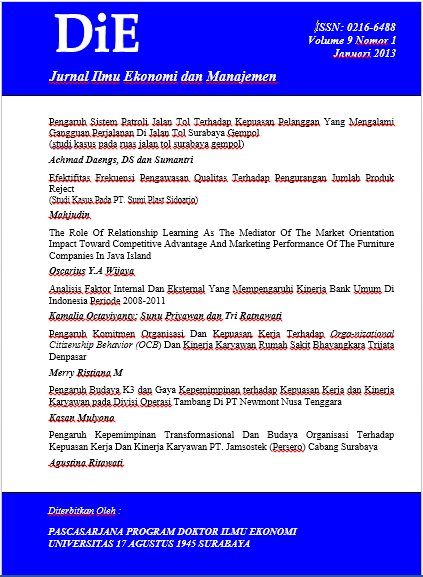
Pengaruh Kepemimpinan Transformasional Dan Budaya Organisasi Terhadap Kepuasan Kerja Dan Kinerja Karyawan PT. Jamsostek (Persero) Cabang Surabaya
DOI:
https://doi.org/10.30996/die.v9i1.206Abstract
Research objectives to be achieved from this study are to analyze and prove: Transformational leadership influence on job satisfaction of employees of PT. Jam-sostek (Persero) Branch Surabaya. Organizational culture influence on job satisfaction of employees of PT. Jamsostek (Persero) Branch Surabaya. Transformational leadership influence on the performance of employees of PT. Jamsostek (Persero) Branch Surabaya. Organizational culture influence on employee performance PT. Jamsostek (Persero) Branch Surabaya. Job satisfaction influence on the performance of employees of PT. Jamsostek (Persero) Branch Surabaya.
The study subjects taken as many as 111 people, this number is expected to have a minimum number of eligible study sample. Data analysis technique used is to use the software SPSS and AMOS-SEM.
The results showed that: Transformational leadership has a positive and significant influence on job satisfaction. Organizational culture has a significant and positive influence on job satisfaction.Transformational leadership has a positive and significant impact on employee performance . Organizational culture has a significant and positive impact on employee performance. Job satisfaction has a positive and significant impact on employee performance
Key Words : Transformational Leadership, Organizational Culture, Job Satisfaction and Employee Performance
Downloads
References
Brown, H. Douglas. 2000. Principles of Language Learning and Teaching. New York: Longman.
Chaer, Abdul and Leonie Agustina. 2004. Sosiolinguistik Perkenalan Awal. Jakarta: Rineka Cipta.
Cook, Guy. 1992. Discourse. Oxford: Oxford University Press.
Holmes, Janet. 2001. An Introduction to Sociolinguistics. London: Pearson Education Limited.
Mulyana, Deddy. 2004. Komunikasi Efektif: Suatu Pendekatan Lintas Budaya. Bandung: Remaja Rosdakarya.
Ohoiwutun, Paul. 1997. Sosiolinguistik: Memahami Bahasa dalam Konteks Masyarakat dan Kebudayaan. Jakarta: Kesaint Blanc.
Spolsky, Bernard. 2001. Sociolinguistics. Oxford: Oxford University Press.
Soar, Liz and John Soar. 1997. Headway: English Course. Oxford: Oxford University Press.
Tillit, Bruce and Marry Newton Bruder. 1993. Speaking Naturally: Communication Skills in American English. Cambridge: Cambridge University Press.
Wardraugh, Ronald. 1988. An Introduction to Sociolinguistics. Oxford: Basil Blackwell.
Yule, George. 1997. Pragmatics. Oxford: Oxford University Press.
Ferdinand, Augusty, 2006, Structural Equ-ation Modeling Dalam Penelitian Mana-jemen, Badan Penerbit Universitas Dipo-negoro
Fey dan Denison, 2000, Cooporate Culture and Organizational Effectiveness, New York, Willey.
Gibson, Ivancevich, Donnally, 1997, Orga-nisasi dan Manajemen Perilaku Struk-tur Proses, Edisi V, Erlangga, Jakarta
Gibson, James L. et.al, 1982, Organizations, Behavior, Structure, Processes. 4th ed, Richard D. Irwin Inc
Glaser, Susan R; Zamanou, Sonia and Hacker Kenneth, 1987, Measuring and Interpre-ting Organizational Culture. Management Communication Quartely Vol.1 No.2 pp 173-178
Golberg C.B., dan Waldman D.A., 2000, “Modelling Employee Absenteeism : Testing Alternative Measures Medating Effecs Based on Job Satisfactionâ€, Journal of Organizational Behavior, 21 (6) : 665-676.
Gratton M., 1993, “Leadership in The Lear-ning Organizationâ€, New Directions for Community Colleges, 84, 93-103.
H.Teman Koesmono, 2005, Pengaruh Budaya Organisasi terhadap Motivasi dan Kepu-asan Kerja serta Kinerja Karyawan Pada Sub Sektor Industri Pengolahan Kayu Skala Menengah Di Jawa Timur. Jurnal, Fakultas Ekonomi, Universitas Katholik Widya Mandala, Surabaya
Handoko, T.H, 1992, Manajemen Personalia dan Sumber Daya Manusia. Yogyakarta, BPFE
Harris L.C., Ogbonna E, 2001, “Leadership Style and Market Orientation : An Empi-rical Studyâ€, European Journal of Mar-keting, 35,5/6
Heidjrachman, Ranupundoko dan Suad Husnan, 1995, Manajemen Personalia, BPFE, Yogyakarta
Hersey dan Blanchard, 1986, Manajemen Perilaku Organisasi: Pendayagunaan Sumber Daya Manusia, Penerjemah Agus Dharma, Erlangga Jakarta.
Hofstede G., Neuijen B., Ohayu D. dan San-der G., 1986, “Measuring Organizational Cultures : A Qualitative Study Across Twenty Casesâ€, Adminitrative Science Quarterly, 35 : 285 – 316
Kadarman, A.M., et.al, 1992, Pengantar Ilmu Manajemen: Buku Panduan Ma-hasiswa, Jakarta, A.A. Bakelma Vitge-versB.V
Kartini Kartono, 1993, Pemimpin dan Kepe-mimpinan, Hak Cipta.
Keith Davis, Werther, dan William B, 1985, Human Resources And Personel Mana-jemen, Fith Edition, The United States Copyright, USA
Keith, Davis, 1995, Human Behaviour at Work: Organizational Behaviour, Struc-ture, Processes, edisi empat, Richard D, Irwin Inc
Kilmann R., Saxton M., & Serpa R., 1986, Gaining Control of The Corporate Cul-ture, San Francisco: Jossey-Bass
Kotter, John P. and Heskett, james L., 1992, Corporate Culture and Perfor-mance, New York: The Free Press, A Division of Mac Millan, Inc
Kreitner dan Kinichi, 1995, Organization Behavior. Irwin. McGraw-Hill, Boston.
Lawler E. E., & Porter L. W., 1969, “The Effect of Performance on Job Satis-factionâ€, Industrial Relations, Vol.8, p.20-8
Levy P.E., dan Williams J.R, 1998, “The Rule of Perceived System Knowledge in Predicting Appraisal Reactios , Job Satisfaction and Organizational Com-mitmenâ€.
Downloads
Published
Issue
Section
License
The author who will publish the manuscript at DiE: Jurnal Ilmu Ekonomi dan Manajemen, agree to the following terms:
1. Authors retain copyright and grant the journal right of first publication with the work simultaneously licensed under a Creative Commons Attribution ShareAlike License that allows others to share the work with an acknowledgment of the work's authorship and initial publication in this journal.
2. Authors are able to enter into separate, additional contractual arrangements for the non-exclusive distribution of the journal's published version of the work (e.g., post it to an institutional repository or publish it in a book), with an acknowledgment of its initial publication in this journal.
3. Authors are permitted and encouraged to post their work online (e.g., in institutional repositories, pre-prints sites or on their website) prior to and during the submission process, as it can lead to productive exchanges, as well as earlier and greater dissemination of published work