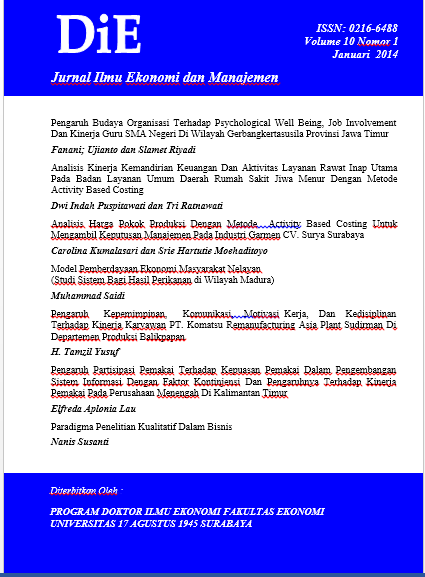
Pengaruh Kepemimpinan, Komunikasi, Motivasi Kerja, Dan Kedisiplinan Terhadap Kinerja Karyawan PT. Komatsu Remanufacturing Asia Plant Sudirman Di Departemen Produksi Balikpapan
DOI:
https://doi.org/10.30996/die.v10i1.234Abstract
The purpose of this study was to determine whether the leadership, communication, motivation, and discipline employees simultaneously or partial effect on employee performance. Retrieve data through a questionnaire on 100 employees of PT. Komatsu Remanufacturing Asia Plant Production In Balikpapan. In addition, to determine which factors among the leadership, communication, motivation, and discipline is partially dominant influence on employee performance. Based on the analysis of data that have been presented can be concluded that the leadership, communication, job motivation and discipline employees work together has been linked to employee performance. The relationship between leadership, communication, motivation and discipline employees work together with the employee's performance as very good. This is shown by the coefficient of determination that leadership, communication, motivation and discipline employees work together to provide an effective contribution to improving employee performance up to 83.7%. Moreover, different test results showed that the variables of leadership, communication, self-motivation and discipline employees are also able to provide a partial influence on employee performance. From the results of different test is well known that the employee discipline factor contributed most to the increase in employee performance in PT. Komatsu Remanufacturing Asia Plant Production Department Sudirman In Balikpapan.Keywords: Leadership, Communication, Motivation, discipline, and employee performanceDownloads
References
Ruky, Achmad S., 2004, Sistem Manajemen Kinerja, PT. Gramedia Pustaka Utama, Jakarta.
Sabardi Agus, 2003, Pengantar Manajemen, Yogyakarta, STIE YKPN.
Sedarmayanti, 2001, Sumber Daya Manusia dan Produktivitas Kerja, Penerbit Ilham Jaya, Bandung.
Siagian. P. Sondang, 2001 Organisasi, Kepe-mimpinan dan Perilaku Administrasi, Jakarta, Gunung Agung.
Suyadi, Prawirosentono, 1999, Manajemen Sumber Daya Manusia. “Kebijakan Kiner-ja Karyawan, Penerbit BPFE, Yogyakarta.
Singgih Santoso, 2009, Statiscal Package for Social Sciences (SPSS) 17,0 for Windows, Penerbit PT.Elex Media Komputindo, Jakarta.
Suparmoko, N , 2000, Metode Penelitian Prak-tis (Untuk llmu-llmu Sosial dan Ekonomi), Edisi 3, Cetakan Ketiga, BPFE, Yogya-karta.
Sugiyono, 2004, Statistik Untuk Penelitian, Cetakan Keenam, Penerbit Alfabeta, Ban-dung
Siswanto, Bedjo, 1999, Manejemen Tenaga Kerja, Ancaman Dalam Pendayagunaan dan Pengembangan Unsur Tenaga Kerja, Cetakan Pertama, Penerbit Sinar Baru, Bandung.
Saydam, Gozali, 2000, Manajemen Sumber Daya Manusia, Jilid 1, cetakan kesatu, Gu-nung Agung Jakarta.
Suparmoko, N., 2000, Metode Penelitian Prak-tis (Untuk llmn-llmu Sosial dan Ekonomi), Edisi3, Cetakan Ketiga, BPFE, Yogyakarta.
Syaiffudin, Anwar, 2000, Metode Penelitian, Penerbit Pustaka Pelajar, Yogyakarta.
Thoha Miftah, 1999, Kepemimpinan Dalam Manajemen, Rajawali, Jakarta.
Winardi, 2000, Kepemimpinan Dalam Mana-jemen, PT. Rineka Cipta, Jakarta.
Downloads
Published
Issue
Section
License
The author who will publish the manuscript at DiE: Jurnal Ilmu Ekonomi dan Manajemen, agree to the following terms:
1. Authors retain copyright and grant the journal right of first publication with the work simultaneously licensed under a Creative Commons Attribution ShareAlike License that allows others to share the work with an acknowledgment of the work's authorship and initial publication in this journal.
2. Authors are able to enter into separate, additional contractual arrangements for the non-exclusive distribution of the journal's published version of the work (e.g., post it to an institutional repository or publish it in a book), with an acknowledgment of its initial publication in this journal.
3. Authors are permitted and encouraged to post their work online (e.g., in institutional repositories, pre-prints sites or on their website) prior to and during the submission process, as it can lead to productive exchanges, as well as earlier and greater dissemination of published work