
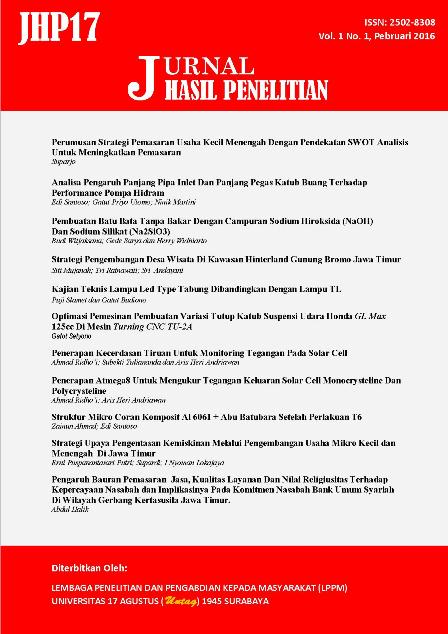
ANALISA PENGARUH PANJANG PIPA INLET DAN PANJANG PEGAS KATUB BUANG TERHADAP PERFORMANCE POMPA HIDRAM
Abstract
Hidram pump is one of the water pumps are energy efficient and
environmentally friendly. Pump hidram an effective technology in the field of
energy pumping by using the momentum of the water (water hammer) to raise
the water, so the pump hidram one water pump that does not use fuel and
electricity. Effectiveness hidram pump performance is affected by several
parameters such as the diameter of the pipe, reservoir height, exhaust valve, the
air tube on hidram pump, inlet pipe length. This study aimed to observe and
analyze the effect on the length of the inlet pipe to the pump hidram high
discharge pumps and pumping. This research method through the design of the
pump installation hidram and observation influence the inlet pipe length (6 m, 8
m, 10 m), and the observation of the effect of the length of the exhaust valve
spring (7 cm, 8 cm, 10 cm) to the pressure value (H) and the value of discharge
(Q) to the pump performance hidram. The test is performed in Production
Process Laboratory August 17, 1945 University of Surabaya. The longer the
pipe, the flow in the pump inlet hidram (Q) generated will be even greater. So in
the above study also directly proportional to the value of head (H) and
discharge rate (Q) on the pump performance hidram. So the value of the
existing pressure in the pump hidram with maximum value is generated head
with value - average (H) 1.41 bar and the discharge of water produced with -
average (Q) 21 liters / min. This is because the moment of greatest impact on
the water valve.
Keywords: Pump Hidram
Downloads
References
Abraham , C dan Shanley,E (1996). Psikologi Sosial untuk perawat .Jakarta: Buku Kedokteran EGC
Andrews D.R. & Dziegielewski S. (2005) The nurse manager: job satisfaction, the nursing shortage and retention. Journal of Nursing Management 13 (4), 286–295.
Ahmad, G.(1991). Burnout Syndrome. Fakultas Psikologi Universitas Padjadjaran. Andarika,
Bandura, A. (1986).Social Foundation of Thought and Action: a Social CognitiveTheory. New Jersey: Prentice-Hall Inc. ------- 1997. Self Efficacy: The Exercise of Control. New York: W.H.Freeman and Company.
Bandura, A. (1986). Social foundations of thought and action.New York: Prentice-Hall.
Bandura, A. (1997). Self-efficacy: The exercise of control. New York: Freeman.
Bandura, A. (2001). Guide for constructing self-efficacy scales. In G. V. Caprara (Ed.), Lavalutazione dell ‘autoeffcacia (The assessment of self-efficacy). (pp. 15-37). Trento, Italy: Erickson.
Bandura, A., Reese, L., & Adams, N. E. (1982).Microanalysis of action and fear arousal as afunction of differential levels of perceived self-efficacy. Journal of Personality and Social Psychology, 43, 5-21.
Carver, C. S. & Scheier, M. F.(1982). Control theory: A useful conceptual framework for personality-social, clinical and health psychology. Psychological Bulletin, 92, 111-135.
Chang, E., & Hancock, K. (2003). Role stress and role ambiguity in new nursing graduates in Australia. Nursing and Health Sciences, 5, 155-163
Chiswik 2005, Social relathionship and social support , Chapter 8
Cohen, J. (1988). Statistical power analysis for the behavioral sciences (2nd ed.). Hillsdale, NJ: Toronto: Multi-Health Systems.
Cohen, S., and Syme, S.L. (1985).Issues in the Study and Application of Social Support. Social Support and Health.Cohen, S., Syme, S.L. (editor). London:Academic Press, Inc.
Corbett, T. (1995). The Nurse as A Professional Carer. Interpersonal Communication in Nursing. Theory and Practice. Ellis, R.B., Gates, R.J., Kenworthy, N. (editor). New York: Churchil Livingstone.
Callaghan, P., & Field, M. (1991). Organization and stress among mental nurses. Nursing Times, 87,50.
Cordes, C.L., & Dougherty, T.W. (1993).A review and integration of research on self efficacyAcademy of Management Review, 18, 621-656.
Dormann, C., and Zapf, D. (1999). Social Support, Social Stressors at Work, andDepressive Symptoms: Testing for Main and Moderating Effects with Structural Equations in a Three-Wave Longitudinal Applied Psychology, Vol.72, No.2. hal. 269-274..
Ford, M. E. (1992). Motivating humans: Goals emotions and personal agency. New-bury Park, CA; Sage.
Ford, Gilboe Marilyn and Judith A. Cohen. (2000). Handbook Of Stres, Coping, And Health: Implication For Reasearch, Theory, And practice.. London : Sage Publication., Inc.
Garman, A., Corrigan, P. & Morris, S. (2002). Staff burnout and patient satisfaction: Evidence of relationships at the care unit level. Journal of Occupational Health Psychology, 7, 235 (2006).
Glass, D. C. & McKnight, J. D. (1996). Perceived control, depressive symp-tomatology, and professional burnout: a review of the evidence. Psychology and Health, 11, 23-48.
Hewitt, P. L. & Flett, G. L. (1997).Personality traits and the coping process.In M. Zeidner & N.S. Endler.Handbook of Coping.(pp. 410 - 433) New York: John Wiley & Sons.
Jackson, S.E., Schwab, R.L., and Schuler, R.S. (1986). Toward an Understanding ofthe Burnout Phenomenon. Journal of Applied Psychology,Vol.71,No.4. hal. 630-640.
Jex, S.M., and Bliese, P.D. (1999). Efficacy Beliefs as A Moderator of The Impactof Work-Related Stressors: A Multilevel Study. Journal of AppliedPsychology, Vol. 84, No. 3.hal 349-361.
Downloads
Published
Issue
Section
License
COPYRIGHT NOTICE
The copyright in this website and the material on this website (including without limitation the text, computer code, artwork, photographs, images, music, audio material, video material and audio-visual material on this website) is owned by JHP17and its licensors.
Copyright license
JHP17 grants to you a worldwide non-exclusive royalty-free revocable license to:
- View this website and the material on this website on a computer or mobile device via a web browser;
- Copy and store this website and the material on this website in your web browser cache memory; and
- Print pages from this website for your
- All articles published by JHP17are licensed under the creative commons attribution 4.0 international license. This permits anyone to copy, redistribute, remix, transmit and adapt the work provided the original work and source is appropriately cited.
JHP17does not grant you any other rights in relation to this website or the material on this website. In other words, all other rights are reserved.
For the avoidance of doubt, you must not adapt, edit, change, transform, publish, republish, distribute, redistribute, broadcast, rebroadcast or show or play in public this website or the material on this website (in any form or media) without appropriately and conspicuously citing the original work and source or JHP17prior written permission.
Permissions
You may request permission to use the copyright materials on this website by writing to jhp17@untag-sby.ac.id
Enforcement of copyright
JHP17takes the protection of its copyright very seriously.
If JHP17discovers that you have used its copyright materials in contravention of the license above, JHP17 may bring legal proceedings against you seeking monetary damages and an injunction to stop you using those materials. You could also be ordered to pay legal costs.
If you become aware of any use of JHP17's copyright materials that contravenes or may contravene the license above, please report this by email to jhp17@untag-sby.ac.id
Infringing material
If you become aware of any material on the website that you believe infringes your or any other person's copyright, please report this by email to jhp17@untag-sby.ac.id
target="_blank"


