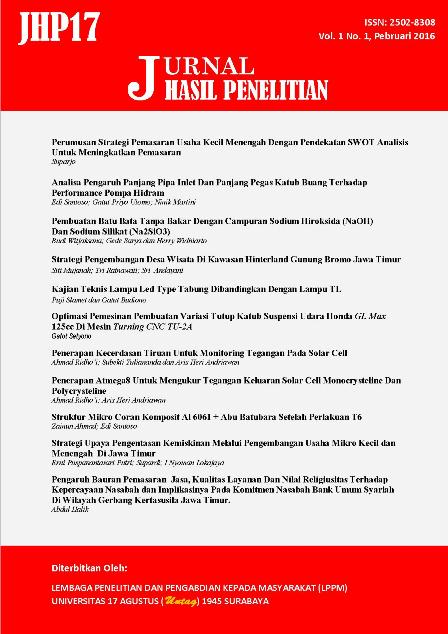
STRUKTUR MIKRO CORAN KOMPOSIT Al 6061 + ABU BATUBARA SETELAH PERLAKUAN T6
Abstract
Heat treatment on the aluminum alloy is done by heating until a single
phase was then arrested a few moments and forwarded by rapid cooling to not
have time to change to another phase. If the material was left for a certain
period of time then there was the process of aging (aging). Changes will occur
in the form of precipitation (precipitation) The second phase begins with the
onset of nucleation and atom clusters that became the beginning of the
precipitates. This precipitates can increase the strength and hardness. This
process is the age hardening process called natural aging. If after rapid cooling
then heated again to below the solvus temperature (solvus line) then detained in
the long term and followed by slow cooling in the air called artificial aging
process (artificial aging). This study aims to determine the microstructure of
what is formed from a material with a temperature variation of aging (200oC,
225oC, 250oC) and holding time (8 hours, 12 hours, 16 hours) to determine how
much influence the variables, can be analyzed through testing SEM EDXA.
From the test results of SEM-EDXA it can be determined microstructure formed
in 6061 + Al composite coal bottom ash, which is composed of aluminum oxide
compound of Al 2 O 3 and MgO.
Keywords: microstructure, composites, coal bottom ash
Downloads
References
Abidin, Y. (2009). Bermain Pengantar bagi Penerapan Pendekatan Beyond Centers and Circle Time (BCCT) dalam Dimensi PAUD. Bandung: Rizqi Press.
Azwar, S. (2010). Penyusunan Skala Psikologi. Yogyakarta : Pustaka Pelajar.
Berk,L.E, (1992). Children’s Private Speech : An Overview Of Theory And The Status Of Research. In R.M. Diaz & L.E. Berk (Eds), Private Speech : From Social Interaction To Self Regulation. UK : Lawrance Erlbaum Associates
Chaplin, J.P. (2004). Kamus Psikologi. Jakarta: PT. Raja Grafindo Persada.
Depdikbud.1994 Kurikulum Taman Kanak-kanak. Jakarta.
Departemen Pendidikan dan Kebudayaan. 1999. Pedoman Pembelajaran Bidang Pengembangan Kognitif Pendidikan Taman Kanak-kanak
Hurlock, Elizabeth B. (1978). Child Development. 6th Ed. Tokyo: McGraw Hill Inc. International Student Ed.
Hurlock, B. Elizabeth. (1997). Perkembangan Anak Jil. I. Jakarta Erlangga
Hurlock, E.B. (2005). Perkembangan Anak Jilid 2. Alih Bahasa: Dr. Medmeitasari Tjandrasa. Jakarta: Erlangga
Hurlock, E.B. (2008). Perkembangan Anak Jilid 1 Edisi Keenam Alih Bahasa: Meitasari Tjandrasa dan Muslichah Zarkasih. Jakarta. Erlangga
Helms, D. B & Turner, J.S., (1983), Exploring Child Behavior, New York : Holt Rinehartand Winston.
Kemendiknas, (2012). Kurikulum Taman Kanak-kanak Pedoman Pengembangan Program Pembelajaran di TK. Jakarat
Mehibin, S. (1995). Psikologi Belajar, Ciputra: Logos Wacana Ilmu
Nugraha A, (2006). Metode Pengembangan Sosial Emosional. Jakarta. UT
Nurani, Sujiono, Yuliani (2009). Konsep dasar Pendidikan Anak Usia Dini. Jakarta: PT Indek
Seto, Mulyadi. 2004. Bermain dan Kreativitas, Upaya mengembangkan Kreativitas Anak melalui Kegiatan Bermain, Jakarta:Papas SinarSinanti
SkalaLikert,http://id.wikipedia.org/wiki/Skala_Likert, akses 2 Nopember 2014
Tim Penyusun Kamus Pembinaan dan Pengembangan Bahasa. 1997. Kamus Besar Bahasa IndonesiaEdisi Kedua, Cetakan Kesepuluh. Jakarta: BalaiPustaka.
Undang-undang No.20 Tahun 2003. Pasal1 angka 14. Tentang Pendidikan Nasional. Jakarta: Departemen Pendidikan Nasional.
Uno, Hamzah. 2008. Model Pembelajaran, Bumi Aksara
Downloads
Published
Issue
Section
License
COPYRIGHT NOTICE
The copyright in this website and the material on this website (including without limitation the text, computer code, artwork, photographs, images, music, audio material, video material and audio-visual material on this website) is owned by JHP17and its licensors.
Copyright license
JHP17 grants to you a worldwide non-exclusive royalty-free revocable license to:
- View this website and the material on this website on a computer or mobile device via a web browser;
- Copy and store this website and the material on this website in your web browser cache memory; and
- Print pages from this website for your
- All articles published by JHP17are licensed under the creative commons attribution 4.0 international license. This permits anyone to copy, redistribute, remix, transmit and adapt the work provided the original work and source is appropriately cited.
JHP17does not grant you any other rights in relation to this website or the material on this website. In other words, all other rights are reserved.
For the avoidance of doubt, you must not adapt, edit, change, transform, publish, republish, distribute, redistribute, broadcast, rebroadcast or show or play in public this website or the material on this website (in any form or media) without appropriately and conspicuously citing the original work and source or JHP17prior written permission.
Permissions
You may request permission to use the copyright materials on this website by writing to jhp17@untag-sby.ac.id
Enforcement of copyright
JHP17takes the protection of its copyright very seriously.
If JHP17discovers that you have used its copyright materials in contravention of the license above, JHP17 may bring legal proceedings against you seeking monetary damages and an injunction to stop you using those materials. You could also be ordered to pay legal costs.
If you become aware of any use of JHP17's copyright materials that contravenes or may contravene the license above, please report this by email to jhp17@untag-sby.ac.id
Infringing material
If you become aware of any material on the website that you believe infringes your or any other person's copyright, please report this by email to jhp17@untag-sby.ac.id
target="_blank"