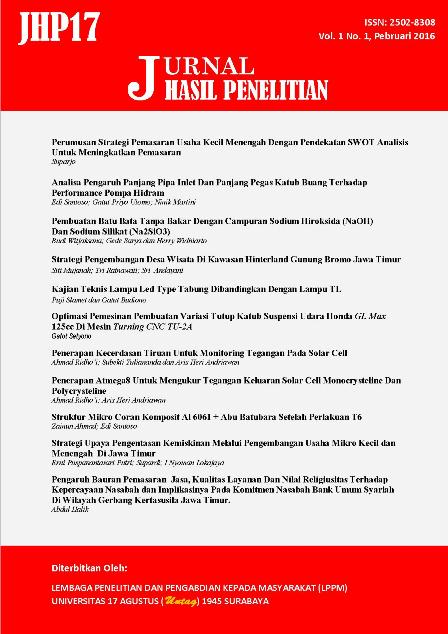
OPTIMASI PEMESINAN PEMBUATAN VARIASI TUTUP KATUB SUSPENSI UDARA HONDA GL MAX 125cc DI MESIN TURNING CNC TU-2A (Studi Kasus Kondisi Optimum nt=1 dan nt=500)
Abstract
Optimization is a way to get optimum machinery condition where to
reached optimization condition, usually done with optimizing toward engine
cutting parameter that exist. The aim of optimization is to get cheapest
production cost and lowest production time. In air suspension valve cover
variation making in Honda GL Max 125 cc in turning machine CNC TU-2A
method that done is analytical method with chisel age criteria (T), cutting speed
(v), machine time (tm) and production cost (Cp) in turning machinery process
CNC TU-2A. The result of air suspension valve cover variation making in
Honda GL Max 125 cc in turning machine CNC TU-2A that time required to
completing one product is tc = 3,90 minutes. With optimum condition analysis
between nt = 1 with nt = 500, so obtained calculation result for economic
condition nt = 1, economic production time required tme = 20,69 minutes and
economic production cost Cp,c = Rp. 132.193,04,-/product, productive
production time tm,p = 17,97 minutes, productive production cost Cp,p = Rp.
133.648,69,-/product. For economic condition nt = 500, economic production
time tm,e = 12,74 minutes and economic production cost Cp,e = Rp. 2.175,94,-/
product, productive production time required tm,p = 10,06 minutes, productive
production cost Cp,p = Rp. 3.632,42,-/product.
Keywords : Optimization, cutting speed, chisel age, production time and
production cost.
Downloads
References
Abdullahi, O.E. (2002). Relationship Among Achievement Motivation, Self- Esteem, Locus of Control and Academic Performance of Nigerian University Student. British Journal of Educational Psychology. Vol: 53, p: 60-78.
Anderson, A., Hattie, J., and Hamilton, J.R (2005). Locus of Control, Self- Efficacy, and Motivation in Different Schools: Is moderation the key to success?. Educational Psychology Journal. Vol. 25, No. 5, pp. 517–535
Appelbaum, S.H., and Harre, A. (2010). Self-efficacy as a mediator of goal setting and performance Some human resource applications. Journal of Managerial Psychology,Vol. 11 No. 3, 1996, pp. 33-47.
Bandura, A. (1997). Self-efficacy: The exercise of control. New York: Freeman
Bansal, S., Thind, S.K., and Jaswal, S (2006). Relationship Between Quality of Home Environment, Locus of Control and Achievement Motivation Among
High Achiever Urban Female Adolescents. Journal of Human and Ecology, Vol. 19 (4), p: 253-257
Bozgeyikli, H., EroandÄŸlu, S.E., dan Hamurcu, H (2009). Career decision making self-efficacy, career maturity and socioeconomic status with turkish youth. Georgian Electronic Scientific Journal: Education Science and Psychology.No.1(14), p: 15-24
Creed, P.A., Patton, W., and Watson, M.B. (2003), Cross-cultural equivalence of the CareerDecision-Making Self-EfficacyScale – Short Form: An Australian and South African comparison. Journal of Counseling and Development, Vol:74, p: 276-279.
Devilly, G. J. (2005). Power Therapies and possible threats to the science of psychology and psychiatry. Australian
and New Zealand Journal of Psychiatry, Vol. 39 (6): 437–445.
Dysvik, A., and Bård, K (2008), The relationship between perceived training opportunities, work moti-vation and employee outcomes. International Journal of Training and Development. Volume 12, Issue 3, pages 138–157,
Erikson, E. H (1992). Siklus Hidup Manusia dan Krisis Identitas. Jakarta: Penerbit PT. Gramedia
Flores, L.Y., Ojeda, Ldan Yu-Ping, H . (2006). The Relation of Accultura-tion, Problem-Solving Appraisal, and Career Decision-Making Self- Efficacy to Mexican American High SchoolStudents’ Educational Goals. Journal of Counseling Psychology. Vol. 53, No. 2, p: 260–266
Gallavan, N.P. (2003) Decision making, self-efficacy, and the place of career
education in elementary school social studies. Journal of Social Studies, Vol:
p: 5-5)
Ghazali, I.A (2006). Aplikasi Analisis Multivariate dengan Program SPSS. Semarang : Badan Penerbit Dipo-negoro
Goldstein, H (1996). Using Examination Results as Indicators of School and College Performance. Journal of Royal Statistical Society. No. 159,Vol: 1, pp. 149-163.
Gushue, G.V., Scanlan, K.R.L., Pantzer, K.M., and Clarke, C.P (2006), TheRelationship of CareerDecision-Making Self-Efficacy, Vocational Identity,and Career Exploration Behaviorin African AmericanHigh School Students. Journal of Career Development. Volume 33 Number 1, p: 19-28
Hadi, S (2000). Statistik 2. Yogyakarta : Yayasan penerbitan Fak. Psikologi
Downloads
Published
Issue
Section
License
COPYRIGHT NOTICE
The copyright in this website and the material on this website (including without limitation the text, computer code, artwork, photographs, images, music, audio material, video material and audio-visual material on this website) is owned by JHP17and its licensors.
Copyright license
JHP17 grants to you a worldwide non-exclusive royalty-free revocable license to:
- View this website and the material on this website on a computer or mobile device via a web browser;
- Copy and store this website and the material on this website in your web browser cache memory; and
- Print pages from this website for your
- All articles published by JHP17are licensed under the creative commons attribution 4.0 international license. This permits anyone to copy, redistribute, remix, transmit and adapt the work provided the original work and source is appropriately cited.
JHP17does not grant you any other rights in relation to this website or the material on this website. In other words, all other rights are reserved.
For the avoidance of doubt, you must not adapt, edit, change, transform, publish, republish, distribute, redistribute, broadcast, rebroadcast or show or play in public this website or the material on this website (in any form or media) without appropriately and conspicuously citing the original work and source or JHP17prior written permission.
Permissions
You may request permission to use the copyright materials on this website by writing to jhp17@untag-sby.ac.id
Enforcement of copyright
JHP17takes the protection of its copyright very seriously.
If JHP17discovers that you have used its copyright materials in contravention of the license above, JHP17 may bring legal proceedings against you seeking monetary damages and an injunction to stop you using those materials. You could also be ordered to pay legal costs.
If you become aware of any use of JHP17's copyright materials that contravenes or may contravene the license above, please report this by email to jhp17@untag-sby.ac.id
Infringing material
If you become aware of any material on the website that you believe infringes your or any other person's copyright, please report this by email to jhp17@untag-sby.ac.id
target="_blank"