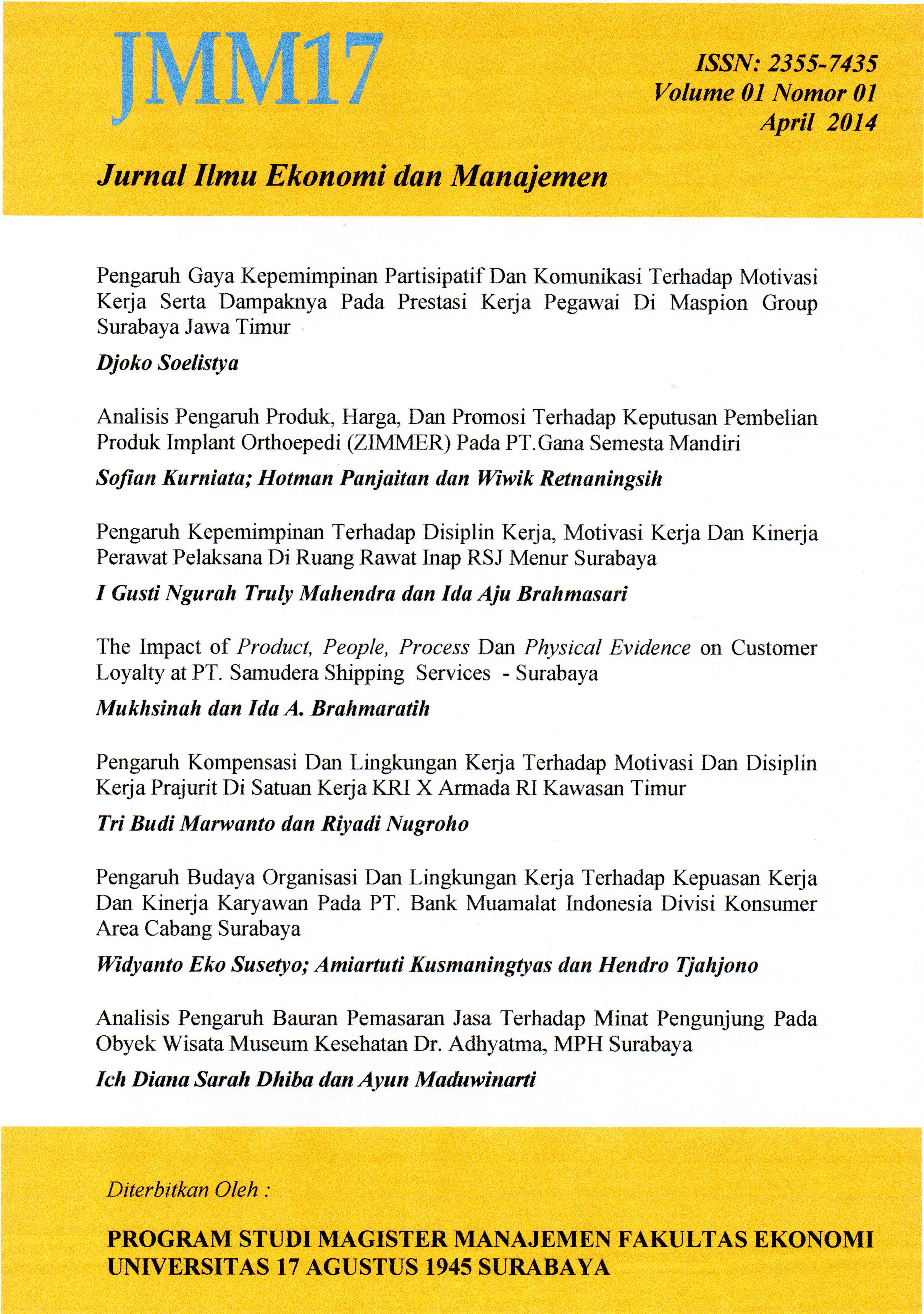
Pengaruh Kepemimpinan Terhadap Disiplin Kerja, Motivasi Kerja Dan Kinerja Perawat Pelaksana Di Ruang Rawat Inap RSJ Menur Surabaya
DOI:
https://doi.org/10.30996/jmm17.v1i01.311Abstract
Nurse performance define by nurse activity in implementation of authority, duty and its responsibility in order to fundamental duty target attainment of profession and existing of certifiable treatment upbringing. This research is to prove and analyse the leadership influence to work discipline, leadership to work motivation, work discipline to performance, work motivation to performance and leadership influence to performance of nurse who take care of patients at ward of the RSJ Menur Surabaya. This research is performed in ward of the RSJ Menur Surabaya with the responder of nurse as much 76 people. Research instrument by kuesioner and use the Likert scale to collect the data, while analysis constructively program the Smart PLS 2.0. Result of analysis find the existence of significancy relation between leadership and discipline (t statistic: 5,192), leadership and motivation (t statistic: 2,294), and between motivation and performance (t statistic: 4,251). While relation do not signifikan between discipline and performance (t statistic: 1,362) and between leadership and performance (t statistic: 0,209). This research founded that Leadership have influence which are positive and significan to work discipline, Leadership have influence which are positive and signifikan to work motivation, Work Discipline have influence which are positive but do not signifikan to performance, Work Motivation have influence which are positive and signifikan to performance and Leadership have influence which do not signifikan to performance of nurse who take care of patients at ward of the RSJ Menur Surabaya. Among work discipline variable, work motivation, leadership, and performance, founded that leadership have the biggest influence at work discipline, and performance very influenced by work motivation of nurse who take care of patients at ward of the RSJ Menur Surabaya.
Key word: leadership, work discipline, work motivation, nurse performance.
Downloads
References
A.A. Oka Mahendra, Komisi Pemberantasan Terbaik, Suara Karya, 29 Mei 2001.
Achmad Ali, Asas Pembuktian Terbalik dan Tak Bersalah, Artikel Vol.1 No.2 Jurnal Keadilan, Juni, 2001, h.30.
Adami Chazawi, Kejahatan Terhadap Harta Benda, Bayumedia, Malang, 2003, h.16.
Andi Hamzah, Korupsi Indonesia, Masalah dan Pemecahannya, Gramedia, Jakarta, 1984, hal.18.
Andy Hamzah, Perkembangan Hukum Pidana Khusus, Aditya Bakti, Bandung, 2002, h.115.
Baharuddin Lopa, Pembuktian Terbalik, Salah Satu Pilihan, Kompas, 26 Juli 1999, hal.9.
Bambang Poernomo, Hukum Acara Pidana Pokok-pokok Tata Cara Peradilan Pidana Indonesia dalam Undang-undang RI No.8 tahun 1981, Liberty, Yogyakarta, 1986, h.20.
Bambang Purnomo, Potensi Kejahatan Korupsi di Indonesia, Cet.I, Bina Aksara, 1983, hal.10.
Djoko Prakoso dan Ati Suyati, Uptimisme Dari Undang-undangPemberantasan Tindak Pidana Korupsi Tahun 1971, Bina aksara, Jakarta, 1986, h.8.
Happy B., Bambang Soedjiartono dan Jalil Hakim, Terbentur Pejabat, Kejahatan Digugat, Kompas, 12 Juli 1999, hal 18.
Hari Sasangka dan Lily Rosita, Hukum Pembuktian Dalam Perkara Pidana, Sinar Wijaya, Surabaya, 1995, hal.11-12.
Hariyanto Seno Adji, Sistem Pembuktian Terbalik Meminimalisasi Korupsi di Indonesia, Jurnal Keadaan, 2 Juni 2001, h.42.
Haryono Mintaroem, Korupsi Menurut UU No. 3/1971, Bahan Kuliah Tindak Pidana Korupsi dalam Perbuatan Pidana Korupsi Fakultas Hukum Universitas Airlangga, hal.1.
Hermien Hadiati K., Korupsi di Indonesia, Dari Delik Jabatan ke Tindak Pidana Korupsi, Cet.I, Citra Aditya Bakti, Bandung, 1994, hal.32.
Ika Nurmasari, Upaya Peningkatan Peran Serta Masyarakat Dengan Mendayagunakan Prosedur Gugatan Perwakilan Kelompok Untuk Memberantas Korupsi, FH Unair, Surabaya, 2006, h.35.
J.S. Badudu – Sutan Muhammad Zein, Kamus Umum Bahasa Indonesia, Pustaka Sinar Harapan, Jakarta, 2001, h.86.
K. Watjik Saleh, Tindak Pidana Korupsi dan Suap, Ghalia Indonesia, Jakarta, 1983, h.51.
Kompas, Pengadaan Barang, APBN bocor Rp 100 Triliyun, 18 Juni 2004.
Leden Marpaung, Unsur-unsur Yang Dapat Dihukum (Delik), Cet.I, Sinar Grafika, Jakarta, 1991, hal.7-8.
Lilik Mulyadi, Tindak Pidana Korupsi, PT. Citra Aditya, Bandung, 2000, hal.17.
Litbang KPK, Tata Kelola Pemerintahan Yang Baik, h. 13.
Luhut MP Panggaribuan, Sistem Pembuktian Terbalik, Kompas, 2 April 2001, h.7.
M. Yahya Harahap, Pembahasan Permasahan dan Penerapan KUHAP, Pemeriksaan Sidang Pengadilan, Banding, Kasasi dan Peninjauan Kembali, Sinar Grafika, Jakarta, 2000.
M. Yahya Harahap, Pembahasan Permasalahan dan Penerapan KUHAP, Jilid II, Pustaka Kartini, Jakarta, 1998. hal .99.
Martiman Prodjohamidjojo, Penerapan Pembuktian Terbalik Dalam Perkara Delik Korupsi, CV. Mandar, Bandung, 2001, hal.99.
Martiman Prodjohamijojo. Perempuan Pembuktuan Terbaik Dalam Delik Korupsi (UU No. 13 Tahun 1999), Mandar Maju, Bandung, 2001, h.7.
R. Wiyono, Pembahasan Undang-Undang Pemberantasan Tindak Pidana Korupsi, Sinar Grafika, Jakarta, 2005, h.233.
Ralph Braibanti, Reflection on Bureacratic Corruption, Public Administration, 1962, Jakarta, h.47.
Rihad Wiranto, Rita T. Budiarto dan Koesworo Setiawan, Jadi Tersangka Sehari, Forum No.35 Th.V, 17 Juli 1999, hal.85.
Downloads
Published
How to Cite
Issue
Section
License
Authors who publish to JMM17: Jurnal Ilmu Ekonomi Dan Manajemen agree to the following terms:
- Authors transfer the copyright and grant the journal right of first publication with the work simultaneously licensed under a Creative Commons Attribution-ShareAlike 4.0 International License.. that allows others to share the work with an acknowledgement of the work's authorship and initial publication in this journal.
- Authors are able to enter into separate, additional contractual arrangements for the non-exclusive distribution of the journal's published version of the work (e.g., post it to an institutional repository or publish it in a book), with an acknowledgement of its initial publication in this journal.
- Authors are permitted and encouraged to post their work online (e.g., in institutional repositories or on their website) prior to and during the submission process, as it can lead to productive exchanges, as well as earlier and greater citation of published work (See The Effect of Open Access)