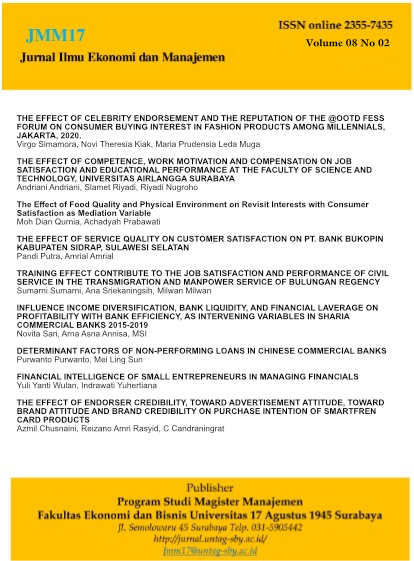
TRAINING EFFECT CONTRIBUTE TO THE JOB SATISFACTION AND PERFORMANCE OF CIVIL SERVICE IN THE TRANSMIGRATION AND MANPOWER SERVICE OF BULUNGAN REGENCY
DOI:
https://doi.org/10.30996/jmm17.v8i02.5231Keywords:
Training, Job Satisfaction, Employee PerformanceAbstract
The rationale of this study was to analyze and prove the training effect on the performance of the Civil Service through job satisfaction variables. Type of research is included in explanatory research. The population is all employees of Transmigration and Manpower Office of Bulungan Regency about 55 persons. The number of samples in this study were 55 respondents. The sampling technique performed by using total sampling technique. Data analysis technique used a path analysis approach. The findings showed that training has a positive and significant effect on employee job satisfaction. Training has a positive and significant effect on employee performance. Job satisfaction has a positive and significant effect on employee performance. In step 1, training is proven to have a significant effect on employee performance. In step 2 when training and job satisfaction are regressed together to predict employee performance, training remains significant. Thus job satisfaction is able to mediate the effect of training on employee performance.
Downloads
References
Wicaksono, Y.S. (2016). “Pengaruh Pelatihan dan Pengembangan Sumber Daya Manusia dalam Rangka Meningkatkan Semangat Kerja dan Kinerja Karyawan (Studi di SKM Unit V PT. Gudang Garam,Tbk Kediri)”. Jurnal Bisnis dan Manajemen. Vol. 3 No.1, Januari 2016. Pp. 31-39.
Widodo, Suparno Eko. (2015). Manajemen Pengembangan Sumber Daya Manusia. Cetakan ke-1, Pustaka Pelajar, Yogyakarta
Winardi. (2016). Kepemimpinan dalam Manajemen. Cetakan Kedua, Yogyakarta.
Wirawan. (2015). Evaluasi Kinerja Sumber Daya Manusia (Teori, Aplikasi, dan Penelitian). Jakarta: Salemba Empat.
Downloads
Published
How to Cite
Issue
Section
License
Authors who publish to JMM17: Jurnal Ilmu Ekonomi Dan Manajemen agree to the following terms:
- Authors transfer the copyright and grant the journal right of first publication with the work simultaneously licensed under a Creative Commons Attribution-ShareAlike 4.0 International License.. that allows others to share the work with an acknowledgement of the work's authorship and initial publication in this journal.
- Authors are able to enter into separate, additional contractual arrangements for the non-exclusive distribution of the journal's published version of the work (e.g., post it to an institutional repository or publish it in a book), with an acknowledgement of its initial publication in this journal.
- Authors are permitted and encouraged to post their work online (e.g., in institutional repositories or on their website) prior to and during the submission process, as it can lead to productive exchanges, as well as earlier and greater citation of published work (See The Effect of Open Access)