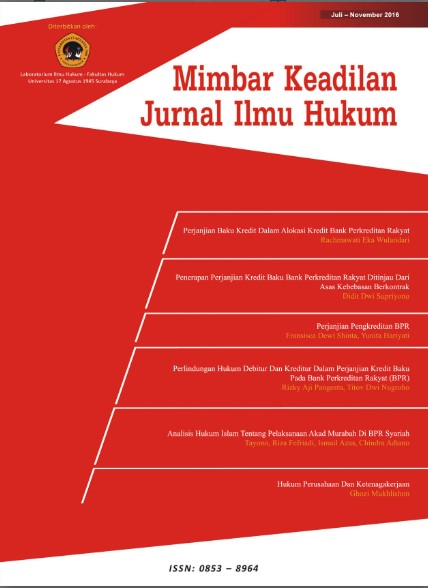
PERJANJIAN BAKU KREDIT DALAM ALOKASI KREDIT BANK PERKREDITAN RAKYAT
DOI:
https://doi.org/10.30996/mk.v0i0.2210Keywords:
perjanjian baku kredit, bank perkreditan rakyat, alokasi kreditAbstract
Perjanjian baku kredit dalam perbankan terutama bagi Bank Perkreditan Rakyat (BPR) merupakan suatu hal yang lumrah. Hal ini memudahkan pada saat penandatanganan perjanjian kredit. Namun sebelum melakukan penandatangana perjanjian kredit pihak bank harus lebih dulu memperhatikan beberapa hal dalam alokasi kredit. Metode pendekatan yang dipakai adalah pendekatan yuridis normatif yaitu pendekatan yang menggunakan legis positivis.
Downloads
References
R. Setiawan, 1999, Pokok-pokok Hukum Perikatan. Putra A Bardin.
Singarimbun, M, 1982. Penelitian Ilmiah – Dasar Metode Teknik. Penerbit Tarsito. Bandung.
Subekti, 1978, Hukum Perjanjian, Intermasa Jakarta.
Susanto, 2017,Perjanjian Kredit Yang Dibuat Secara Baku Pada Kredit Perbankan Dan Permasalahan Pilihan Domisili Hukum Penyelesaian Sengketa, Dinamika Masalah Hukum dan Keadilan, Surya Kencana Dua,Vol 4,1.
Thomas Suyatno, Dasar-dasar Perkreditan, Gramedia Jakarta.
Wibisana, 1988, Penelitian Penyempurnaan Sistem Pembinaan dan Pengawasan Bank Perkreditan Rakyat. Pusat Penelitian dan Pengembangan Faperta Universitas Brawijaya Malang. Malang.
Downloads
Published
Issue
Section
License
Authors who publish with Mimbar Keadilan agree to the following terms:
- Authors transfer the copyright and grant the journal right of first publication with the work simultaneously licensed under a Creative Commons Attribution-ShareAlike 4.0 International License.. that allows others to share the work with an acknowledgement of the work's authorship and initial publication in this journal.
- Authors are able to enter into separate, additional contractual arrangements for the non-exclusive distribution of the journal's published version of the work (e.g., post it to an institutional repository or publish it in a book), with an acknowledgement of its initial publication in this journal.
- Authors are permitted and encouraged to post their work online (e.g., in institutional repositories or on their website) prior to and during the submission process, as it can lead to productive exchanges, as well as earlier and greater citation of published work (See The Effect of Open Access)