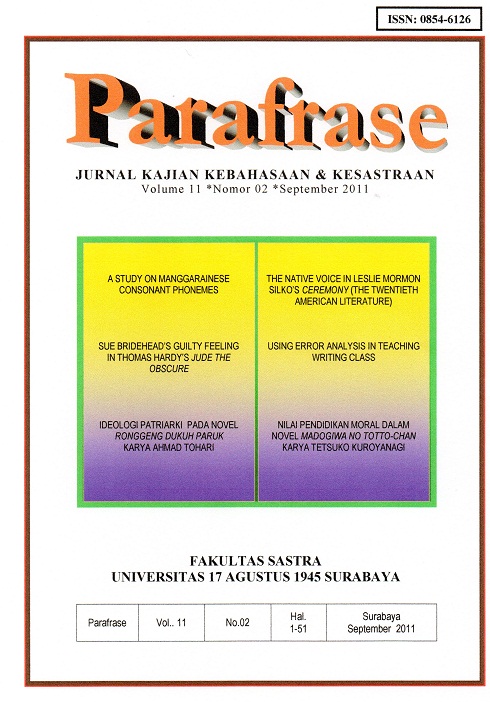
A STUDY ON MANGGARAINESE CONSONANT PHONEMES
DOI:
https://doi.org/10.30996/parafrase.v11i02.191Abstract
Abstrak. Penelitian ini adalah tentang inventarisasi bunyi-bunyi konsonan Dialek Manggarai ‘S berubah menjadi H’ (Manggarainese Dialect S>H, atau MDS>H) yang digunakan di wilayah Flores bagian barat, Provinsi Nusa Tenggara Timur. Inventarisasi bunyi konsonan yang telah dikenal meliputi delapan belas (18) bunyi konsonan, tidak termasuk unsure pra-nasal  karena selama ini urutan bunyi nasal homorgan plus obstruent, yaitu /mp/, /mb/, /ns/, nt/, ŋk/ dan /ŋg/ dianggap deretan konsonan (consonant clusters). Penelitian ini difokuskan pada identifikasi fonem konsonan MDS>H, klasifikasi fonetik fonem konsonan, distribusinya dan deretan fonem konsonan. Dalam penelitian ini akan dianalisis klasifikasi fonem-fonem konsonan MDS>H atas dasar komposisi fonetisnya seperti arah aliran udara dalam proses penghasilan bunyi, posisi pita suara, tempat dan cara artikulasi.
Â
Kata kunci: phoneme classification, place and manner of articulations, Manggarainese Dialects of S shift to H.
Downloads
References
Bandura, A. (1994). Efikasi-diri. In V. S. Rama-chaudran (Ed.), Encyclopedia of human behavior (Vol. 4, pp. 71-81). New York: Academic Press. (Reprinted in H. Friedman [Ed.], Encyclopedia of mental health. San Diego: Academic Press, 1998). Available at http://des.emory.edu/mfp/BanEncy.html. Unduh 12 Juni 2011.
Bandura, A. (1997). Efikasi-diri: The Exercise of Control. NY: Freeman & Company.
Bracke, P, Christiaens. W., & Verhaeghe. M. (2008). Self-Esteem, Efikasi-diri, and the Balance of Peer Support Among Persons With Chronic Mental Health Problems. Jour-nal of Applied Social Psychology, 38, 2, 436–459.
Brady, T.J. (2003). Measures of efikasi-diri, helplessness, mastery, and control: The Arthritis Helplessness Index (AHI)/Rheuma-tology Attitudes Index (RAI), Arthritis Efi-kasi-diri Scale (ASES), Children's Arthritis Efikasi-diri Scale (CASE), Generalized Efi-kasi-diri Scale (GSES), Mastery Scale, Multi-Dimensional Health Locus of Control Scale (MHLC), Parent's Arthritis Efikasi-diri Scale (PASE), Rheumatoid Arthritis Efikasi-diri Scale (RASE), and Efikasi-diri Scale (SES). Arthritis Care & Research, 49, S5, S147–S164.
Choi, N. (2005). Efikasi-diri and self-concept as predictors of college students' academic performance. Psychology in the Schools, 42, 2, 197–205.
Cooper, R.K., Sawaf, A. 2002. Executive EQ: Kecerdasan Emosi Dalam Kepemimpinan dan Organisasi. Jakarta: Gramedia Pustaka Utama.
Franzblau, S.H., & Moore, M. (2001). Socia-lizing efficacy: a reconstruction of efikasi-diri theory within the context of inequality. Journal of Community & Applied Social Psy-chology, 11, 2, 83–96.
Geller, K.S., Dzewaltowski, D.A., Rosenkranz, R.R., & Karteroliotis, K. (2009). Measuring Children’s Efikasi-diri and Proxy Efficacy Related to Fruit and Vegetable Consumption. Journal of School Health, 79, 2, 51–57.
Germain, R.B. (1978). Self-concept and self-esteem reexamined. Psychology in the Schools, 16, 3, 386-390.
Goleman, D. 1999. Kecerdasan Emosi: Menga-pa EQ Lebih Penting Daripada IQ? Jakarta: Gramedia Pustaka Utama.
King, K, A. (1997). Self-Concept and Self-Esteem: A Clarification of Terms. Journal of School Health, 67, 2, 68-70.
Lyman, R.D., Prentice-Dunn, S., Wilson, D.R., & Bonfilio, S.A. (1984). The effect of success or failure on efikasi-diri and task persistence of conduct-disordered children. Psychology in the Schools, 21, 4, 516–519.
Magaletta, P.R., & Oliver, J.M. (1999). The hope construct, will, and ways: Their relati-ons with self-efficacy, optimism, and general well-being. Journal of Clinical Psychology, 55, 5, 539–551.
Mikkelsen, E.G., & Einarsen, S. (2002). Rela-tionships between exposure to bullying at work and psychological and psychosomatic health complaints: The role of state negative affectivity and generalized self–efficacy. Scandinavian Journal of Psychology. 43, 5, 397–405.
Muawanah, L.B. (2012). Kematangan emosi, konsep diri dan kenakalan remaja. Tesis. Surabaya: Universitas 17 Agustus 1945.
Patton, P. I. (1997). EQ (Kecerdasan Emosio-nal) di Tempat Kerja. Jakarta: Pustaka Dela-prastasa.
Shapiro, L. E. (1997). Mengajarkan Emotional Intelligence pada Anak. Jakarta: Gramedia Pustaka Utama.
Stein, J.S., Book, E.H. 2002. Ledakan EQ: 15 Prinsip Dasar Kecerdasan Emosional Mera-ih Sukses. Bandung: Kaifa.
Vincent, J., & Houlihan, D. (1991). Brief re-port: Measuring efikasi-diri with female adolescents who are conduct disordered: Validation of the program efficacy scale. Behavioral Interventions, 6, 4, 303–310.
Wilson, J.P., Wilson, S.R. (1996). Sources of Self Esteem and The Person X Situasion Controversy, Psychol. Rep./ Apr., 38, 355-8.
Yule, G. 1985. The Study of Language: An Introduction. Cambridge: CUP.
Downloads
Published
How to Cite
Issue
Section
License
Authors publishing in the Journal will be asked to sign a Copyright Assignment Form. In signing the form, it is assumed that authors have obtained permission to use any copyrighted or previously published material. All authors must read and agree to the conditions outlined in the form, and must sign the form or agree that the corresponding author can sign on their behalf. Articles cannot be published until a signed form has been received.It is a condition of publication that authors assign copyright or license the publication rights in their articles, including abstracts, to email jurnalparafrase@untag-sby.ac.id. . This enables us to ensure full copyright protection and to disseminate the article, and of course the Journal to the widest possible readership in print and electronic formats as appropriate.