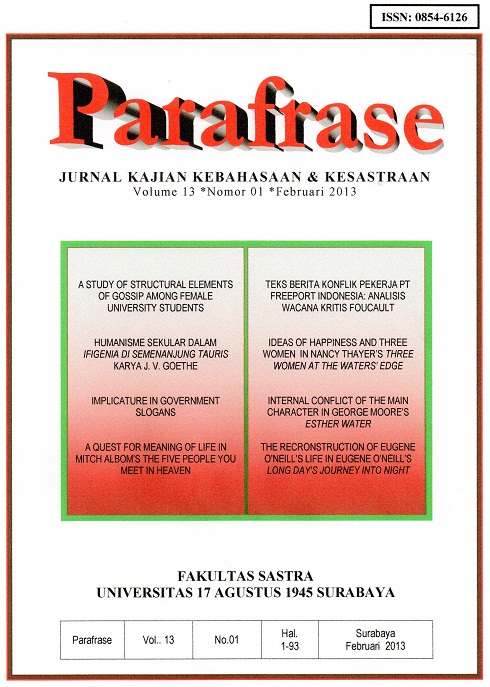
IMPLICATURE IN GOVERNMENT SLOGANS
DOI:
https://doi.org/10.30996/parafrase.v13i01.224Abstract
Abstrak. Penelitian ini membahas implikatur dalam sebelas slogan pemerintah yang dipajang di jalan-jalan utama Surabaya. Slogan yang umumnya mengandung kalimat-kalimat yang menarik dan dicetak dalam warna menantang memiliki makna atau pesan tersirat (implisit). Penelitian difokuskan pada jenis kalimat yang digunakan dan jenis implikatur dalam  slogan. Hasil penelitian menunjukkan bahwa sembilan (9) dari sebelas (11) slogan menggunakan bentuk imperative, sementara dua menggunakan deklaratif. Makna tersirat dalam slogan bervariasi sesuai dengan tujuan slogan, antara lain, peringatan (warning), himbauan dan penyebaran informasi. Jenis implikatur yang digunakan adalah conversational implicature, scalar implicature dan conventional implicature.
Â
Keywords: implicit meaning, conversational, scalar, conventional implicature
Downloads
References
Smith, S.E. 2010. “What is a Culvertâ€.http://www.wisegeek.com, (9th September 2010).
“Sloganâ€.http://en.wikipedia.org/wiki/Slogan. (February 5, 2011).
Suwarti. 2005. A study of implicaturefound in the conversation among the resident of Manyarrejo 8/16 boarding house in Surabaya. S1, Thesis, University of 17 Agustus 1945 Surabaya.
Undang-Undang Negara Republik Indonesia No. 22 Tahun 1997.www.bpkp.go.id. (January 25th 2011).
“UpacaraPeringatanHari SumpahPemuda ke-81 di Surabayaâ€.http://www.surabaya.go.id. (January 25th 2011).
“Utamaâ€.http://dictionary.reference.com. (January 25th 2011).
Wahyudi, Ahyar. 2009. “Bahaya Merokok Bagi Kesehatanâ€. http://ahyarwahyudi.wordpress.com.(January 25th 2011).
“Why-is-communication-importantâ€.http://buzzle.com. (January 25th 2011).
“Youthâ€.http://en.wikipedia.org/wiki/Youth. (January 25th 2011).
Yudarisdian, Amri. 2005. A study on implicature in cellular phone brochures. S1, Thesis, University of 17 Agustus 1945 Surabaya. S1, Thesis, University of 17 Agustus 1945 Surabaya.
Downloads
Published
How to Cite
Issue
Section
License
Authors publishing in the Journal will be asked to sign a Copyright Assignment Form. In signing the form, it is assumed that authors have obtained permission to use any copyrighted or previously published material. All authors must read and agree to the conditions outlined in the form, and must sign the form or agree that the corresponding author can sign on their behalf. Articles cannot be published until a signed form has been received.It is a condition of publication that authors assign copyright or license the publication rights in their articles, including abstracts, to email jurnalparafrase@untag-sby.ac.id. . This enables us to ensure full copyright protection and to disseminate the article, and of course the Journal to the widest possible readership in print and electronic formats as appropriate.