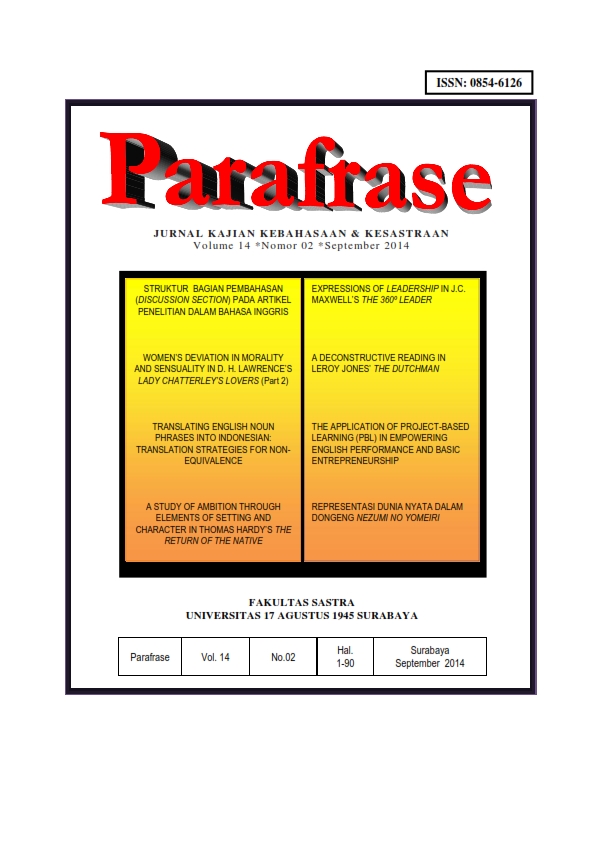
REPRESENTASI DUNIA NYATA DALAM DONGENG NEZUMI NO YOMEIRI
DOI:
https://doi.org/10.30996/parafrase.v14i02.431Abstract
Abstract. This paper reports a mimetic approach to a Japanese fairy tale (mukashi banashi) entitled ‘Nezumi no yomeiri.’ Mimetic approach to literary criticism assumes that a work of literature is an image of nature or description of the world and human life in the universe. Its proponents, Plato and Aristotle, proposed that literary works were copies of the authors’ ideas, while the ideas themselves were copies from realities of human life itself. Fairy tales are one type of literary work, which has originally been orally transmitted through generation. The question of the study is to what extent the fairy tale represents real world and universe. The study found that the animal characters (mouses) in the tale are presented to have human characteristics, think and act like human, and hold human values and morals. The study may give more insights to the function of literary works in real life.
Â
Keywords: mimetic approach, Japanese fairy tales
Downloads
References
Agung, D.B., & Matulessy, A. (2012). Kecer-dasan Emosi, Keceerdasan Spiritual dan Agresivitas Pada Remaja. Jurnal Persona Vol 1 No. 02 September 2012.
Ali & Asrori. (2004). Psikologi Remaja. Jakar-ta: Bumi Aksara.
Azwar, S. (1998). Sikap Manusia: Teori dan Pengukurannya. Yogyakarta: Pustaka Pela-jar.
Biggs, & Philip, J. (1983). Process of Learning (Third Edition). New York: Prentice Hall.
Calhoun, dkk. (1995). Psychology of adjustment and human relationships. New york: Mc Graw- Hill, Inc.
Chaplin, C.P. (1989). Kamus lengkap psikologi (Kartono, alih bahasa). Jakarta: Rajawali Pers.
Dalimunthe. (2000). Hubungan Antara Kede-mokratisan Pola Asuh Orang
Tua dengan Kompetensi Sosial Pada Remaja.
Dayakisni, T. & Hudaniyah. (2003). Psikologi sosial. Yogyakarta: UMM Press.
Denham, S., Mason, T., Caverly, S., Schmidt, M., Hacney, R., Caswel, C,
& DeMulder, E. (2001). Preschoolers at Play: Co-sosialisers of Emotional and Sosial Competence. International Journal of Behavioral Deve-lopment. Hal. 25, 4, 290-301.
Eka, A. (2004). Hubungan antara pola asuh orang tua dengan kemampuan sosialisasi anak retardasi mental di SLB C Negeri II Gondomanan Yogyakarta. Skripsi, tidak diterbitan, Fakultas Kedokteran UGM Yog-yakarta.
Fatchurahman dan Pratikto, H. (2012), Keper-cayaan Diri, Kematangan Emosi, Pola Asuh Orang Tua Demokratis dan Kenakalan Remaja. Jurnal Persona Vol 1 No. 02 Sep-tember 2012.
Ford L’abate, L. (1990). Building Family Com-petence Primary and Secondary Prevention Strategies. London: Sage Publication.
Goleman, D. (2000). Kecerdasan Emosional, Mengapa EI lebih Penting dari pada IQ. Jakarta: Gramedia Pustaka Utama.
Gunarsa, YSD, & Gunarsa, SD. (1988). Psiko-logi Remaja. Jakarta: PT BPK Gunung Mulia.
Hadi, S. (2000). Statistik jilid II. Yogyakarta: Andi Offset.
Hamdayani S.R.I., & Suharnan. (2012) Konsep Diri, Stres dan Prokrastinasi Akademik pada Mahasiswa. Jurnal Persona Vol 1 No. 02 September 2012.
Hawadi & Akbar, R. (2001). Psikologi perkem-bangan anak mengenal sifat, bakat, dan kemampuan anak. Jakarta: PT. Grasindo.
Hurlock, EB. (1991). Psikologi Perkembangan, Suatu Pendekatan Sepanjang Rentang Kehi-dupan. Jakarta: Penerbit Erlangga.
...... (2001). Perkembangan Anak Jilid 2. Jakarta: Erlangga.
Krasnor, L. (1997). The Nature of Sosial Competence: A Theoretical. Review: Sosial Development.
Latifah, L. (2000). Kompetensi Sosial, Status Sosial, Dan Viktimisasi Disekolah Dasar. Skripsi, tidak diterbitkan, Fakultas Psikologi Universitas Gajah Mada Yogyakarta.
Martani, W., & Adiyanti, M. G. (1990). Kompe-tensi Sosial Dan Kepercayaan Diri Remaja. Laporan Penelitian, tidak diterbitkan, Fakul-tas Psikologi Universitas Gajah Mada Yog-yakarta.
Monk, dkk. (1999). Psikologi Perkembangan, Pengantar dalam berbagai bagiannya. Yog-yakarta: Gajah mada university press.
...., (2004). Psikologi perkembangan pengantar dalam berbagai bagiannya. Yogyakarta: Gadjah Mada University Press.
Muawanah L.B., Suroso & Pratikto, H. (2012). Kematangan Emosi, Konsep Diri dan Kena-kalan Remaja. Jurnal Persona Vol 1 No. 02 September 2012.
Munawaroh, F. (2012). Konsep Diri, Intensitas Komunikasi Orang Tua-Anak dan Kecende-rungan Perilaku Seks Pranikah, Jurnal Persona Vol 1 No. 02 September 2012.
Rakhmat, J. (2003). Psikologi Komunikasi. Bandung: Remaja Rosda Karya.
Sabig, S. & Djalali, M. A. (2012). Kecerdasaan Emosi, Kecerdasan Spiritual dan Perilaku Proposial Santri Pondok Pesantren Nasyrul Ulum Pamekasan. Jurnal Persona Vol 1 No. 02 September 2012.
Santrock, J. W. (2002). Life-span development: perkembangan masa hidup. Jakarta: Er-langga.
Sobur, A. (2003). Psikologi umum. Bandung: Pustaka Setia.
Syah. (1995). Psikologi Pendidikan: Remaja. Bandung: Rosda Karya.
Walgito. (1999). Psikologi Sosial. Yogayakarta: Andi Offset.
Wirawan, S. (2003). Psikologi Remaja. Jakarta: Raja Grafindo Persada.
Yusuf, L.N. (2004). Psikologi Anak dan Rema-ja. Bandung: Remaja Rosda Karya.
Downloads
Published
How to Cite
Issue
Section
License
Authors publishing in the Journal will be asked to sign a Copyright Assignment Form. In signing the form, it is assumed that authors have obtained permission to use any copyrighted or previously published material. All authors must read and agree to the conditions outlined in the form, and must sign the form or agree that the corresponding author can sign on their behalf. Articles cannot be published until a signed form has been received.It is a condition of publication that authors assign copyright or license the publication rights in their articles, including abstracts, to email jurnalparafrase@untag-sby.ac.id. . This enables us to ensure full copyright protection and to disseminate the article, and of course the Journal to the widest possible readership in print and electronic formats as appropriate.