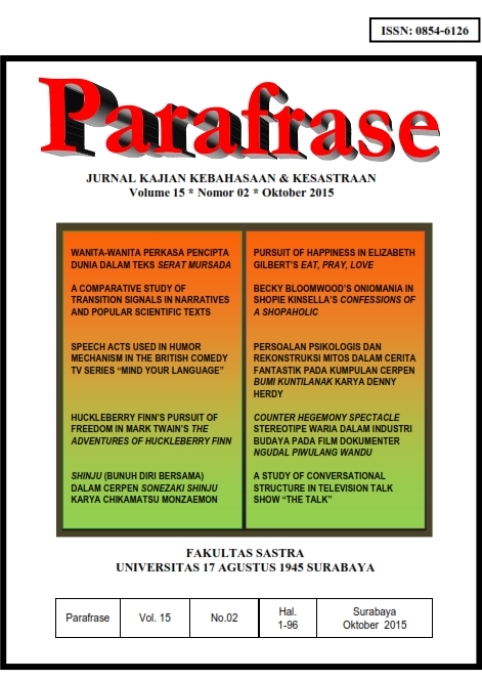
PURSUIT OF HAPPINESS IN ELIZABETH GILBERT’S EAT, PRAY, LOVE
DOI:
https://doi.org/10.30996/parafrase.v15i02.570Abstract
Abstrak. Artikel ini membahas pentingnya kebahagiaan dalam kehidupan sebagaimana digambarkan dalam novel Eat, Pray, Love karya Elizabeth Gilbert. Penelitian ini menganalisis kehidupan seorang penulis yang sukses yang memiliki pengalaman tragis namun penuh pelajaran dalam usahanya mencari kebahagiaan sejati. Permasalahan yang diajukan meliputi perspektif kebahagiaan tokoh cerita serta penyebab dan akibat dari pencarian kebahagiaan tersebut. Penelitian menggunakan pendekatan kasus kualitatif. Hasil penelitian menunjukan bahwa perspektif tokoh tentang kebahagiaan meliputi: simple life, friendships, spiritual development, love of nature, kindness. Penyebab pencarian kebahagiaan meliputi unhappy marriage, insecure relationship, self-underestimate, and discontentment. Sementara akibat dari ketidakbahagiaan adalah feeling ungrateful, hurting others, depression and loneliness, spiritual pilgrimage.
Keywords: theme analysis, pursuit of happiness
Downloads
References
Cooper, C., and Buhalis, D., 1993, The Future of Tourism, in Cooper, C., Fletcher, J., Gilbert,
D., and Wanhill, S., (Eds), Tourism: Principles and Practice, www.buhalis.com/
Publications.htm
Dadan Rosana, Dr., M.Si (2012) ―Model Akselerasi Pengembangan Sambi Sebagai Desa
Wisata Internasional Melalui Strategi Kemitraan dan Pemberdayaan Masyarakat dalam
Penerapan Literasi Sains dan Teknologi dengan dukungan Kompetensi Komunikasi
Bahasa Global‖.Yojakarta, Universitas Negeri Yogjakarta, http://eprints.uny.ac.id/id/
eprint/402 download 3 April 2013
David, Fred R. (2004). Manajemen Strategis: Konsep-konsep (Edisi Kesembilan). PT Indeks
Kelompok Gramedia. ISBN 979-683-700-5.
David, F. R., 2011, Strategic Management (13th ed.), New Jersey: Prentice Hall.
Dwi Wahyu, Indra (2010) ―Pengembangan Desa Wisata Untuk Meningkatkan Pembangauanan
Sektor Pariwisata di Kabupaten Magetan: Studi Kasus di Desa Sumberdodol Kec. Panekan
Published
How to Cite
Issue
Section
License
Authors publishing in the Journal will be asked to sign a Copyright Assignment Form. In signing the form, it is assumed that authors have obtained permission to use any copyrighted or previously published material. All authors must read and agree to the conditions outlined in the form, and must sign the form or agree that the corresponding author can sign on their behalf. Articles cannot be published until a signed form has been received.It is a condition of publication that authors assign copyright or license the publication rights in their articles, including abstracts, to email jurnalparafrase@untag-sby.ac.id. . This enables us to ensure full copyright protection and to disseminate the article, and of course the Journal to the widest possible readership in print and electronic formats as appropriate.