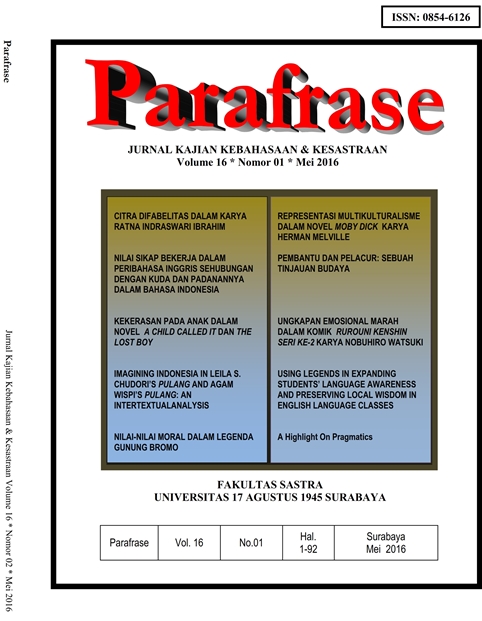
CITRA DIFABELITAS DALAM KARYA RATNA INDRASWARI IBRAHIM
DOI:
https://doi.org/10.30996/parafrase.v16i01.673Abstract
Abstract. Injustice has been part of life for different ability people, especially for diffabled women in
many parts of Indonesia. A diffabled woman writer, Ratna Indraswari Ibrahim, refuses the assumption
and proves on strength and spirit of life in women and diffable people through her works. This study
discusses Ibrahim’s short stories about women and the life of her diffabled characters. The data sources of
the study are novelettes by Ratna Indraswari Ibrahim. The data are quotes from the works that talk about
diffability. The study was based on understanding and interpretation processes. The study found that the
Ibrahim’s works discusses the image and strength of the diffabled woman character in defending for her
rights. Ibrahim also proves that being diffabled does not necessarily mean constant mercy-seeking and
dependence on others. Ibrahim tries to introduce a new paradigm that the diffabled people have the same
pontential as the normal people do. The image of diffability is illustrated in her works that are fully
loaded with struggle of both a woman and a diffabled person.
Kata kunci: citra, difabel, Ratna Indraswari Ibrahim
Downloads
References
Azwar, Saifrudin (1999). Penyusunan Skala
Psikologi. Yogyakarta : Pustaka
belajar
Azwar, Saifrudin (2012). Penyusunan Skala
Psikologi. Edisi 2. Pustaka belajar
Burns, R, B. (1993). Konsep Diri, Teori,
Pengukuran, Perkembangan, dan
Perilaku. Jakarta : Arcan
Astuti,dkk. (2000).Jurnal Psikologi.
Hubungan antara dukungan
keluarga dengan
Penyesuaian diri perempuan pada
kehamilan pertama. No.2. 84-95
Brehm,S.S dan Kassin,SM,(1996). Social
Downloads
Published
How to Cite
Issue
Section
License
Authors publishing in the Journal will be asked to sign a Copyright Assignment Form. In signing the form, it is assumed that authors have obtained permission to use any copyrighted or previously published material. All authors must read and agree to the conditions outlined in the form, and must sign the form or agree that the corresponding author can sign on their behalf. Articles cannot be published until a signed form has been received.It is a condition of publication that authors assign copyright or license the publication rights in their articles, including abstracts, to email jurnalparafrase@untag-sby.ac.id. . This enables us to ensure full copyright protection and to disseminate the article, and of course the Journal to the widest possible readership in print and electronic formats as appropriate.