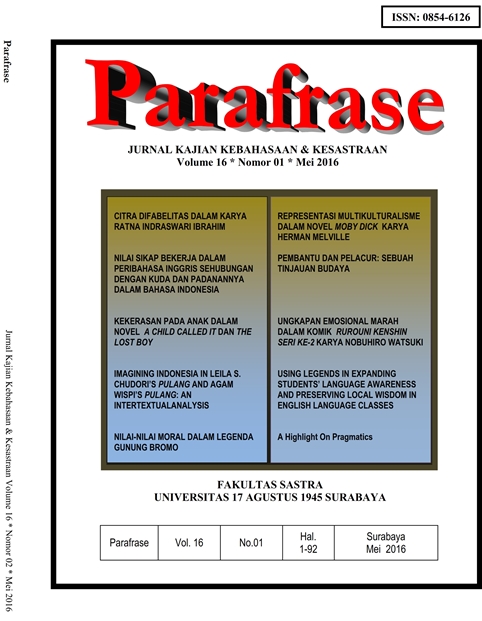
REPRESENTASI MULTIKULTURALISME DALAM NOVEL MOBY DICK KARYA HERMAN MELVILLE
DOI:
https://doi.org/10.30996/parafrase.v16i01.678Abstract
ABSTRACT. This study expresses reflection of Herman Melville’s point of view about multiculturalism in his novel, Moby Dick (1851). Five indicators of characteristic of multicultural literature applied as the base of this study are: varied and unique characters, admission of equality of all characters, authentic character’s social background, values of ancient treasure, and author as part of story. By expressive-hermeneutic approach, it can be concluded as followings. First, Moby Dick represents varied and unique characters. Second, Moby Dick represents admission of equality of all characters. Third, Moby Dick shows authentic social background of characters. Fourth, Moby Dick promotes values of ancient treasure, namely tradition and religion (Christian). Fifth, Moby Dick represents Melville’s involvement as part of story through character (Ishmael). Therefore, Moby Dick really represents multicultural values.
Keywords: represent, multiculturalism, exspressive-hermeneutic approach, multicultural literature
Downloads
References
Azar, Betty Schrampfer. 1999. Understanding and Using English Grammar Third Edition. New York: Pearson Education.
Coulmas, Florian.1999. The Blackwell Encyclopedia of Writing Systems. Oxford: Blackwell.
Crimmon, Mc. 1984. Writing with a Purpose. Houghton: Mifflin Company
David, Lindsay. 2011. Scientific Writing = Thinking in Words. Australia: Csiro Publishing.
Ayu D.A.& N.K. Mirahayuni – A Comparative Study of Transition Signals
Parafrase Vol. 15 No.02 Oktober 2015
Eggins, Suzanne. 1994. An Introduction to Systemic Functional Linguistics. London: Pinter.
Fraenkel, J. R. (1993). How to Design and Evaluate Research. New York: Mc Graw Hill.
Green, Thomas A. 2008. The Greenwood Library of World Folktales Volume Two. London: Greenwood Press.
Halliday, M.A.K. and Hasan, R. 1976. Cohesion in English. London: Longman.
Houge, Ann. 1996. First Step in Academic Writing. NewYork: Addison-Weshley Publishing Company Inc.
Kane, Thomas S..2000. The Oxford Essential Guide to Writing. NewYork: Berkley Books.
Kirszner, Laurie G. and Stephen R. Mandell. 1978. Basic College Writing. New York: W.W. Norton & Company Inc.
Langan, John. 2005. College Writing Skills 6th Edition. New York: Mc.Graw Hill
Mark, Anderson and Kathy Anderson. 2003. Text Types in English. Australia: MacMillan Education Australia Pty. Ltd.
Martin, JR., Matthiessen, CMIM, Painter, C.1997. Working with Functional Grammar. London; Arnold.
Melzer, Dan.2009. Student Writing Handbook 1st Edition. Sacramento State University.
Oshima, Alice and Thomas Hogue. 1998. Writing Academic English Third Edition. New York: AdditionWesley Longman.
Weber, Ryan and Karl Stolley. Transitions and Transitional Devices. Purdue Online Writing Lab (OWL). West Lafayette, Indiana: Purdue University. (accessed date: February 11st, 2015)
www.omniglot.com (accessed date: November 12nd, 2014, 5:11am).
Louie, B.Y. (2005). Guiding principles for teaching multicultural literature. Reading Teacher, 59(5) Feb. 2006, p. 438-448.
Melville, H. (2004). Moby Dick or The Whale. New York: Castle Books.
Ratna, N.K. (2005). Sastra dan Culture Studies: Representasi Fiksi dan Fakta. Yogyakarta: Pustaka Pelajar.
Ratna, N.K.(2006). Teori, Metode, dan Teknik Penelitian Sastra. Yogyakarta: Pustaka Pelajar.
Rampersad, A. (1994). Melville and race. Dlm Jehlen,M. (ed.), Herman Melville: A collection of critical essays. Englewood Cliffs: Prentice-Hall.
Sumardjo, J. (1990). Melville, Herman. Ensiklopedi Nasional Indonesia Jild 10, p. 240. Jakarta: PT Cipta Adi Pustaka.
Sweetland, R. (2010). Characteristics of quality multicultural literatureâ€. http://www. homeofbob.com/literature/genre/multicultural/Akses: 22-04-2016
Downloads
Published
How to Cite
Issue
Section
License
Authors publishing in the Journal will be asked to sign a Copyright Assignment Form. In signing the form, it is assumed that authors have obtained permission to use any copyrighted or previously published material. All authors must read and agree to the conditions outlined in the form, and must sign the form or agree that the corresponding author can sign on their behalf. Articles cannot be published until a signed form has been received.It is a condition of publication that authors assign copyright or license the publication rights in their articles, including abstracts, to email jurnalparafrase@untag-sby.ac.id. . This enables us to ensure full copyright protection and to disseminate the article, and of course the Journal to the widest possible readership in print and electronic formats as appropriate.