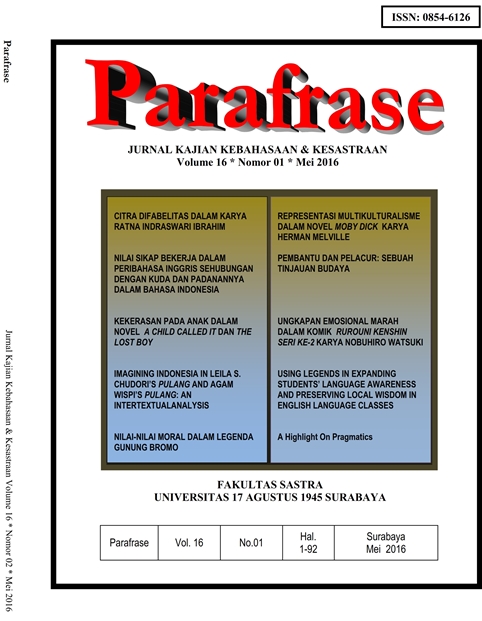
UNGKAPAN EMOSIONAL MARAH DALAM KOMIK RUROUNI KENSHIN SERI KE-2 KARYA NOBUHIRO WATSUKI
DOI:
https://doi.org/10.30996/parafrase.v16i01.680Abstract
ABSTRAK. Manga atau komik Jepang merupakan salah satu budaya Jepang dalam kehidupan sehari–hari. Sebagai media untuk memperkenalkan sejarah dan sains yang baik digunakan untuk anak-anak. Komik Rurouni Kenshin adalah salah satu komik sejarah yang sangat menarik karena berbagai macam konflik, cerita, isi, karakter dan tokohnya. Penelitian ini bertajuk “Analisis Ungkapan Emosional Marah dalam Komik Rurouni Kenshin Seri Ke-2 Karya Nobuhiro Watsuki.â€. Penelitian ini hendak menjawab permasalahan sebagai berikut: (1) Bagaimana ungkapan emosional marah para tokoh dalam komik Rurouni Kenshin Seri ke-2 karya Nobuhiro Watsuki? (2) Apa saja jenis–jenis penyebab kemarahan para tokoh dalam komik Rurouni Kenshin seri ke-2? Penelitian ini menggunakan metode deskriptif kualitatif dengan pendekatan psikolinguistik. Penelitian ini menghasilkan temuan sebagai berikut, pertama, seseorang mengungkapkan kemarahan dengan memperlihatkan ciri-ciri fisik seperti otot menegang, rahang menjadi kaku, kepalan tinju; kedua, ditemukan 10 jenis penyebab kemarahan; dan ketiga, dari 10 jenis penyebab kemarahan, penyebab yang paling umum adalah kemarahan karena berang.Downloads
References
Abrams, M.H. Harpam, Geoffrey Galt. 2009. A Glossary of Literary Terms, Ninth Edition. Canada: Wadsworth, Cengage Learning.
Burke, Vernon. Will In Western Thought. New Yourk: Sheed and Ward.
Foster, E. M. 1972. Aspect of the Novel. Harcourt Brance and World, New York.
Kennedy, X.J. Literature An Introduction to fiction, Poetry, and Drama. New York: McGraw Hill Book Co.
Kenney, William. 1996. How to Analyze Fiction. New York: Lexicon
Downloads
Published
How to Cite
Issue
Section
License
Authors publishing in the Journal will be asked to sign a Copyright Assignment Form. In signing the form, it is assumed that authors have obtained permission to use any copyrighted or previously published material. All authors must read and agree to the conditions outlined in the form, and must sign the form or agree that the corresponding author can sign on their behalf. Articles cannot be published until a signed form has been received.It is a condition of publication that authors assign copyright or license the publication rights in their articles, including abstracts, to email jurnalparafrase@untag-sby.ac.id. . This enables us to ensure full copyright protection and to disseminate the article, and of course the Journal to the widest possible readership in print and electronic formats as appropriate.