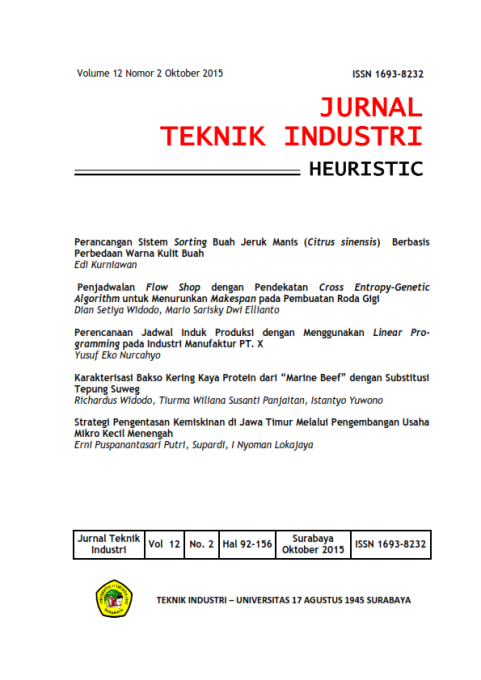
PENJADWALAN FLOW SHOP DENGAN PENDEKATAN CROSS ENTROPY-GENETIC ALGORITHM UNTUK MENURUNKAN MAKESPAN PADA PEMBUATAN RODA GIGI
DOI:
https://doi.org/10.30996/he.v12i02.629Abstract
Flow shop is the process of determining the sequence of jobs that have the same product path. While the flow-shop scheduling takes assumption that a number of jobs that each has the same machine work sequence. The problems faced by com-panies, namely the high demand and yet the existence of a good scheduling planning resulted in the company should be able to optimize sche-duling job. One of the ways to solve these problems is by minimizing the Makespan. This research will solve the problem regarding to the flow shop scheduling by using cross entropy-genetic algorithm (CEGA) method to minimize Makespan. The technique that is used to solve the problem is by comparing the result of the application of existing methods in the company with the proposed method (CEGA). To support the application of CEGA used MATLAB software. Finally known that the results CEGA can give optimal solution, Makespan values obtained for 10829 seconds. So far, it was more effective than the method that used at the firm with Makespan efficiency by 10.06%.
Keywords: Flow Shop, Scheduling, Cross Entropy-Genetic Algorithm, Makespan.
Downloads
References
Adisasmita dan Rahardjo, 2010, Pembangunan Kawasan dan Tata Ruang. Yogyakarta: Graha
Ilmu.
BPS Provinsi Jawa Timur, 2010, Laporan Kinerja Makro Sosial dan Ekonomi Provinsi Jawa
Timur Tahun 2010.
BPS Kabupaten Sampang, 2013, Sampang Dalam Angka 2013, BPS Kabupaten Sampang.
Diskopukm, 2013, Peran Serta Konsultan Tenaga Bisnis (TKB) dalam Pengembangan Usaha
Kecil di Kabupaten Sampang, http://diskopukm. sampangkab.go.id
Putri, Erni Puspanantasari, 2005, Peningkatan Daya Saing Pengrajin Industri Kecil Rumah
Tangga Pedesaan di Kabupaten Sidoarjo Melalui Peningkatan Kualitas Yang
Berkesinambungan, Penelitian Dosen Muda, DP2M DIKTI
Putri, Erni Puspanantasari dan Zainal, 2006, Strategi Pengembangan Pengrajin Meubel Untuk
Meningkatkan Daya Saing Pasar Yang Semakin Kompetitif, Penelitian Dosen Muda,
DP2M DIKTI.
Putri, Erni Puspanantasari dan Indahati, 2007, Kajian Peta Bisnis Sentra Industri Di Kabupaten
Sidoarjo Dengan Pendekatan Klastering Sebagai Basis Untuk Membangun Keunggulan
Daerah Melalui Pengembangan Industri Kecil Dan Menengah Yang Efektif Dan
Kompetitif, Penelitian Dosen Muda, DP2M DIKTI.
Putri, Erni Puspanantasari dan Nyoman, 2007, Strategi Pengembangan Bisnis Perusahaan
Industri Manufaktur Kecil Dan Menengah Berbasis Strategi Unggulan Untuk
Meningkatkan Daya Saing Pasar Yang Semakin Kompetitif, Penelitian Dosen Muda,
DP2M DIKTI .
Putri, Erni Puspanantasari dan I Nyoman Lokajaya, 2008, Strategi Pengembangan Bisnis
Pengrajin Rotan Untuk Meningkatkan Keunggulan Bersaing Yang Semakin Kompetitif,
Penelitian Dosen Muda, DP2M DIKTI.
Putri, Erni Puspanantasari dan I Nyoman Lokajaya, 2009, Peningkatan Kualitas Produk
Pengrajin Industri Rumah Tangga Pedesaan Untuk Meningkatkan Daya Saing Pasar yang
Semakin Kompetitif, Penelitian Dosen Muda, DP2M DIKTI.
Putri, Erni Puspanantasari dan I Nyoman Lokajaya, 2009, Strategi Pengembangan Bisnis Usaha
Kecil Dan Menengah Untuk Memperluas Jaringan Pasar Yang Semakin Kompetitif,
Penelitian Dosen Muda, DP2M DIKTI .
Putri, Erni Puspanantasari dan Istantyo Yuwono, 2009, Strategi Pengembangan Bisnis Usaha
Kecil Dan Menengah Untuk Memperluas Jaringan Pasar Yang Semakin Kompetitif,
Penelitian Dosen Muda, DP2M DIKTI .
Downloads
Published
How to Cite
Issue
Section
License
Authors who publish with Heuristic agree to the following terms:
- Authors transfer the copyright and grant the journal right of first publication with the work simultaneously licensed under a Creative Commons Attribution-ShareAlike 4.0 International License.. that allows others to share the work with an acknowledgement of the work's authorship and initial publication in this journal.
- Authors are able to enter into separate, additional contractual arrangements for the non-exclusive distribution of the journal's published version of the work (e.g., post it to an institutional repository or publish it in a book), with an acknowledgement of its initial publication in this journal.
- Authors are permitted and encouraged to post their work online (e.g., in institutional repositories or on their website) prior to and during the submission process, as it can lead to productive exchanges, as well as earlier and greater citation of published work (See The Effect of Open Access)