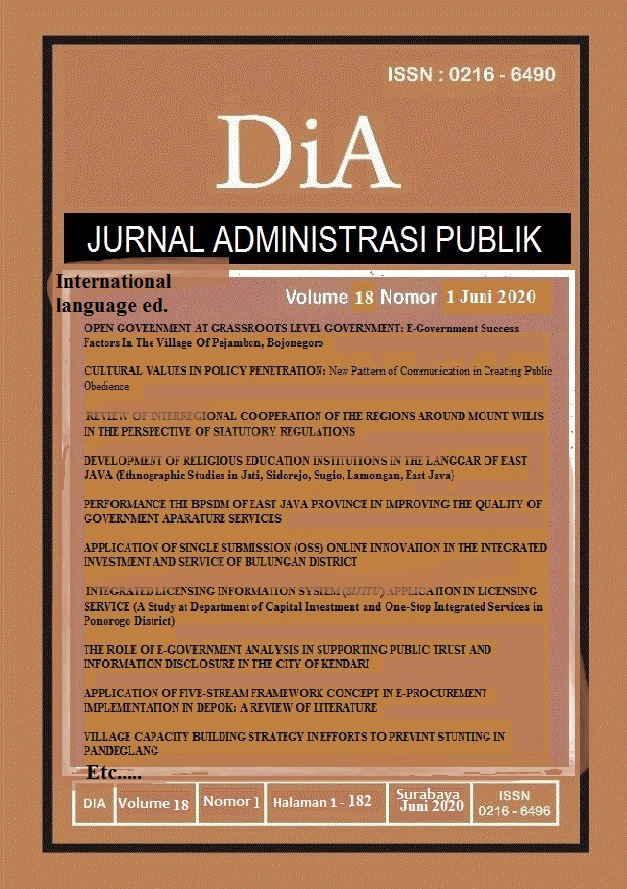
VILLAGE CAPACITY BUILDING STRATEGY IN EFFORTS TO PREVENT STUNTING IN PANDEGLANG
DOI:
https://doi.org/10.30996/dia.v18i1.3465Keywords:
organizational capacity building, villages, stunting, PandeglangAbstract
Local autonomy that revolves in Indonesia has provided opportunities for villages to develop independent villages in accordance with the potential of the villages —in line with the Undang-Undang Nomor 6 Tahun 2014 concerning Villages. The most common health problem in the rural areas and directly related to the quality of Indonesian human resources is stunting. For this reason, this study is intended to illustrate how the strategy of increasing the capacity of organizations and increasing the capacity of village officials in efforts to prevent stunting in villages. Besides the government, stunting prevention in Pandeglang also involves the private sector and academics. These sectors are directly involved in increasing village capacity to prevent stunting. This study used a qualitative approach with descriptive method. Data collection techniques were in-depth interviews, observation, and study of documents related to the research topic. From the results of the study it was found that the ability of organizations in planning, implementing, and evaluating programs, managing village funds, socialization and communication, partnerships, fostering village government and village communities, became the dominant factor in handling stunting in Pandeglang.
Downloads
References
Hoddinott, J., Alderman, H., Behrman, J. R., Haddad, L., & Horton, S. (2013). Original Article The economic rationale for investing in stunting reduction. Maternal and Child Nutrition, Suppl.2(2013), 69–82. https://doi.org/10.1111/mcn.12080
Horton, D., Alexaki, A., Bennett-lartey, S., Brice, K. N., Campilan, D., Carden, F., … Duong, L. T. (1995). Evaluating Capacity Development : Experience from Research and Development Organizations Around the Worlld. In ISNAR, IDRC, and CTA (Vol. 9). Retrieved from http://search.ebscohost.com/login.aspx?direct=true&db=bth&AN=16602244&site=ehost-live
Hughes, O. E. (2003). Public Management and Public Administration An introduction Third Edition. Palgrave Macmillan.
Kesehatan, K. (2018). HASIL UTAMA RISKESDAS 2018.
Rosihan. (2012). Kebijakan Revitalisasi Posyandu di Provinsi Kalimantan Selatan. DIA, Jurnal Publik Administrasi, 10(2), 32–43.
Satriawan, E. (2018). Strategi Nasional Percepatan Pencegahan Stunting 2018-2024.
Unicef. (2013). IMPROVING CHILD NUTRITION The achievable imperative for global progress. Unicef.
Grindle, M.S., (editor), (1997) Getting Good Government : Capacity Building in the Public Sector of Developing Countries, MA: Harvard Institute for International Development. Boston.
Peraturan Presiden Nomor 18 Tahun 2020 tentang Rencana Pembangunan Jangka Menegah Nasional Tahun 2020-24
Spencer, L. & Spencer, S. (1993.) Competence at Work: A Model for Superior Performance. New York: Wiley.
Undang-Undang Nomor 6 Tahun 2014 tentang Desa, Lembaran Negara Republik Indonesia Nomor 7 Tahun 2014.
Downloads
Published
How to Cite
Issue
Section
License
The DiA journal allows authors to retain the copyright of their papers without limitation. Authors may grant publishers non-exclusive publishing rights to publish articles. Granting first publishing rights to publishers also qualifies as unlimited copyright (because there are no restrictions imposed by publishers on author copyright).