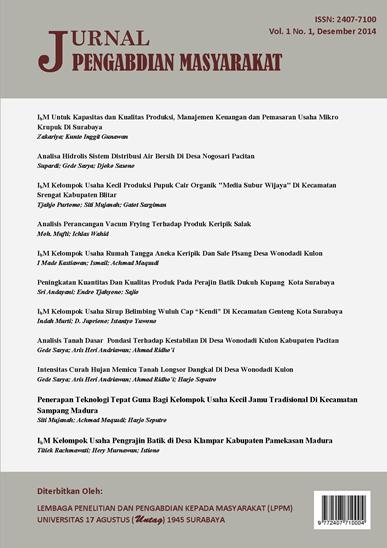
IbM Kelompok Usaha Kecil Produksi Pupuk Cair Organik "Media Subur Wijaya" di Kecamatan Srengat Kabupaten Blitar
DOI:
https://doi.org/10.30996/jpm17.v1i01.349Abstract
Abstract. It is estimated that the plantation sub-sector fertilizer needs for 2010 through 2025 for urea, Superphos and KCl decreased. Instead NPK compound fertilizer demand is increasing. This is because the single fertilizer NPK fertilizer has been converted into a proportional basis. The use of organic fertilizer prioritized for seasonal crops (sugar cane, cotton, tobacco, patchouli, lemon grass, roots, fragrant and serehwangi) and for annual crops (coffee and cocoa). One of the producers of fertilizer that can be expected as a supplier of fertilizer demand in Indonesia is "Fertile Media Wijaya" (MSW). Their products in the form of liquid organic fertilizer that has proved useful in several times damplot test for rice, soybeans, corn, onions, potatoes and coconut oil. Liquid fertilizer is produced in the Desa Pakisrejo, Kecamatan Srengat Blitar and Desa Gondang Kecamatan Purwodadi since 2009. The process of making the MSW organic liquid fertilizer is traditionally done manually and by using small drums each with a capacity of 70 liters, so it requires a lot of places and can not accept orders in large amounts continuously. Time manufacturing process takes ± 60 days. IBM is expected to resolve the constraints that occur, and the process can increase production and marketing of liquid organic fertilizer smoothly.
Keywords: MSW Organic Liquid Fertilizer
Downloads
References
Ahmed, Shahid. (2002). Asia-Pacific Develop-ment Journal. Vol. 9, No. 2, December. UN: Economic and Social Commission for Asia and the Pacific.
Alsop, Ruth dan Heinsohn, Nina. (2005). Measuring Empowerment in Practice: Structuring Analysis and Framing Indica-tors. World Bank Policy Research Working Paper 3510, February.
Alsop, Ruth. (2004). Power, Rights, and Poverty: Concepts and connections. Washington, DC: The World Bank.
Attali, Jacques. (1999). Milenium Ketiga. Ter-jemahan oleh Emmy Nor Hariati. Yogya-karta: Pustaka Pelajar.
Balanof (Ed.). (1999). Annual Edition: Public Administration 99/00. Guilford: McGraw-Hill.
Bapemas KB. (2009). Pelatihan Keterampilan Keluarga Miskin. Laporan Pelatihan yang Diselenggarakan oleh Bapemas KB Kota Surabaya Tahun 2009 & 2010. Surabaya: Bapemas KB.
Bapemas KB. (2010). Pelatihan Keterampilan Keluarga Miskin. Laporan Pelatihan yang Diselenggarakan oleh Bapemas KB Kota Surabaya Tahun 2010. Surabaya: Bapemas KB.
Bappeko Surabaya. (2003). Penyusunan Indeks Kemiskinan Manusia di Kota Sura-baya. Surabaya: Bappeko Surabaya.
Bappeko Surabaya. (2006). Monitoring dan Evaluasi Program Kompensasi Pengurang-an Subsidi Bahan Bakar Minyak. Surabaya: Bappeko Surabaya.
Bartlett, Andrew. (2004). Entry Points for Empowerment. A report. Bangladesh: the UK Government’s Department for Interna-tional Development (DFID).
Baulch, Bob et.al. (2008). Social Protection Index for Committed Poverty Reduction. Volume 2. Manila: Asian Development Bank.
Becker, G. S. (1992). Nobel lecture: The economic way of looking at life. Journal of Political Economy.
Becker, Sascha O. & Ludger Wobmann. (2007). Was Weber Wrong? A Human Capital Theory of Protestant Economic History. Discussion Paper 2007-07, Janua-ry, Department of Economics, Uiversity of Munich, Volkswirtschaftliche Fakultat, Ludwig-Maximilians-Universitat Munchen, http://epub.ub.uni-muenchen.de/1366/1/weberKMU.pdf.
Biklen, Sari Knop & Robert C. Bogdan. (1986). Qualitative Research in Education. An introduction to theory and methods. Third Edition. London: Allyn and Bacon.
Bogdan, Robert C. & Sari Knopp Biklen. (1982). Qualitative Research for Education. Boston: Allyn & Bacon.
Downloads
Published
Issue
Section
License
COPYRIGHT NOTICE
The copyright in this website and the material on this website (including without limitation the text, computer code, artwork, photographs, images, music, audio material, video material and audio-visual material on this website) is owned by PM17: Jurnal Pengabdian Masyarakat and its licensors.
Copyright license
JPM17: Jurnal Pengabdian Masyarakat grants to you a worldwide non-exclusive royalty-free revocable license to:
- View this website and the material on this website on a computer or mobile device via a web browser;
- Copy and store this website and the material on this website in your web browser cache memory; and
- Print pages from this website for your
- All articles published by PM17: Jurnal Pengabdian Masyarakat are licensed under the creative commons attribution 4.0 international license. This permits anyone to copy, redistribute, remix, transmit and adapt the work provided the original work and source is appropriately cited.
JPM17: Jurnal Pengabdian Masyarakat does not grant you any other rights in relation to this website or the material on this website. In other words, all other rights are reserved.
For the avoidance of doubt, you must not adapt, edit, change, transform, publish, republish, distribute, redistribute, broadcast, rebroadcast or show or play in public this website or the material on this website (in any form or media) without appropriately and conspicuously citing the original work and source or JPM17: Jurnal Pengabdian Masyarakat prior written permission.
Permissions
You may request permission to use the copyright materials on this website by writing to compliance@academicjournals.org.
Enforcement of copyright
JPM17: Jurnal Pengabdian Masyarakat takes the protection of its copyright very seriously.
If JPM17: Jurnal Pengabdian Masyarakat discovers that you have used its copyright materials in contravention of the license above, JPM17: Jurnal Pengabdian Masyarakat may bring legal proceedings against you seeking monetary damages and an injunction to stop you using those materials. You could also be ordered to pay legal costs.
If you become aware of any use of ACADEMIC JOURNALS' copyright materials that contravenes or may contravene the license above, please report this by email to compliance@academicjournals.org.
Infringing material
If you become aware of any material on the website that you believe infringes your or any other person's copyright, please report this by email to jpm17@untag-sby.ac.id
target="_blank"