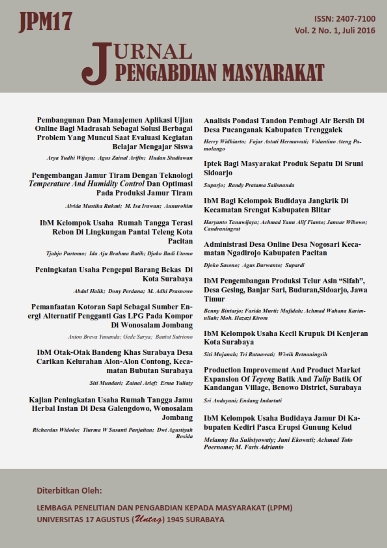
IbMKELOMPOKUSAHA KECIL KRUPUK DI KENJERAN KOTA SURABAYA
DOI:
https://doi.org/10.30996/jpm17.v2i01.791Abstract
The purpose of the activities for the community IbM is to provide appropriate
technology for Small Businesses engaged in Krupuk Shells. The objective of this activity
is IbM three (3) business owners in the field of crackers in the area Kenjeran. Problems
faced by Sme Krupuk is the low capability in the production of chips so that their
products are less if the fries are less able to expand and it does not feel as most vitsin,
besides chips business is done by hand in mixing the chips is by churning by hand, as
well as in cooking with pot coming from the drums were very doubtful of hygiene and
health, in addition to the practice of business management has not been in touch in the
conduct of business, for example, to market the production to just wait for customers to
come, and there are no financial records so that they confuse the money business with
the household money. Proposer activities IbM have agreed with all three partners to
procure the technology in the production of which is to buy machinery Mixer material
crackers, pot to cook the dough crackers, accompanied by the also given training in the
production of crackers are tasty and higienes, as well as training in business
management, finance and marketing strategy.
Keyword : Crackers production, appropriate technology, and Business
Management
Downloads
References
Barthes has said that all texts are potentially plural and that they cannot be considered singular objects. What has been clear from the discussion is that Chudori’s Pulang implicitly and explicitly refers to Wispi’s Pulang.
The connections that Chudori established between Pulang and Wispi’s Pulang should be analyzed in order to discover their connotations. The writer argues that Chudori’s Pulang is a pastiche of Wispi’s Pulang in the sense that Chudori has taken the elements from Wispi’s Pulang and reconstructed them. Chudori’s Pulang has made new connections and has added new elements to the original one. On one hand, Chudori’s Pulang has made a faithful imitation, while on the other hand, the pastiche is more subconscious, since Chudori’s Pulang incorporated other texts and influenced into this new text.
Through the analysis, it can be stated that there are connections between Chudori’s Pulang and Wispi’s Pulang. Chudori’s Pulang reconstructs Wispi’s Pulang. Chudori underscores her points of view and elaborates on possible situations that Agam Wispi could not make happen. Rather than deconstructs his work, she enhances it and thereby encourages readers to also read Agam Wispi’s Pulang..
The differences in setting in these two literary works can be ascribed to the different time and place these works were written in and the subsequent differences in attitude the events are interpreted with. For all readers decode the texts differently, depending on their personal and literary backgrounds. Chudori elaborates on Wispi’s Pulang instead of replacing it. For it is almost impossible to appreciate Chudori’s Pulang to the fullest extent if one has not read Wispi’s Pulang. And this is why she considers the relationship among these two works to be continuous.
Tri P. & Y.B. Agung P. – Imagining Indonesia
Parafrase Vol. 16 No.01 Mei 2016
References
Allen, Graham. 2000. Intertextuality. London & New York: Routledge.
Assem, Al- Faress. 1992. Comparative Literature and Intertextuality: A theoretical Study in Modern European and American Literary Criticism. Indiana University Press.
Bakhtin, Mikhael. 1984. Problems of Dostoevsky’s Poetics.University of Minnesota.
Barthes, Roland . 1975. The Pleasure of the Text, Richard Miller (trans.), Hill and Wang, New York.
—— . 1977. Image – Music – Text, Stephen Heath (trans.), Fontana, London.
—— . 1981.‘Theory of the text’ in Young (ed.) 1981, 31–47.
——. 1986. The Rustle of Language, Richard Howard (trans.). Oxford Basil: Blackwell.
Chudori, Leila S. 2012. Pulang. Jakarta: PT Gramedia.
Lodge, David.1992. The Art of Fiction. UK: Secker and Warburg.
Kristeva, Julia. 1980. Desire in Language: A Semiotic Approach to Literature and Art. Ed. Roudiez, L. Translated by Jardine, A., Gora T. and Roudiez, L. New York: Columbia University Press; London: Basil Blackwell.
Kristeva, Julia 1967 "Bakhtine, le mot, le dialogue et le roman."Critique 33/239, 438-465. - Rpt. in: Kristeva. Semeiotike: Recherches pour unesemanalyse. Paris: Seuil, 1969, 143 -173. - Engl. tr.: "Word, Dialogue and Novel." In Kristeva. Desire in Language: A Semiotic Approach to Literature and Art. Ed. Leon S. Roudiez. New York: Columbia Up, 1980,64-91. - Also in: Kristeva. The Kristeva Reader. Ed. Toril Moi. Oxford: B. Blackwell, 1986, 34-61.
Kristeva, Julia 1974. La revolution du langagepohique: L'Avant-garde a la fin du dix-neuviemesiede: Lautreamontet Mallarme. Paris: Seuil. - Eng!. tr. (excerpts): Kristeva. Revolution in Poetic Language.New York: Columbia Up, 1975. - Rpt. (excerpts): "Revolution inPoetic Language." In Toril Moi, ed. The Kristeva Reader.Oxford: Basil Blackwell,1986, 89-136.
Plett, Heinrich F. (ed.) .1991. Intertextuality: Research In Text Theory. Berlin and New York: Walter de Gruyter.
Riffaterre, Michael. 1978. Semiotics of Poetry, Indiana University Press, Bloomington IN.
—— . 1983.Text Production, Terese Lyons (trans.), New York: Columbia University Press.
—— . 1984.‘Intertextual representation: on mimesis as interpretive discourse’ in Critical Inquiry 11 (1), 141–62.
Riffaterre, Michael. “Compulsory Reader Response: The Intertextual Drive.†Intertextuality: Theories and Practices.Ed. Michael Worton and Judith Still. Manchester: Manchester UP, 1990. 56-78.
Wispi, Agam. 2002. “ Pulang†: Di Negeri Orang : Puisi Penyair Indonesia Eksil. Ed. Asahan Alham and Co. Amanah- Lontar.
Downloads
Published
Issue
Section
License
COPYRIGHT NOTICE
The copyright in this website and the material on this website (including without limitation the text, computer code, artwork, photographs, images, music, audio material, video material and audio-visual material on this website) is owned by PM17: Jurnal Pengabdian Masyarakat and its licensors.
Copyright license
JPM17: Jurnal Pengabdian Masyarakat grants to you a worldwide non-exclusive royalty-free revocable license to:
- View this website and the material on this website on a computer or mobile device via a web browser;
- Copy and store this website and the material on this website in your web browser cache memory; and
- Print pages from this website for your
- All articles published by PM17: Jurnal Pengabdian Masyarakat are licensed under the creative commons attribution 4.0 international license. This permits anyone to copy, redistribute, remix, transmit and adapt the work provided the original work and source is appropriately cited.
JPM17: Jurnal Pengabdian Masyarakat does not grant you any other rights in relation to this website or the material on this website. In other words, all other rights are reserved.
For the avoidance of doubt, you must not adapt, edit, change, transform, publish, republish, distribute, redistribute, broadcast, rebroadcast or show or play in public this website or the material on this website (in any form or media) without appropriately and conspicuously citing the original work and source or JPM17: Jurnal Pengabdian Masyarakat prior written permission.
Permissions
You may request permission to use the copyright materials on this website by writing to compliance@academicjournals.org.
Enforcement of copyright
JPM17: Jurnal Pengabdian Masyarakat takes the protection of its copyright very seriously.
If JPM17: Jurnal Pengabdian Masyarakat discovers that you have used its copyright materials in contravention of the license above, JPM17: Jurnal Pengabdian Masyarakat may bring legal proceedings against you seeking monetary damages and an injunction to stop you using those materials. You could also be ordered to pay legal costs.
If you become aware of any use of ACADEMIC JOURNALS' copyright materials that contravenes or may contravene the license above, please report this by email to compliance@academicjournals.org.
Infringing material
If you become aware of any material on the website that you believe infringes your or any other person's copyright, please report this by email to jpm17@untag-sby.ac.id
target="_blank"