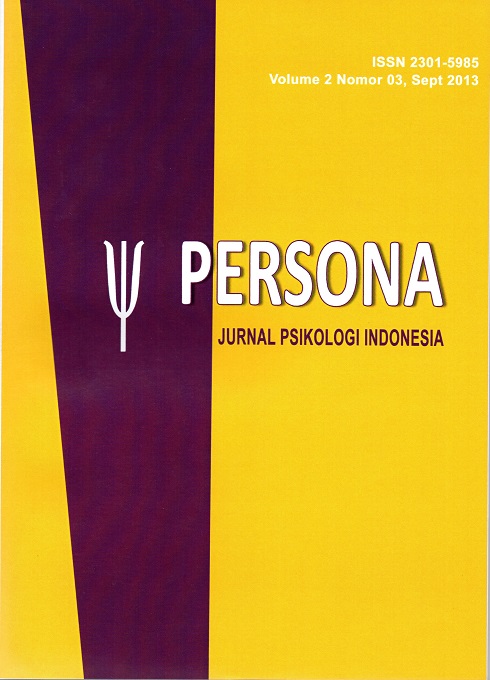
Peran Kreativitas Dalam Membentuk Strategi Coping Mahasiswa Ditinjau Dari Tipe Kepribadian Dan Gaya Belajar
DOI:
https://doi.org/10.30996/persona.v2i3.308Abstract
Abstract. This study aims to determine the effect of creativity in shaping the student coping strategy mainly by distinguishing personality type (ie based on the type of Dominance, Influence, Steadiness and Complience and differentiate learning styles (ie visual learning style, auditory and kinestesik). Variables consisted of variables depending Strategy coping and three independent variables, namely Creativity, Personality Types and Learning Styles. models are quantitative study with 38 study subjects at the end of the semester students of the Faculty of Psychology, University of Surabaya August 17, 1945. research data retrieval is done by deploying scale two of them made by a team of researchers and one scale using standard scales that have proven validity reliability. regression analysis by ANOVA using SPSS version 20 ( IBM version) shows that creativity plays a role in shaping the individual coping strategies. separately but not learning styles play a role in shaping the coping strategies despite a role in creativity individuals, where the t-test results illustrate that there are significant differences in creativity between the visual and auditory learning styles. opposite, personality type does not affect creativity but affect the individual coping strategies, although the results of the t test shows that only dominance and Steadiness personality and influence by complience which have significant differences in coping strategies.
Keywords : Coping Strategies , Creativity , Personality Types , Learning StylesDownloads
References
Hamdan, M., Tindak Pidana Pencemaran Lingkungan Hidup, Mandar Maju, Bandung, 2000.
St. Munadjat Danusaputro, Hukum Ling-kungan, Buku I- Umum, Binacipta, Jakarta, 1985
Rozikin Daman, Hukum Tata Negara, PT. Raja Grafindo Persada, Jakarta, 1993
Kala K. Mulqueeny , Regionalism, Economic Integration and Legislation in ASEAN : What Space for Environmental Sustaina-bility? Asia Pacific Journal Of Environ-mental Law,Australian Centre for Environ-mental Law, Sydney, 2004
Munadjat Danusaputro, Hukum Lingkungan, Buku II – Nasional, Binacipta, Jakarta, 1985
Joeniarto, Selayang Pandang Tentang Sum-ber-Sumber Hukum Tatanegara di Indone-sia, Liberty, Yogyakarta, 1991
L.J. Van Apeldoorn, Inleiding tot de studie van het Nederlandse recht, terjemahan Oetarid Sadino, Pengantar Ilmu Hukum, Pradnya Paramita, cetakan ke 31, Jakarta
Suparto Wijoyo, Refleksi Matarantai Penga-turan Hukum Pengelolaan Lingkungan Hidup Secara Terpadu, Airlangga Univer-sity Press, Surabaya, 2005
Maria Farida Indrati S 2007, Ilmu Perundang-undangan, Kanisius, Yogyakarta, 2007
M. Hamdan, 2000, Tindak Pidana Pence-maran Lingkungan Hidup, Mandar Maju, Bandung, 2000
Siti Sundari Rangkuti, Hukum Lingkungan dan Kebijaksanaan Lingkungan Nasional, Airlangga University Press. Surabaya, 2005
Koesnadi Harjasoemantri, Hukum Tata Lingkungan, Gadjah Mada University Press, 2002
Suparto Wijoyo, Penyelesaian Sengketa Lingkungan, Airlangga University Press, Surabaya, 2003
Peraturan Perundang-undangan
Undang-undang Dasar l945 dan Peru-bahannya
Ketetapan-ketetapan Majelis Permusya-waratan Rakyat
Undang-undang Nomor 22 Tahun l999 tentang Pemerintahan Daerah
Undang-undang Nomor 32 Tahun 2004 tentang Pemerintahan Daerah
Undang-undang Nomor 12 Tahun 2008 tentang Perubahan Undang-undang Nomor 32 Tahun 2004 tentang Pemerintahan Daerah
Undang-undang Nomor 23 Tahun l997 tentang Pengelolaan Lingkungan Hidup
Undang-undang Nomor 32 Tahun 2009 tentang Pengelolaan Lingkungan Hidup
Downloads
Published
Issue
Section
License
The author who will publish the manuscript at Persona: Jurnal Psikologi Indonesia, agree to the following terms:
1. Authors retain copyright and grant the journal right of first publication with the work simultaneously licensed under a Creative Commons Attribution ShareAlike License that allows others to share the work with an acknowledgment of the work's authorship and initial publication in this journal.
2. Authors are able to enter into separate, additional contractual arrangements for the non-exclusive distribution of the journal's published version of the work (e.g., post it to an institutional repository or publish it in a book), with an acknowledgment of its initial publication in this journal.
3. Authors are permitted and encouraged to post their work online (e.g., in institutional repositories, pre-prints sites or on their website) prior to and during the submission process, as it can lead to productive exchanges, as well as earlier and greater dissemination of published work