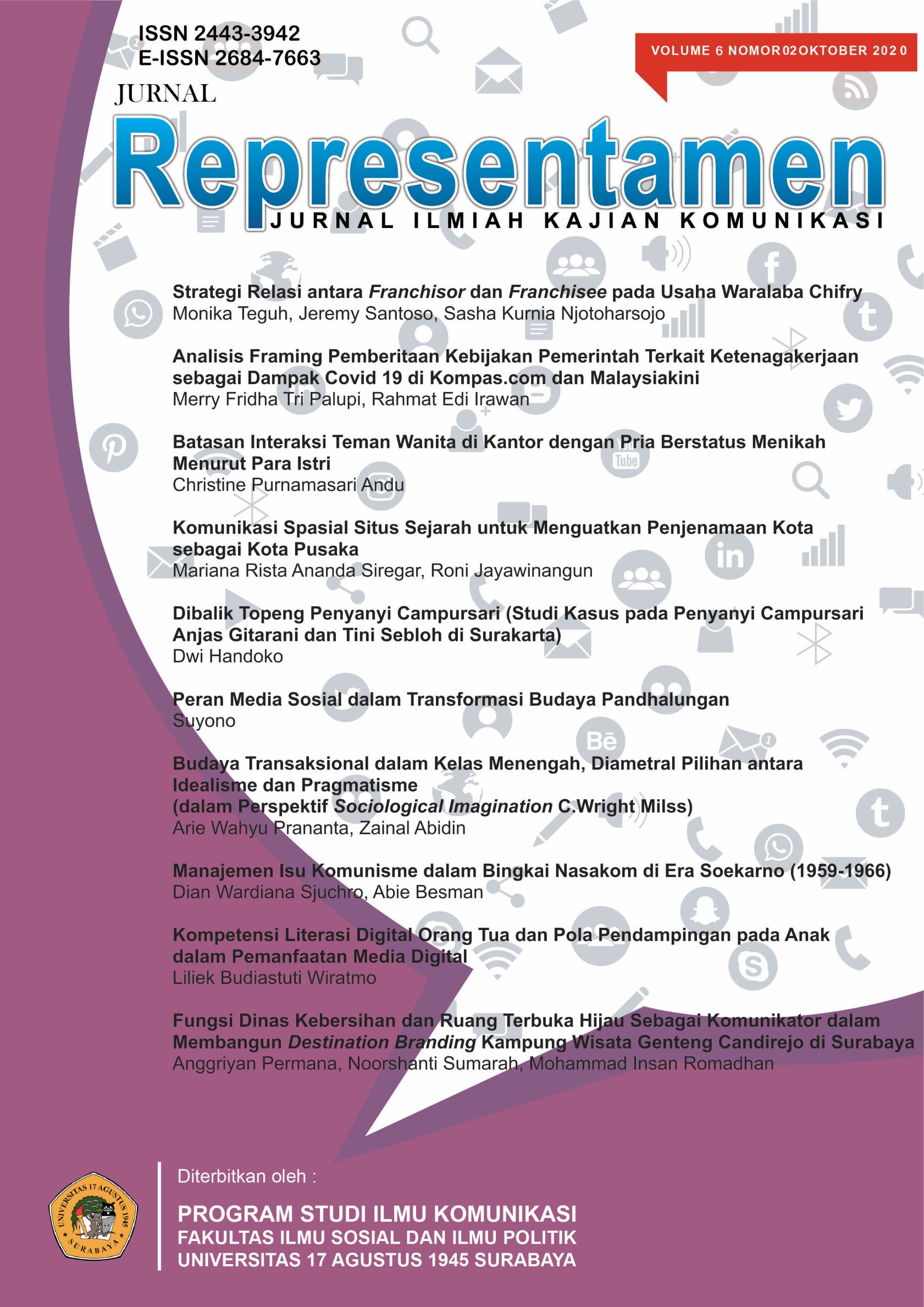
Batasan Interaksi Teman Wanita di Kantor dengan Pria Berstatus Menikah Menurut Para Istri
DOI:
https://doi.org/10.30996/representamen.v6i02.4263Abstract
Abstract
The research aims to know (1) interaction limit for woman at office with married man according to wives and (2) kinds of the excessive interactions according to wives. This research was used qualitative descriptive method with research location runed at Makassar and Semarang City. Data used for this were primary and secondary data. Total informants are twenty, where ten came from Makassar and another ten from Semarang City. Data collection were done by interviewed with those twenty informants, then being analysed with two theories such as Symbolic Interactionism Theori and Atribution Theori. Research showed that several things a husband and female coworkers should not do like (1) do not chat or discussing things out of work hours or things not related to work, not allowed to go out together, not allowed to do intense communication, not allowed to contact physically like holding hands, etc. (2) excessive interactions were answered 15% for confide, 25% answered contact physically, 25% answered go out together, 10% answered chat in the night late, and 20% answered intense talk as the kinds of excessive interactions according to wives.
Keywords : Excessive Interaction, Husband, Marriage
Downloads
References
Daftar Pustaka:
Peraturan Perundang-Undangan:
Burgelijk Wetboek
Undang-Undang Dasar Negara Republik Indonesia Tahun 1945.
Undang-Undang Nomor 42 Tahun 1999 tentang Jaminan Fidusia.
Undang-Undang Nomor 2 Tahun 2014 tentang perubahan atas Undang-Undang Nomor 30 Tahun 2004 tentang Jabatan Notaris.
Peraturan pemerintah Nomor 21 Tahun 2015 tentang Tata Cara Pendaftaran Jaminan Fidusia dan Biaya Pembuatan Akta Jaminan Fidusia.
Peraturan Presiden Nomor 9 tahun 2009 tentang Lembaga Pembiayaan.
Peraturan Menteri Hukum dan Hak Asasi Manusia Nomor 9 Tahun 2013 tentang Pendaftaran Jaminan Fidusia Secara Elektronik.
Buku :
Abdulkadir Muhammad dan Rilda Murniati, (2000), Segi Hukum Lembaga Keuangan dan Pembiayaan, Bandung: Citra Aditya Bakti.
Ahmadi Miru, (2007), Hukum Kontrak dan Perancangan Kontrak, Jakarta: Rajawali Pers.
Andy Hartanto, (2015), .Hukum Jaminan dan Kepailitan, Laksbang Yustisia, Surabaya.
Edy P Soekadi, (1990), Mekanisme Leasing, Jakarta: Ghalia Indonesia.
G.H.S. Lumban Tobing, (2012), Peraturan Jabatan Notaris, Cetakan ke 4, .Jakarta: Erlangga.
Ghansham Anand, (2014), .Karakteristik jabatan Notaris di Indonesia, Sidoarjo: Zifatama Publisher.
Salim HS, (2008), .Pengantar Hukum Perdata Tertulis (BW), Jakarta: Sinar Grafika.
Salim HS, (2012), .Perkembangan Hukum Jaminan di Indonesia , Jakarta: Rajawali Pers.
Subekti, (2007), .Kitab Undang-Undang Hukum Perdata, Jakarta: Arga Printing.
Subekti & Tjitrosudibio, (2004), Kitab Undang-undang Hukum Perdata, Jakarta: Pradnya Paramita.
Munir Fuady, (2000), Hukum Jaminan Utang, Jakarta: Erlangga.
Munir Fuady, (1999), Hukum tentang Pembiayaan Dalam Teori dan Praktik (Leasing, Factoring, Modal Ventura, Pembiayaan Konsumen, Kartu Kredit), Bandung: Citra Aditya Bakti.
Peter Mahmud Marzuki, (2011) Penelitian Hukum, Jakarta: Kencana Prenamedia Group.
Downloads
Published
Issue
Section
License
Authors whose manuscript is published will approve the following provisions:
The right to publication of all journal material published on the jurnal representamen website is held by the editorial board with the author's knowledge (moral rights remain the property of the author).
The formal legal provisions for access to digital articles of this electronic journal are subject to the terms of the Creative Commons Attribution-ShareAlike (CC BY-SA) license, which means Jurnal Representamen reserves the right to store, modify the format, administer in database, maintain and publish articles without requesting permission from the Author as long as it keeps the Author's name as the owner of Copyright.
Printed and electronic published manuscripts are open access for educational, research and library purposes. In addition to these objectives, the editorial board shall not be liable for violations of copyright law.