
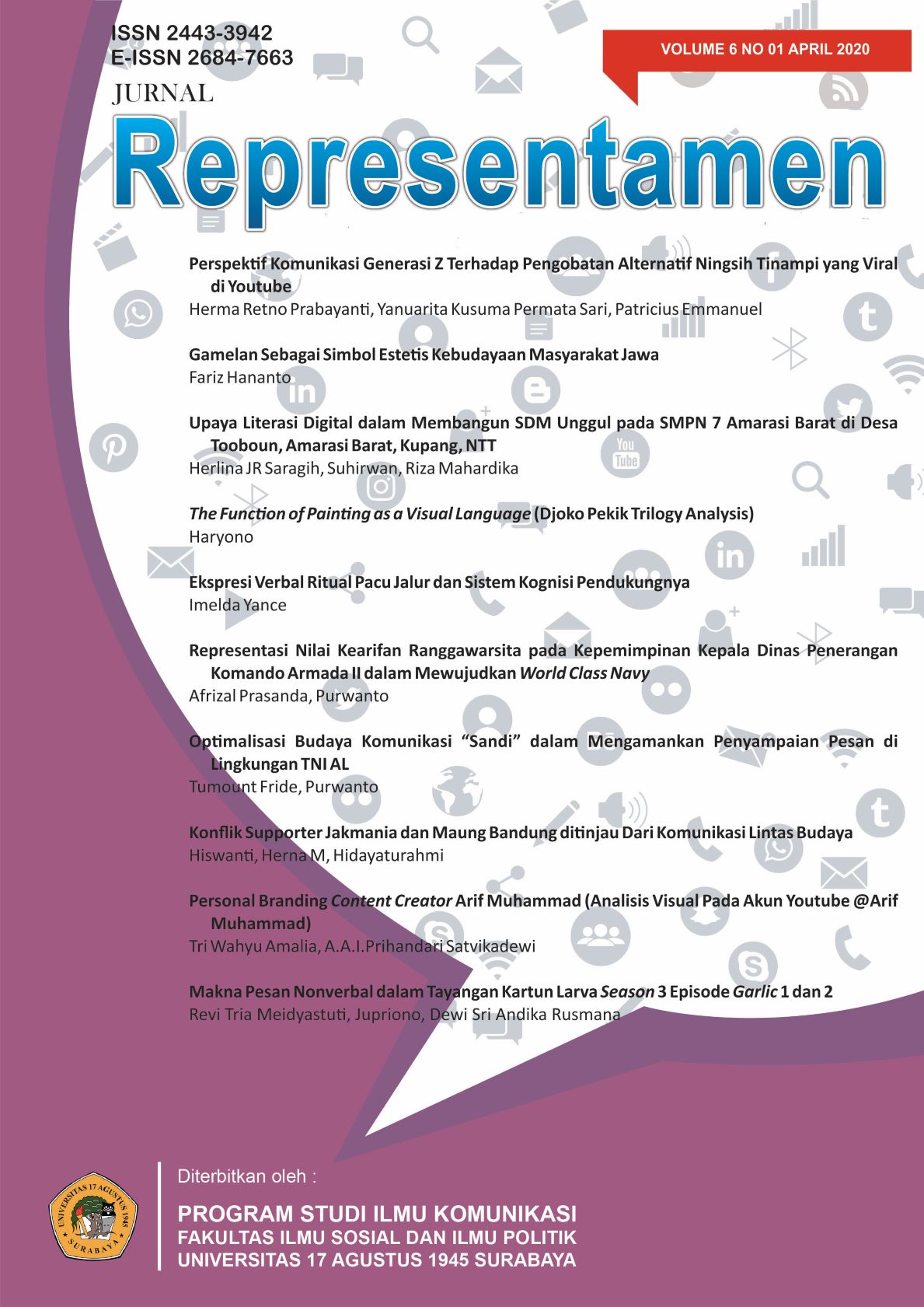
Representasi Nilai Kearifan Ranggawarsita pada Kepemimpinan Kepala Dinas Penerangan Komando Armada II dalam Mewujudkan World Class Navy
DOI:
https://doi.org/10.30996/representamen.v6i01.3515Abstract
Public relations (PR) has an important focus on the ability of a public relations practitioner to carry out leadership functions. The importance of a quality and value of leadership in the world of public relations (excellent leadership in public relations) in managing an organization. On the other hand, leadership in general is universal, but leadership in public relations practice is contextual. Specifically, the context of this research on how the leadership carried out by the head of the Information Service Fleet Command II represents the value of wisdom contained in the fiber and philosophy of life of Ranggawarsita which is applied to internal and external public in order to realize the Navy World Class. Through the constructivist paradigm, researchers conduct qualitative data collection and are processed through descriptive research. The results of this study indicate, (1). Referring to Panca Pratama, the concept of maintaining good relations between public relations leaders and their public, is in accordance with the concept of Amilala (which means to maintain) (2). In making a decision, the head of the office is the head of the information service or the commander of the Koarmada who takes over and all parts of the organization must carry out. This relates to the Javanese concept of accepting pandum. (3). The head of the information service has a positive attitude and outlook on life, so that subordinates will always melu handarbeni, hangrungkebi melu, mulat sarira hangrasa wani in the sense that all achievements obtained by the organization will always be well developed by subordinates.
Keywords: Public Relations, Leadership, Koarmada II, Local Wisdom, Ranggawarsita
Downloads
References
Asmara, Y. (2017). Konsep Diri Gay yang Coming Out. Jurnal Psikologi Udaya, 4 (2). 277-289.
Barmawi, & Silmi, M. (2016). Identifikasi Penyebab Transgender pada Waria Di Banda Aceh. Jurnal Psikoislamedia, 1 (2). 372-384.
Canali, T. J., Oliveira, Reduit, Vinholes, & Feldens. (2014). Evaluation of Self-Esteem among Homosexuals in the Southern Region of The State of Santa Catarina, Brazil. Journal of Science collectiva, 19 (11). 4569-4576. DOI: 10.1590/1413-812320141911.15982013.
Crews, D. & Crawford, M. (2015). Exploring the Role of Being Out o a Queer Person’s Self Compassion. Journal of Gay & Lesbian Social Services, 27, (2). 172-186.
Damayanti, M. N. (2013). Lesbian dalam Pergulatan Gender dan Seksualitas di Sudut Pasar Kartika Niaga Surabaya. Jurnal kajian sastra dan budaya, 1 (2). 17-27.
Engin, C. (2015). LGBT in Turkey: Policies and Experiences. Journal of Social Sciences. 4 (3). 838-858.
Fajarina, Y. A., & Murdhiono, W. R. (2017). Studi Fenomena tentang Pembentukan Ideal Diri Transgender di Daerah Yogyakarta. Jurnal Keperawatan Respati, 4 (1). 100-105.
Faridatunnisa,A. (2010). Gambaran Status Identitas Remaja Putri Lesbi. Jurnal Psikologi, 8 (2). 82-93.
Grffith, K. H., & Hebl, M.R. (2002). The Disclosure Dilemma for
Gay Men and Lesbians: “Coming Out†at Work. Journal of Applied Psychology, 87 (6). 1191-1199.
Leung, L. C. (2016). Why Lesbian and Gay Survivors Don’t Seek Help from Social Services: Barriers Perceived by Service Users and Providers in Hong Kong. British Journal of Social Work. 46. 2393-2409. Doi:10.1093/bjsw/ bcv01
Lestari, I., & Sefitri, S. (2016). Konseling Bagi Populasi Transgender. Jurnal Konseling GUSJIGANG, 2 (1). 37-42.
Martos, A. J., Wilson, P. A., & Meyer, I. H. (2017). Lesbian, Gay, bisexual, and Transgender (LGBT) Health Services in The United States: Origins, Evolution, and Comtemporary Landscape. Journal of Climate Change and Health Plos ONE, 12 (7). Doi.org/10.1371/journal.pone.0180544.
Muttaqin, I. (2016). Membaca Strategi Eksistensi LGBT Di Indonesia. Jurnal Studi Gender dan Anak, 3 (1). 78-86. DOI: 10.24260/raheema.v3i1.562
Oetomo, dkk.(2012). Laporan LGBT Nasional Indonesia. USAID From the American People. UNDP Empowered lives Resilient Nations. (online). https://www.usaid.gov/sites/default/files/documents/2496/Being_LGBT_in_Asia_Indonesia_ Country_Report_Bahasa_language.pdf. Retrieved in 21 September 2018.
Owen, S. S., Burke, T.W., April, L., Demo, F., & Natwick, J. (2017). Perceptions of the Police by LGBT Communities. American Journal of Criminal Justice. 43 (3), 668-693.
Papilaya, J. O. (2016). Lesbian, Gay, Biseksual, Transgender (LGBT) dan Keadilan Sosial. Jurnal Humaniora Yayasan Bina Darma, 3 (1), 25-34.
Reyes, DKK. (2015). Self Stigma, Self-Concept Clarity, and Mentalh Health Status of Filipino LGBT Individuals. Journal of Psychology, 17 (2): 343-350.
Setiawan, W., & Sukmadewi, Y. D. (2017). Peran Pancasila pada Era Globalisasi “Kajian Terhadap Pancasila dan Fenimena LGBT (Lesbian, Gay, Bisexual, dan Transgender). Jurnal Dinamika Sosial Budaya, 19 (1): 126-147.
Suherry, Mandala, E.,Mustika, D., Bastiar, R., & Novalino, D. (2016). Lesbian, Gay, Biseksual, dan Transgender (LGBT) dalam Perspektif Masyarakat dan Agama. Jurnal Aristo, 4 (2), 89-99.
Vitasandy, T. D., & Zulkaida, A. (2010). Konsep Diri Para Biseksual. Jurnal Psikologi, 3 (2), 188-194.
Widiarti, P. W. (2017). Konsep Diri (Self-Concept) dan Komunikasi Interpersonal dalam Pendampingan pada Siswa SMP Se-Kota Yogyakarta. Jurnal Ilmu Komunikasi FIS UNY, 47 (1), 135-148.
Downloads
Published
Issue
Section
License
Authors whose manuscript is published will approve the following provisions:
The right to publication of all journal material published on the jurnal representamen website is held by the editorial board with the author's knowledge (moral rights remain the property of the author).
The formal legal provisions for access to digital articles of this electronic journal are subject to the terms of the Creative Commons Attribution-ShareAlike (CC BY-SA) license, which means Jurnal Representamen reserves the right to store, modify the format, administer in database, maintain and publish articles without requesting permission from the Author as long as it keeps the Author's name as the owner of Copyright.
Printed and electronic published manuscripts are open access for educational, research and library purposes. In addition to these objectives, the editorial board shall not be liable for violations of copyright law.


